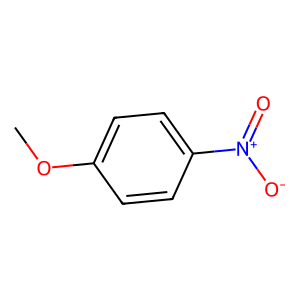
4-Nitroanisole
Names and Identifiers of 4-Nitroanisole
CAS Number |
100-17-4 |
|---|---|
EC Number |
202-825-3 |
MDL Number |
MFCD00007327 |
IUPAC Name |
1-methoxy-4-nitrobenzene |
InChI |
InChI=1S/C7H7NO3/c1-11-7-4-2-6(3-5-7)8(9)10/h2-5H,1H3 |
InChIKey |
BNUHAJGCKIQFGE-UHFFFAOYSA-N |
Canonical SMILES |
COC1=CC=C(C=C1)[N+](=O)[O-] |
UNII |
G989Z7WOLH |
UNSPSC Code |
12352100 |
Physical and chemical properties of 4-Nitroanisole
Boiling Point |
531 °F at 760 mmHg (NTP, 1992) |
|---|---|
Density |
1.254 at 68 °F (NTP, 1992) |
Exact Mass |
153.042587 |
Flash Point |
greater than 230 °F (NTP, 1992) |
Index of Refraction |
1.543 |
LogP |
2.03 |
Melting Point |
48.9 °F (NTP, 1992) |
Molecular Formula |
C7H7NO3 |
Molecular Weight |
153.135 |
PSA |
55.05000 |
Solubility |
less than 1 mg/mL at 75 °F (NTP, 1992) |
Stability |
Stable. Incompatible with strong oxidizing agents, strong bases. |
Vapour Pressure |
0.01 [mmHg] |
Water Solubility |
0.468 g/L (20 ºC) |
Safety Information of 4-Nitroanisole

Interaction Studies of 4-Nitroanisole
Studies on the interactions of 4-nitroanisole with biological systems have revealed significant metabolic pathways leading to its conversion into more reactive species. The compound's interaction with liver enzymes suggests potential implications for drug metabolism and toxicity assessments. Furthermore, its reactivity with nucleophiles indicates that it may serve as a model compound for investigating nucleophilic aromatic substitution reactions under various conditions.
Biological Activity of 4-Nitroanisole
Research indicates that 4-nitroanisole can be metabolized by human liver microsomes into 4-nitrophenol, which has been associated with various biological activities, including potential toxicity. The compound is classified as a toxic organic pollutant and has been linked to urinary bladder cancer risk in humans. Moreover, it may cause skin irritation and sensitization upon contact. Its mutagenic properties have been documented, raising concerns about its safety in environmental and occupational contexts.
Physical sample testing spectrum (NMR) of 4-Nitroanisole


 Cas:768-93-4

 Cas:70712-85-5
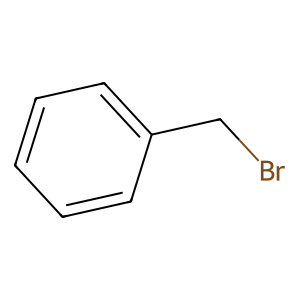 Cas:100-39-0