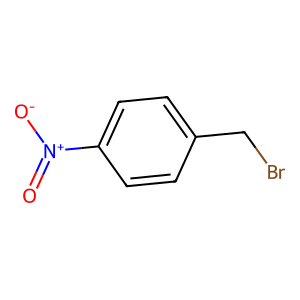
4-Nitrobenzyl bromide
Names and Identifiers of 4-Nitrobenzyl bromide
CAS Number |
100-11-8 |
|---|---|
EC Number |
202-820-6 |
MDL Number |
MFCD00007373 |
IUPAC Name |
1-(bromomethyl)-4-nitrobenzene |
InChI |
InChI=1S/C7H6BrNO2/c8-5-6-1-3-7(4-2-6)9(10)11/h1-4H,5H2 |
InChIKey |
VOLRSQPSJGXRNJ-UHFFFAOYSA-N |
Canonical SMILES |
C1=CC(=CC=C1CBr)[N+](=O)[O-] |
UNII |
QCHRSPCHUE |
UNSPSC Code |
12352100 |
Physical and chemical properties of 4-Nitrobenzyl bromide
Boiling Point |
304.2±17.0 °C at 760 mmHg |
|---|---|
Density |
1.7±0.1 g/cm3 |
Exact Mass |
214.958176 |
Flash Point |
137.8±20.9 °C |
Index of Refraction |
1.612 |
LogP |
2.65 |
Melting Point |
98 °C |
Molecular Formula |
C7H6BrNO2 |
Molecular Weight |
216.032 |
PSA |
45.82000 |
Stability |
Stable. Incomaptible with bases, amines, oxidizing agents, alcohols. May be moisture sensitive. Corrodes steel. |
Vapour Pressure |
0.0±0.6 mmHg at 25°C |
Safety Information of 4-Nitrobenzyl bromide

Applications of 4-Nitrobenzyl bromide
4-Nitrobenzyl bromide has several applications in organic chemistry:
- Intermediate in Organic Synthesis: It serves as an important intermediate in the synthesis of pharmaceuticals and agrochemicals.
- Electrocatalysis: Due to its electrochemical properties, it is utilized in electrocatalytic processes for carbon dioxide reduction and other transformations.
- Chemical Probes: The compound can be used as a chemical probe in biological studies to explore interactions with biomolecules.
Interaction Studies of 4-Nitrobenzyl bromide
Interaction studies involving 4-nitrobenzyl bromide focus on its reactivity with various nucleophiles and its role as a catalyst. Research has shown that it does not react with certain hard bases but engages in electron transfer mechanisms under specific conditions. Additionally, studies examining its electrochemical behavior have highlighted its potential utility in developing sensors and catalysts for environmental applications.
Biological Activity of 4-Nitrobenzyl bromide
While specific biological activities of 4-nitrobenzyl bromide are not extensively documented, compounds with similar structures often exhibit various biological properties. Nitro-containing compounds are known for their potential antimicrobial and anticancer activities. The presence of the nitro group can influence biological interactions, making 4-nitrobenzyl bromide a candidate for further pharmacological studies.
 Cas:3145-86-6

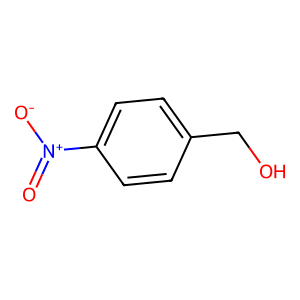 Cas:619-73-8

 Cas:631-61-8
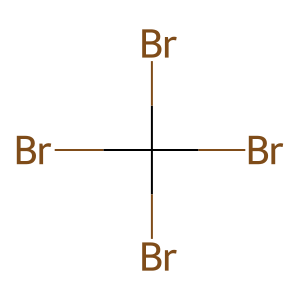 Cas:558-13-4