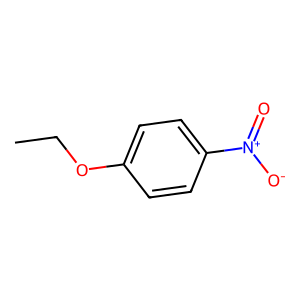
4-Nitrophenetole
Names and Identifiers of 4-Nitrophenetole
CAS Number |
100-29-8 |
|---|---|
EC Number |
202-837-9 |
IUPAC Name |
1-ethoxy-4-nitrobenzene |
InChI |
InChI=1S/C8H9NO3/c1-2-12-8-5-3-7(4-6-8)9(10)11/h3-6H,2H2,1H3 |
InChIKey |
NWPKEYHUZKMWKJ-UHFFFAOYSA-N |
Canonical SMILES |
CCOC1=CC=C(C=C1)[N+](=O)[O-] |
UNII |
O0A69I1MCU |
Physical and chemical properties of 4-Nitrophenetole
Boiling Point |
283 °C |
|---|---|
Density |
1.1176 AT 100 °C/4 °C |
Exact Mass |
167.058243 |
Flash Point |
90 °C |
Index of Refraction |
1.535 |
LogP |
2.56 |
Melting Point |
60 °C |
Molecular Formula |
C8H9NO3 |
Molecular Weight |
167.162 |
PSA |
55.05000 |
Solubility |
SLIGHTLY SOL IN WATER, ALCOHOL; SOL IN HOT PETROLEUM ETHER; VERY SOL IN HOT ALCOHOL, DIETHYL ETHER; SOL IN ALL PROPORTIONS IN ACETONE, BENZENE |
Stability |
Stable. Incompatible with strong oxidizing agents. |
Vapour Pressure |
0.00623 [mmHg] |
Safety Information of 4-Nitrophenetole

Applications of 4-Nitrophenetole
4-Nitrophenetole serves multiple purposes across various industries:
- Intermediate in Synthesis: It is used as an intermediate for synthesizing pharmaceuticals such as acetaminophen and other analgesics.
- Agricultural Chemicals: The compound is utilized in the production of fungicides and insecticides.
- Dyes and Indicators: It plays a role in dye manufacturing and as a pH indicator due to its color change properties upon ionization.
Interaction Studies of 4-Nitrophenetole
Studies have shown that 4-nitrophenetole interacts with biological systems primarily through enzyme activity assays. It is often used as a substrate for alkaline phosphatase and other glycosidases, where its enzymatic cleavage produces measurable amounts of 4-nitrophenol, allowing for quantitative analysis of enzyme activity. This interaction is crucial for biochemical assays in research settings.
Biological Activity of 4-Nitrophenetole
4-Nitrophenetole exhibits biological activity that has been studied primarily in the context of its toxicity and potential therapeutic applications. Acute exposure can lead to symptoms such as headaches, drowsiness, nausea, and cyanosis due to methemoglobinemia. Additionally, it has been shown to possess antimicrobial properties, making it a candidate for further research in pharmacological applications.
Physical sample testing spectrum (NMR) of 4-Nitrophenetole

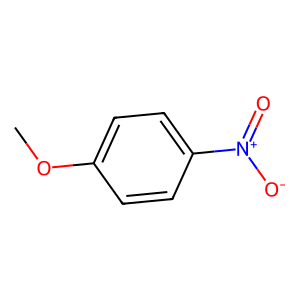 Cas:100-17-4

 Cas:64-17-5

 Cas:28341-54-0
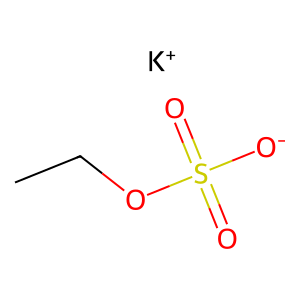 Cas:563-17-7