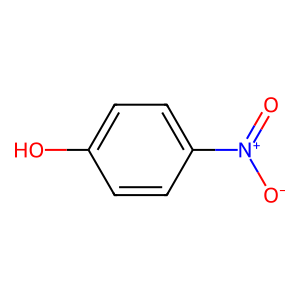
4-Nitrophenol
CAS No.:
100-02-7
M. Wt:
-
M. Fa:
-
InChI Key:
BTJIUGUIPKRLHP-UHFFFAOYSA-N
Appearance:
Bright yellow semi-granular solid
Names and Identifiers of 4-Nitrophenol
CAS Number |
100-02-7 |
|---|---|
EC Number |
202-811-7 |
IUPAC Name |
4-nitrophenol |
InChI |
InChI=1S/C6H5NO3/c8-6-3-1-5(2-4-6)7(9)10/h1-4,8H |
InChIKey |
BTJIUGUIPKRLHP-UHFFFAOYSA-N |
Canonical SMILES |
C1=CC(=CC=C1[N+](=O)[O-])O |
UNII |
Y92ZL45L4R |
Physical and chemical properties of 4-Nitrophenol
Boiling Point |
534 °F |
|---|---|
Decomposition |
279 °C |
Density |
1.48 |
Flash Point |
377 °F |
LogP |
1.91 |
Melting Point |
235-239 °F (sublimes) |
Odor |
Odorless |
Solubility |
Solubility in water, g/100ml at 20 °C: 1.24 |
Vapour density |
1.244 at 149 °F |
Vapour Pressure |
1 mmHg |
Solubility of 4-Nitrophenol
| Solvent | Dissolution Behavior | Temperature Effect | pH Effect |
|---|---|---|---|
| Water | Slightly soluble (~0.17 g/100 mL, 25°C), forms a weakly acidic solution | Increasing temperature slightly increases solubility (due to enhanced molecular thermal motion) | Under acidic conditions, exists in molecular form with low solubility; under basic conditions, forms a salt, leading to significantly increased solubility |
| Ethanol | Soluble (~1.5–2.0 g/100 mL, 25°C), forms a clear solution | Increased temperature further enhances solubility | Basic conditions favor ionization and improve solubility; acidic conditions have minimal effect |
| Diethyl ether | Slightly soluble, prone to form turbid mixtures or phase separation | Increased temperature slightly improves solubility | No significant effect, as diethyl ether is nonpolar and does not participate in proton transfer |
| Acetone | Highly soluble (>5 g/100 mL, 25°C), forms a homogeneous solution | Increased temperature significantly enhances solubility | Higher solubility under basic conditions (promotes deprotonation) |
| Chloroform | Soluble (~2–3 g/100 mL, 25°C), forms a clear solution | Increased temperature slightly increases solubility | No significant effect (chloroform is a neutral, non-protonic solvent) |
| Dimethyl sulfoxide (DMSO) | Extremely soluble (>10 g/100 mL), forms a stable solution | Increased temperature further improves solubility | Higher solubility under strongly basic conditions (promotes deprotonation) |
| Toluene | Practically insoluble, readily separates into layers | Increased temperature provides limited improvement in solubility | No effect |
Safety Information of 4-Nitrophenol


Key Milestone of 4-Nitrophenol
| Year | Event | Description |
|---|---|---|
| 1844 | First Synthesis | Synthesized for the first time by French chemist Auguste Laurent through the nitration of phenol, representing one of the significant early achievements in the study of aromatic nitro compounds. |
| 1870s–1880s | Structure Confirmation & Isomer Studies | Chemists such as Adolf von Baeyer systematically studied the isomers of nitrophenol (ortho, meta, para), confirming 4-nitrophenol as the para-substituted structure, contributing to the development of aromatic substitution orientation rules. |
| 1900s–1920s | Industrial Production | With the development of the dye and explosives industries, 4-nitrophenol was produced on a large scale as an intermediate for synthesizing p-aminophenol, azo dyes, and pesticides. |
| 1930s | Rise in Analytical Chemistry Applications | Discovered to produce a distinct yellow color under alkaline conditions (pKa ≈ 7.1), leading to its use as a pH indicator and colorimetric reagent. |
| 1940s–1950s | Tool in Enzyme Studies | 4-Nitrophenol and its phosphate ester (e.g., pNPP) became widely used for assaying the activity of hydrolytic enzymes like phosphatases and esterases, as the hydrolysis product exhibits strong absorbance at 405 nm, facilitating spectrophotometric detection. |
| 1960s–1970s | Pesticide & Pharmaceutical Intermediate | Served as a key precursor for synthesizing p-aminophenol, used in the production of paracetamol (acetaminophen); also used in the preparation of certain insecticides and herbicides. |
| 1980s–1990s | Environmental Pollutant Concerns | Identified in industrial wastewater and recognized for its toxicity and persistence, it was listed as a priority control pollutant, driving research into treatment technologies like advanced oxidation and biodegradation. |
| 2000s–Present | Nano-Catalysis & Sensing Applications | Used as a model pollutant for evaluating the reduction performance of nanocatalysts (e.g., Au, Ag, Fe₃O₄ nanoparticles); also employed in constructing colorimetric sensors for detecting heavy metals, enzyme activity, etc. |
Applications of 4-Nitrophenol
4-Nitrophenol has diverse applications across various fields:
- Pharmaceuticals: It is an intermediate in the synthesis of paracetamol (acetaminophen) and other drugs.
- Agriculture: Used in the manufacture of fungicides and insecticides.
- Dyes and Indicators: Employed in dye formulations and as a pH indicator due to its distinct color changes upon ionization.
- Analytical Chemistry: Utilized in enzyme assays where its release indicates enzymatic activity.
Interaction Studies of 4-Nitrophenol
Studies have shown that 4-nitrophenol interacts with various biological systems:
- Metabolism: It undergoes extensive metabolic transformation in mammals, primarily through conjugation with glucuronic acid and sulfonic acid.
- Environmental Impact: Its persistence in aqueous environments raises concerns about its potential ecological effects due to bioaccumulation and toxicity to aquatic organisms.
Biological Activity of 4-Nitrophenol
4-Nitrophenol exhibits several biological activities:
- Toxicology: It is known to cause acute effects such as headaches, drowsiness, nausea, and cyanosis upon inhalation or ingestion. Skin contact can lead to irritation.
- Enzyme Activity Measurement: It serves as a substrate for various enzymes in biochemical assays. The amount of 4-nitrophenol produced can be quantitatively measured spectrophotometrically at around 405 nm, making it useful for assessing enzyme activity.
 Cas:108-95-2
