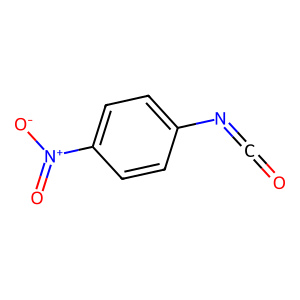
4-Nitrophenyl isocyanate
Names and Identifiers of 4-Nitrophenyl isocyanate
CAS Number |
100-28-7 |
|---|---|
EC Number |
202-836-3 |
MDL Number |
MFCD00007306 |
IUPAC Name |
1-isocyanato-4-nitrobenzene |
InChI |
InChI=1S/C7H4N2O3/c10-5-8-6-1-3-7(4-2-6)9(11)12/h1-4H |
InChIKey |
GFNKTLQTQSALEJ-UHFFFAOYSA-N |
Canonical SMILES |
C1=CC(=CC=C1N=C=O)[N+](=O)[O-] |
UNII |
L4X2CUC34D |
UNSPSC Code |
12352100 |
Physical and chemical properties of 4-Nitrophenyl isocyanate
Boiling Point |
270.4±0.0 °C at 760 mmHg |
|---|---|
Density |
1.3±0.1 g/cm3 |
Exact Mass |
164.022186 |
Flash Point |
121.2±22.6 °C |
Index of Refraction |
1.589 |
LogP |
2.96 |
Melting Point |
56-59 °C(lit.) |
Molecular Formula |
C7H4N2O3 |
Molecular Weight |
164.118 |
PSA |
75.25000 |
Storage condition |
2-8°C |
Vapour Pressure |
0.0±0.5 mmHg at 25°C |
Safety Information of 4-Nitrophenyl isocyanate


Applications of 4-Nitrophenyl isocyanate
4-Nitrophenyl isocyanate finds applications in various fields:
- Organic Synthesis: It serves as an important intermediate for synthesizing pharmaceuticals and agrochemicals.
- Analytical Chemistry: Used in derivatization reactions for analytical applications, particularly in chromatography.
- Polymer Chemistry: Employed in the production of polyurethanes and other polymeric materials due to its reactive nature.
Interaction Studies of 4-Nitrophenyl isocyanate
Research into the interactions of 4-nitrophenyl isocyanate has revealed its potential for forming stable complexes with various nucleophiles. Studies have shown that it can interact with amino acids and proteins, leading to modifications that may affect their biological functions. Its ability to react with thiols and amines makes it a useful tool for probing biological systems and studying protein interactions.
Biological Activity of 4-Nitrophenyl isocyanate
The biological activity of 4-nitrophenyl isocyanate has been studied in various contexts. It exhibits toxicity, particularly as an irritant to skin and mucous membranes. Its acute toxicity is classified as harmful if swallowed, and it can cause skin irritation upon contact. Research indicates that compounds containing isocyanate groups can have significant effects on biological systems, including potential mutagenic properties.
Physical sample testing spectrum (NMR) of 4-Nitrophenyl isocyanate

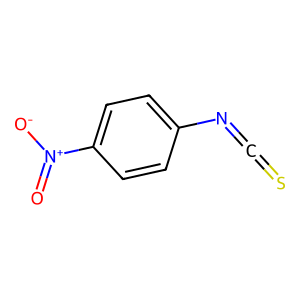 Cas:2131-61-5

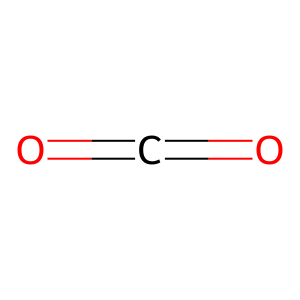 Cas:124-38-9

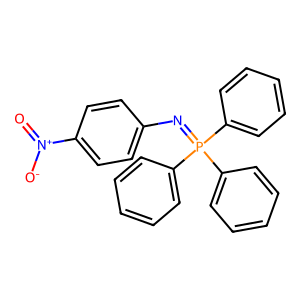 Cas:14562-02-8
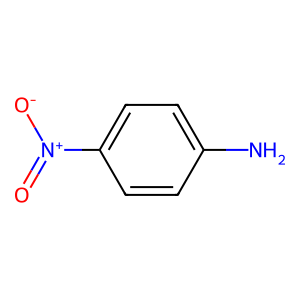 Cas:100-01-6