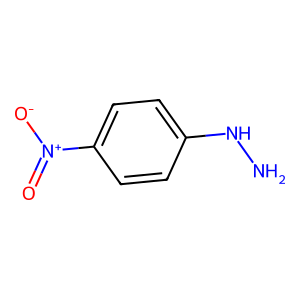
4-Nitrophenylhydrazine
CAS No.:
100-16-3
M. Wt:
153.139
M. Fa:
C6H7N3O2
InChI Key:
KMVPXBDOWDXXEN-UHFFFAOYSA-N
Appearance:
Yellow To Orange To Red To Brown Solid
Names and Identifiers of 4-Nitrophenylhydrazine
CAS Number |
100-16-3 |
|---|---|
EC Number |
202-824-8 |
IUPAC Name |
(4-nitrophenyl)hydrazine |
InChI |
InChI=1S/C6H7N3O2/c7-8-5-1-3-6(4-2-5)9(10)11/h1-4,8H,7H2 |
InChIKey |
KMVPXBDOWDXXEN-UHFFFAOYSA-N |
Canonical SMILES |
C1=CC(=CC=C1NN)[N+](=O)[O-] |
UNII |
2I8586432K |
UN Number |
3376 |
Physical and chemical properties of 4-Nitrophenylhydrazine
Boiling Point |
344.0±25.0 °C at 760 mmHg |
|---|---|
Density |
1.4±0.1 g/cm3 |
Exact Mass |
153.053833 |
Flash Point |
161.8±23.2 °C |
Index of Refraction |
1.691 |
LogP |
1.45 |
Melting Point |
156 °C (dec.)(lit.) |
Molecular Formula |
C6H7N3O2 |
Molecular Weight |
153.139 |
PSA |
83.87000 |
Vapour Pressure |
0.000946 [mmHg] |
Water Solubility |
soluble in hot water |
Safety Information of 4-Nitrophenylhydrazine


Interaction Studies of 4-Nitrophenylhydrazine
Studies have shown that 4-nitrophenylhydrazine interacts with various biological systems, potentially affecting cellular processes through oxidative stress mechanisms. Its toxicity profiles necessitate careful handling and further research into its interactions with cellular components and pathways to assess both risks and therapeutic benefits.
Physical sample testing spectrum (NMR) of 4-Nitrophenylhydrazine

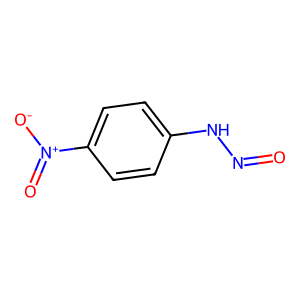 Cas:40078-29-3

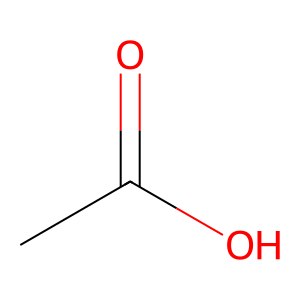 Cas:64-19-7
 Cas:7732-18-5
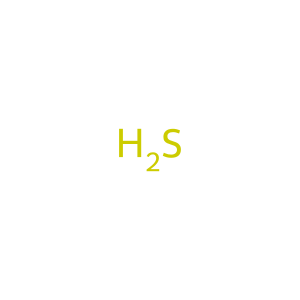 Cas:7783-06-4

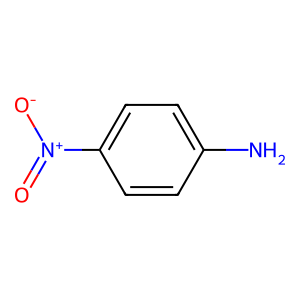 Cas:100-01-6
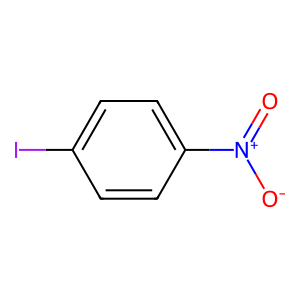 Cas:636-98-6