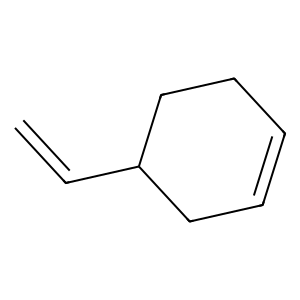
4-Vinylcyclohexene
Names and Identifiers of 4-Vinylcyclohexene
CAS Number |
100-40-3 |
|---|---|
EC Number |
202-848-9 |
IUPAC Name |
4-ethenylcyclohexene |
InChI |
InChI=1S/C8H12/c1-2-8-6-4-3-5-7-8/h2-4,8H,1,5-7H2 |
InChIKey |
BBDKZWKEPDTENS-UHFFFAOYSA-N |
Canonical SMILES |
C=CC1CCC=CC1 |
UNII |
212JQJ15PS |
Physical and chemical properties of 4-Vinylcyclohexene
Boiling Point |
259-261 °F |
|---|---|
BRN |
1901553 |
carcinogen classification |
2B (Vol. Sup 7, 60) 1994 |
Density |
0.83 |
Exact Mass |
108.093903 |
Flash Point |
60 °F |
Index of Refraction |
Index of refraction: 1.4639 @ 20 °C |
LogP |
3.93 |
Melting Point |
-150 °F |
Molecular Formula |
C8H12 |
Molecular Weight |
108.181 |
Stability |
OXIDIZES IN AIR TO FORM HYDROPEROXIDE |
Storage condition |
2-8°C |
Vapour density |
3.76 |
Vapour Pressure |
15 mmHg at 77 °F |
Water Solubility |
50mg/L(25 ºC) |
Safety Information of 4-Vinylcyclohexene


Applications of 4-Vinylcyclohexene
4-Vinylcyclohexene finds applications in several industrial processes:
- Chemical Intermediate: It serves as an intermediate in the production of various chemicals, including flame retardants and epoxy resins.
- Research: Its derivatives are used in toxicological studies to understand mechanisms of ovarian toxicity and other biological effects.
Interaction Studies of 4-Vinylcyclohexene
Studies have demonstrated that 4-vinylcyclohexene interacts with biological systems primarily through metabolic pathways involving liver microsomal enzymes. The major metabolic products include 4-vinyl-1,2-epoxycyclohexane and other epoxides, which may contribute to its biological activity and toxicity profile. Furthermore, research has highlighted the compound's ability to induce oxidative stress and its potential genotoxic effects.
Biological Activity of 4-Vinylcyclohexene
4-Vinylcyclohexene has been studied for its biological effects, particularly concerning reproductive toxicity. Research indicates that its diepoxide form is capable of causing ovarian toxicity by selectively destroying small pre-antral ovarian follicles in animal models. This effect raises concerns regarding its potential impact on human reproductive health, classifying it as a Group 2B carcinogen by the International Agency for Research on Cancer, indicating it is possibly carcinogenic to humans.
Physical sample testing spectrum (NMR) of 4-Vinylcyclohexene

 Cas:106-99-0

 Cas:693-86-7

 Cas:77614-67-6
 Cas:77614-53-0