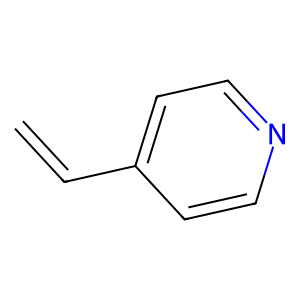
4-Vinylpyridine
CAS No.:
100-43-6
M. Wt:
105.137
M. Fa:
C7H7N
InChI Key:
KFDVPJUYSDEJTH-UHFFFAOYSA-N
Appearance:
Clear red, slightly viscous liquid
Names and Identifiers of 4-Vinylpyridine
CAS Number |
100-43-6 |
|---|---|
EC Number |
202-852-0 |
IUPAC Name |
4-ethenylpyridine |
InChI |
InChI=1S/C7H7N/c1-2-7-3-5-8-6-4-7/h2-6H,1H2 |
InChIKey |
KFDVPJUYSDEJTH-UHFFFAOYSA-N |
Canonical SMILES |
C=CC1=CC=NC=C1 |
UNII |
I56G67XM8D |
Physical and chemical properties of 4-Vinylpyridine
Acidity coefficient |
pK1:5.62(+1) (25°C) |
|---|---|
Boiling Point |
65 °C @ 15 mm Hg |
BRN |
104506 |
Decomposition |
When heated to decomp ... emits toxic fumes of /nitrogen oxides/. |
Density |
0.9800 @ 20 °C/4 °C |
Exact Mass |
105.057846 |
Exposure Limits |
ACGIH: TWA 1 mg/m3 OSHA: TWA 2 mg/m3 NIOSH: IDLH 50 mg/m3; Ceiling 2 mg/m3 |
Flash Point |
51.7±0.0 °C |
Index of Refraction |
INDEX OF REFRACTION: 1.5449 @ 20 °C/D; MAX ABSORPTION (ALC): 242.5 NM (LOG E= 4.12); SADTLER REF NUMBER: 1249 (IR, PRISM) |
LogP |
1.21 |
Melting Point |
< 25ºC |
Molecular Formula |
C7H7N |
Molecular Weight |
105.137 |
Odor |
Pungent unpleasant odor |
PSA |
12.89000 |
Solubility |
In water, 29,100 mg/l @ 20 °C |
Stability |
Stable. Incompatible with strong acids, strong oxidizing agents. |
Storage condition |
-20°C |
Vapour Pressure |
1.71 mm Hg @ 25 °C |
Water Solubility |
29 G/L (20 ºC) |
Safety Information of 4-Vinylpyridine


Applications of 4-Vinylpyridine
4-Vinylpyridine has a wide range of applications across various fields:
- Polymer Chemistry: It serves as a co-monomer in producing styrene-butadiene polymers, enhancing adhesion properties in rubber compounds used for tires and hoses.
- Biochemical Research: It is employed as a reagent for modifying cysteine residues in proteins, facilitating studies related to protein structure and function.
- Industrial Uses: The compound is also utilized as an intermediate in manufacturing chemicals and pharmaceuticals.
Interaction Studies of 4-Vinylpyridine
Studies have investigated the interactions of 4-vinylpyridine with various substrates and conditions:
- Complex Formation: Due to its polar nature, 4-vinylpyridine can form complexes with metal ions and other electron-rich species, which is beneficial in catalytic applications.
- Reactivity with Anions: The compound's high electron affinity allows it to engage in secondary reactions with propagating anions during polymerization processes, influencing polymer characteristics.
Physical sample testing spectrum (NMR) of 4-Vinylpyridine

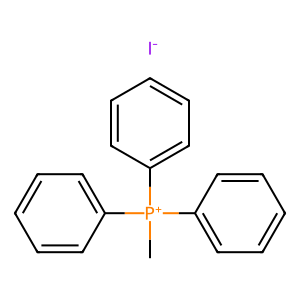 Cas:2065-66-9

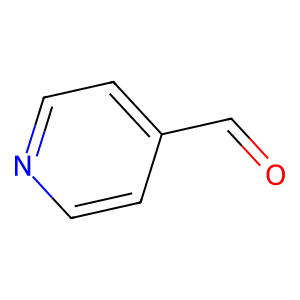 Cas:872-85-5

 Cas:108-89-4
 Cas:50-00-0