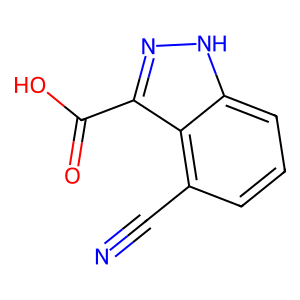
4-cyano-1H-indazole-3-carboxylic acid
CAS No.:
1000341-33-2
M. Wt:
187.155
M. Fa:
C9H5N3O2
InChI Key:
XTNCDNOZENBPPA-UHFFFAOYSA-N
Appearance:
Pale-Yellow To Yellow-Brown Solid
Names and Identifiers of 4-cyano-1H-indazole-3-carboxylic acid
CAS Number |
1000341-33-2 |
|---|---|
MDL Number |
MFCD35098017 |
IUPAC Name |
4-cyano-1H-indazole-3-carboxylic acid |
InChI |
InChI=1S/C9H5N3O2/c10-4-5-2-1-3-6-7(5)8(9(13)14)12-11-6/h1-3H,(H,11,12)(H,13,14) |
InChIKey |
XTNCDNOZENBPPA-UHFFFAOYSA-N |
Canonical SMILES |
C1=CC(=C2C(=C1)NN=C2C(=O)O)C#N |
UNSPSC Code |
12352100 |
Physical and chemical properties of 4-cyano-1H-indazole-3-carboxylic acid
Acidity coefficient |
1.24±0.10(Predicted) |
|---|---|
Boiling Point |
535.0±30.0 °C at 760 mmHg |
Density |
1.6±0.1 g/cm3 |
Exact Mass |
187.038177 |
Flash Point |
277.4±24.6 °C |
H Bond Acceptors |
4 |
H Bond Donors |
2 |
Index of Refraction |
1.729 |
LogP |
0.73 |
Molecular Formula |
C9H5N3O2 |
Molecular Weight |
187.155 |
PSA |
89.77000 |
Vapour Pressure |
0.0±1.5 mmHg at 25°C |
Safety Information of 4-cyano-1H-indazole-3-carboxylic acid

Applications of 4-cyano-1H-indazole-3-carboxylic acid
4-Cyano-1H-indazole-3-carboxylic acid finds applications across various fields:
- Medicinal Chemistry: It serves as a scaffold for developing new pharmaceuticals targeting inflammatory diseases and cancers.
- Material Science: Its unique properties make it suitable for use in organic electronics and as a building block in polymer synthesis.
- Biochemical Research: Utilized as a reagent in biochemical assays to study enzyme activities and interactions.
The versatility of this compound enhances its relevance in both academic research and industrial applications.
Interaction Studies of 4-cyano-1H-indazole-3-carboxylic acid
Interaction studies involving 4-cyano-1H-indazole-3-carboxylic acid focus on its binding affinity with various biological targets, including enzymes and receptors. Preliminary studies suggest that it may interact with kinases, potentially influencing signaling pathways related to cell proliferation and inflammation. Understanding these interactions is crucial for elucidating its mechanism of action and therapeutic potential.