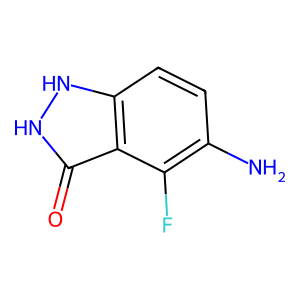
5-AMINO-4-FLUORO-3-HYDROXY (1H)INDAZOLE
Names and Identifiers of 5-AMINO-4-FLUORO-3-HYDROXY (1H)INDAZOLE
CAS Number |
1000340-49-7 |
|---|---|
IUPAC Name |
5-azanyl-4-fluoranyl-1,2-dihydroindazol-3-one |
Canonical SMILES |
C1=CC2=C(C(=C1N)F)C(=O)NN2 |
Physical and chemical properties of 5-AMINO-4-FLUORO-3-HYDROXY (1H)INDAZOLE
Boiling Point |
454.3±40.0 °C at 760 mmHg |
|---|---|
Density |
1.7±0.1 g/cm3 |
Exact Mass |
167.049484 |
Flash Point |
228.6±27.3 °C |
Index of Refraction |
1.799 |
LogP |
0.92 |
Molecular Formula |
C7H6FN3O |
Molecular Weight |
167.140 |
PSA |
74.93000 |
Vapour Pressure |
0.0±1.2 mmHg at 25°C |
Applications of 5-AMINO-4-FLUORO-3-HYDROXY (1H)INDAZOLE
5-Amino-4-fluoro-3-hydroxy (1H)indazole has several potential applications:
- Pharmaceutical Development: Its biological activities make it a candidate for drug development, particularly in treating infections and inflammatory diseases.
- Chemical Research: As a versatile building block, it can be used in synthesizing other complex organic molecules.
The exploration of its applications is ongoing, with researchers investigating new therapeutic uses.
Interaction Studies of 5-AMINO-4-FLUORO-3-HYDROXY (1H)INDAZOLE
Interaction studies have focused on understanding how 5-amino-4-fluoro-3-hydroxy (1H)indazole interacts with various biological targets:
- Protein Binding Studies: These studies assess how well the compound binds to specific proteins involved in disease pathways.
- Receptor Interaction: Investigations into its interaction with receptors have revealed potential mechanisms through which it exerts its biological effects.
Such studies are crucial for elucidating the pharmacological profile of this compound and guiding future therapeutic applications.
Biological Activity of 5-AMINO-4-FLUORO-3-HYDROXY (1H)INDAZOLE
Research indicates that 5-amino-4-fluoro-3-hydroxy (1H)indazole exhibits significant biological activities. It has been studied for its potential therapeutic effects, particularly in the context of:
- Antimicrobial Activity: Some studies suggest that this compound may possess antimicrobial properties, making it a candidate for further investigation in drug development.
- Anti-inflammatory Effects: The compound has shown promise in reducing inflammation, which could be beneficial in treating various inflammatory diseases.
These biological activities are largely attributed to the structural features of the compound, which allow it to interact effectively with biological targets.