
5-Amino-1H-1,2,4-triazol-3(2H)-one
Names and Identifiers of 5-Amino-1H-1,2,4-triazol-3(2H)-one
CAS Number |
1003-35-6 |
|---|---|
EC Number |
824-942-4 |
MDL Number |
MFCD00970120 |
IUPAC Name |
3-amino-1,4-dihydro-1,2,4-triazol-5-one |
InChI |
InChI=1S/C2H4N4O/c3-1-4-2(7)6-5-1/h(H4,3,4,5,6,7) |
InChIKey |
XOHBRLLZSIGHDE-UHFFFAOYSA-N |
Canonical SMILES |
C1(=NNC(=O)N1)N |
UNSPSC Code |
12352100 |
Physical and chemical properties of 5-Amino-1H-1,2,4-triazol-3(2H)-one
Acidity coefficient |
17.07±0.20(Predicted) |
|---|---|
Boiling Point |
548.1ºC at 760mmHg |
Density |
2.27g/cm3 |
Exact Mass |
100.03900 |
Flash Point |
285.3ºC |
Index of Refraction |
1.944 |
Melting Point |
286-290 °C (decomp) |
Molecular Formula |
C2H4N4O |
Molecular Weight |
100.07900 |
PSA |
87.56000 |
Storage condition |
under inert gas (nitrogen or Argon) at 2–8 °C |
Vapour Pressure |
1.26E-12mmHg at 25°C |
Safety Information of 5-Amino-1H-1,2,4-triazol-3(2H)-one

Applications of 5-Amino-1H-1,2,4-triazol-3(2H)-one
5-Amino-1H-1,2,4-triazol-3(2H)-one finds applications across multiple domains:
- Pharmaceuticals: It serves as a scaffold for developing new antimicrobial and antiviral drugs.
- Agriculture: The compound is explored for use in plant protection products due to its fungicidal properties.
- Material Science: Its derivatives are investigated for potential applications in polymer chemistry and materials engineering due to their unique thermal and chemical stability.
Interaction Studies of 5-Amino-1H-1,2,4-triazol-3(2H)-one
Interaction studies of 5-amino-1H-1,2,4-triazol-3(2H)-one have revealed its ability to form complexes with metal ions, which may enhance its biological activity. These interactions can alter the electronic properties of the compound, potentially leading to increased efficacy against pathogens or cancer cells. Furthermore, studies on its binding affinity with various biological targets have provided insights into its mechanism of action .
Biological Activity of 5-Amino-1H-1,2,4-triazol-3(2H)-one
This compound exhibits significant biological activities, particularly as an antimicrobial and antiviral agent. Studies have shown that 5-amino-1H-1,2,4-triazol-3(2H)-one derivatives possess inhibitory effects against various pathogens. Its structural similarity to purines allows it to interfere with nucleic acid synthesis in microorganisms. Moreover, it has been investigated for its potential anticancer properties due to its ability to induce apoptosis in cancer cells .
Physical sample testing spectrum (NMR) of 5-Amino-1H-1,2,4-triazol-3(2H)-one

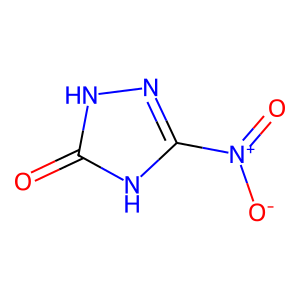 Cas:932-64-9

 Cas:960607-22-1