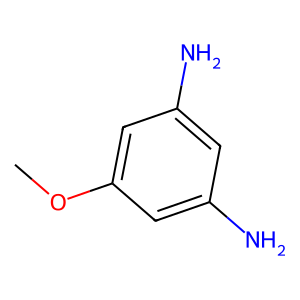
5-Methoxybenzene-1,3-diamine
Names and Identifiers of 5-Methoxybenzene-1,3-diamine
CAS Number |
100-96-9 |
|---|---|
MDL Number |
MFCD00127692 |
IUPAC Name |
5-methoxybenzene-1,3-diamine |
InChI |
InChI=1S/C7H10N2O/c1-10-7-3-5(8)2-6(9)4-7/h2-4H,8-9H2,1H3 |
InChIKey |
FLDIDKTWHOYFMG-UHFFFAOYSA-N |
Canonical SMILES |
COC1=CC(=CC(=C1)N)N |
UNSPSC Code |
12352100 |
Physical and chemical properties of 5-Methoxybenzene-1,3-diamine
Acidity coefficient |
4.46±0.10(Predicted) |
|---|---|
Boiling Point |
198 °C(Press: 0.5 Torr) |
Density |
1.170±0.06 g/cm3(Predicted) |
Exact Mass |
138.07900 |
H Bond Acceptors |
3 |
H Bond Donors |
2 |
LogP |
2.02200 |
Melting Point |
66 °C |
Molecular Formula |
C7H10N2O |
Molecular Weight |
138.16700 |
PSA |
61.27000 |
Safety Information of 5-Methoxybenzene-1,3-diamine

Applications of 5-Methoxybenzene-1,3-diamine
5-Methoxybenzene-1,3-diamine finds applications in various fields:
- Dyes and Pigments: It is used as an intermediate in the synthesis of azo dyes and other colorants.
- Pharmaceuticals: Its derivatives are explored for medicinal applications, particularly in cancer therapy and neuroprotection.
- Polymer Chemistry: It serves as a building block for polyimides and other high-performance polymers due to its thermal stability and mechanical properties.
Interaction Studies of 5-Methoxybenzene-1,3-diamine
Studies on the interactions of 5-Methoxybenzene-1,3-diamine with biological systems reveal its potential effects on enzyme activity and cellular pathways. It has been shown to interact with various receptors and enzymes, influencing metabolic processes. Further research is ongoing to elucidate its mechanisms of action at the molecular level, particularly concerning its therapeutic effects and toxicity profiles.
Biological Activity of 5-Methoxybenzene-1,3-diamine
Research indicates that 5-Methoxybenzene-1,3-diamine exhibits various biological activities. It has been studied for its potential as an anti-cancer agent due to its ability to inhibit certain enzymes involved in tumor proliferation. Additionally, it has shown promise in antimicrobial activity against specific bacterial strains. Its derivatives have also been explored for their roles in treating neurodegenerative diseases due to their ability to cross the blood-brain barrier.
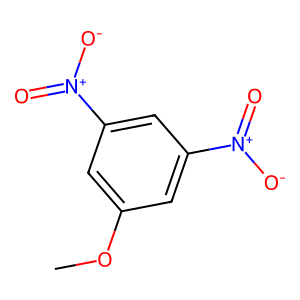 Cas:5327-44-6

 Cas:7647-01-0

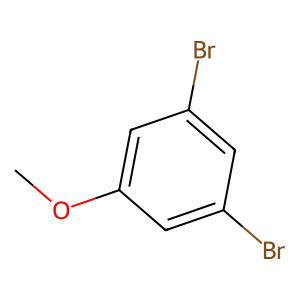 Cas:74137-36-3