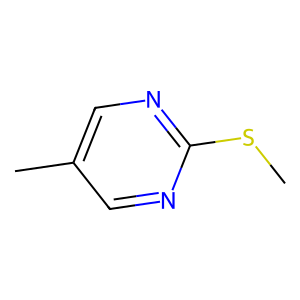
5-Methyl-2-(methylthio)pyrimidine
Names and Identifiers of 5-Methyl-2-(methylthio)pyrimidine
CAS Number |
100114-24-7 |
|---|---|
IUPAC Name |
5-methyl-2-methylsulfanylpyrimidine |
InChI |
InChI=1S/C6H8N2S/c1-5-3-7-6(9-2)8-4-5/h3-4H,1-2H3 |
InChIKey |
HMROJJZKKIPDRB-UHFFFAOYSA-N |
Canonical SMILES |
CC1=CN=C(N=C1)SC |
Physical and chemical properties of 5-Methyl-2-(methylthio)pyrimidine
Boiling Point |
237.3ºC at 760 mmHg |
|---|---|
Density |
1.14 |
Exact Mass |
140.04100 |
Index of Refraction |
1.562 |
LogP |
1.50690 |
Molecular Formula |
C6H8N2S |
Molecular Weight |
140.20600 |
PSA |
51.08000 |
Vapour Pressure |
0.0695mmHg at 25°C |
Applications of 5-Methyl-2-(methylthio)pyrimidine
5-Methyl-2-(methylthio)pyrimidine serves as an important intermediate in the synthesis of various pharmacologically active compounds. Its derivatives are explored for applications in:
- Pharmaceutical Development: As a precursor for creating antiviral and anticancer agents.
- Research: In studies investigating neuroprotective mechanisms and anti-inflammatory therapies.
The compound's structural features make it a valuable building block in medicinal chemistry.
Interaction Studies of 5-Methyl-2-(methylthio)pyrimidine
Studies have focused on the interaction of 5-Methyl-2-(methylthio)pyrimidine with various biological targets. Its ability to modulate pathways related to inflammation and cellular stress responses suggests significant therapeutic potential. Molecular docking studies have been employed to elucidate its binding interactions with target proteins, providing insights into its mechanism of action.
Biological Activity of 5-Methyl-2-(methylthio)pyrimidine
Research has indicated that 5-Methyl-2-(methylthio)pyrimidine exhibits potential neuroprotective and anti-inflammatory properties. It interacts with key proteins involved in cellular stress responses, such as ATF4 and NF-kB. Its mechanism of action includes inhibition of endoplasmic reticulum stress and apoptosis pathways, suggesting its utility in treating neurodegenerative diseases. Furthermore, its biological profile includes activities that may contribute to antiviral and anticancer effects.
Physical sample testing spectrum (NMR) of 5-Methyl-2-(methylthio)pyrimidine
