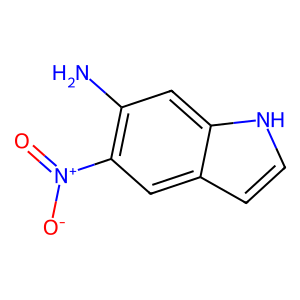
5-Nitro-1H-indol-6-amine
CAS No.:
1000343-12-3
M. Wt:
177.160
M. Fa:
C8H7N3O2
InChI Key:
YXNHJBUZBCFMST-UHFFFAOYSA-N
Names and Identifiers of 5-Nitro-1H-indol-6-amine
CAS Number |
1000343-12-3 |
|---|---|
IUPAC Name |
5-nitro-1H-indol-6-amine |
InChI |
InChI=1S/C8H7N3O2/c9-6-4-7-5(1-2-10-7)3-8(6)11(12)13/h1-4,10H,9H2 |
InChIKey |
YXNHJBUZBCFMST-UHFFFAOYSA-N |
Canonical SMILES |
C1=CNC2=CC(=C(C=C21)[N+](=O)[O-])N |
Physical and chemical properties of 5-Nitro-1H-indol-6-amine
Boiling Point |
451.3±25.0 °C at 760 mmHg |
|---|---|
Density |
1.5±0.1 g/cm3 |
Exact Mass |
177.053833 |
Flash Point |
226.7±23.2 °C |
Index of Refraction |
1.794 |
LogP |
2.41 |
Molecular Formula |
C8H7N3O2 |
Molecular Weight |
177.160 |
PSA |
87.63000 |
Vapour Pressure |
0.0±1.1 mmHg at 25°C |
Applications of 5-Nitro-1H-indol-6-amine
The applications of 5-nitro-1H-indol-6-amine span various fields:
- Pharmaceuticals: Its potential as an enzyme inhibitor makes it a candidate for drug development targeting neurological disorders and cancer.
- Research: It serves as a valuable tool in biochemical studies aimed at understanding enzyme mechanisms and pathways involving nitric oxide signaling.
Interaction Studies of 5-Nitro-1H-indol-6-amine
Interaction studies involving 5-nitro-1H-indol-6-amine focus on its binding affinity to target enzymes and receptors. These studies often employ techniques such as:
- Molecular Docking: Computational methods predict how well the compound binds to specific biological targets.
- In Vitro Assays: Laboratory experiments assess the biological activity of the compound against various enzymes and cell lines, providing insights into its pharmacological profile.
Biological Activity of 5-Nitro-1H-indol-6-amine
5-Nitro-1H-indol-6-amine has been studied for its biological activities, particularly its potential as an inhibitor of various enzymes. Notably, it has shown inhibitory effects on monoamine oxidase B and nitric oxide synthase, which are important targets in neuropharmacology and cardiovascular research. Additionally, compounds with similar structures have demonstrated anticancer properties, suggesting that 5-nitro-1H-indol-6-amine may also have therapeutic potential in oncology.