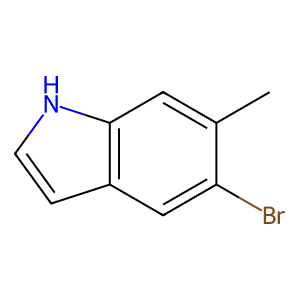
5-bromo-6-methyl-1H-indole
CAS No.:
1000343-13-4
M. Wt:
210.070
M. Fa:
C9H8BrN
InChI Key:
VHHRJOFNSFDEHH-UHFFFAOYSA-N
Appearance:
Pale-yellow Solid
Names and Identifiers of 5-bromo-6-methyl-1H-indole
CAS Number |
1000343-13-4 |
|---|---|
MDL Number |
MFCD09026969 |
IUPAC Name |
5-bromo-6-methyl-1H-indole |
InChI |
InChI=1S/C9H8BrN/c1-6-4-9-7(2-3-11-9)5-8(6)10/h2-5,11H,1H3 |
InChIKey |
VHHRJOFNSFDEHH-UHFFFAOYSA-N |
Canonical SMILES |
CC1=CC2=C(C=CN2)C=C1Br |
UNSPSC Code |
12352100 |
Physical and chemical properties of 5-bromo-6-methyl-1H-indole
Acidity coefficient |
16.40±0.30(Predicted) |
|---|---|
Boiling Point |
320.1±22.0 °C at 760 mmHg |
Density |
1.6±0.1 g/cm3 |
Exact Mass |
208.984009 |
Flash Point |
147.4±22.3 °C |
Index of Refraction |
1.685 |
LogP |
3.46 |
Molecular Formula |
C9H8BrN |
Molecular Weight |
210.070 |
PSA |
15.79000 |
Storage condition |
Sealed in dry,Room Temperature |
Vapour Pressure |
0.0±0.7 mmHg at 25°C |
Safety Information of 5-bromo-6-methyl-1H-indole

Applications of 5-bromo-6-methyl-1H-indole
5-Bromo-6-methyl-1H-indole has several applications in various fields:
- Pharmaceuticals: Due to its biological activities, it may serve as a lead compound in drug development for antimicrobial and anticancer therapies.
- Chemical Research: It is used as an intermediate in organic synthesis for creating more complex molecules.
- Material Science: Indoles are being explored for their potential use in organic electronics and photonic devices due to their unique electronic properties .
Interaction Studies of 5-bromo-6-methyl-1H-indole
Interaction studies involving 5-bromo-6-methyl-1H-indole focus on its binding affinity with various biological targets, including enzymes and receptors. Preliminary data suggest that it may interact with cytochrome P450 enzymes, influencing drug metabolism. Additionally, studies on its interaction with DNA indicate potential implications in anticancer research .
Biological Activity of 5-bromo-6-methyl-1H-indole
Indole derivatives, including 5-bromo-6-methyl-1H-indole, have shown significant biological activities. Research indicates that they possess:
- Antimicrobial Properties: They exhibit activity against various bacterial strains.
- Anticancer Activity: Some studies suggest that indole derivatives can inhibit cancer cell proliferation and induce apoptosis in specific cancer cell lines.
- Neuroprotective Effects: Certain derivatives have been studied for their potential to protect neuronal cells from damage .
The specific biological mechanisms and efficacy of 5-bromo-6-methyl-1H-indole require further investigation to elucidate its pharmacological potential.
Physical sample testing spectrum (NMR) of 5-bromo-6-methyl-1H-indole
