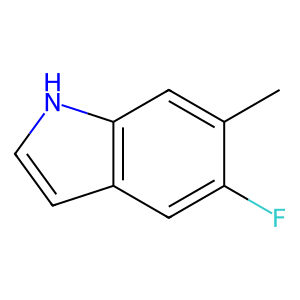
5-fluoro-6-methyl-1H-indole
CAS No.:
1000343-16-7
M. Wt:
149.165
M. Fa:
C9H8FN
InChI Key:
FKAVXDSGDUVHBT-UHFFFAOYSA-N
Appearance:
Pale-yellow Solid
Names and Identifiers of 5-fluoro-6-methyl-1H-indole
CAS Number |
1000343-16-7 |
|---|---|
MDL Number |
MFCD09026971 |
IUPAC Name |
5-fluoro-6-methyl-1H-indole |
InChI |
InChI=1S/C9H8FN/c1-6-4-9-7(2-3-11-9)5-8(6)10/h2-5,11H,1H3 |
InChIKey |
FKAVXDSGDUVHBT-UHFFFAOYSA-N |
Canonical SMILES |
CC1=CC2=C(C=CN2)C=C1F |
UNSPSC Code |
12352100 |
Physical and chemical properties of 5-fluoro-6-methyl-1H-indole
Acidity coefficient |
16.52±0.30(Predicted) |
|---|---|
Boiling Point |
263.4±20.0 °C at 760 mmHg |
Density |
1.2±0.1 g/cm3 |
Exact Mass |
149.064072 |
Flash Point |
113.1±21.8 °C |
Index of Refraction |
1.627 |
LogP |
2.74 |
Molecular Formula |
C9H8FN |
Molecular Weight |
149.165 |
PSA |
15.79000 |
Storage condition |
Keep in dark place,Inert atmosphere,Room temperature |
Vapour Pressure |
0.0±0.5 mmHg at 25°C |
Safety Information of 5-fluoro-6-methyl-1H-indole

Applications of 5-fluoro-6-methyl-1H-indole
5-Fluoro-6-methyl-1H-indole has several applications in various fields:
- Pharmaceuticals: Due to its biological activity, it is explored as a potential lead compound for drug development targeting cancer and infectious diseases.
- Material Science: Fluorinated compounds are often used in developing advanced materials with unique properties, such as increased thermal stability and hydrophobicity.
Interaction Studies of 5-fluoro-6-methyl-1H-indole
Studies on 5-fluoro-6-methyl-1H-indole's interactions with biological targets have revealed:
- Serotonin Receptor Binding: Research indicates that this compound may bind effectively to serotonin receptors, influencing neurotransmitter activity.
- Enzyme Inhibition: It has been shown to inhibit certain enzymes involved in metabolic pathways linked to cancer progression.
Biological Activity of 5-fluoro-6-methyl-1H-indole
Indoles and their derivatives, including 5-fluoro-6-methyl-1H-indole, exhibit various biological activities. They are often investigated for:
- Anticancer Properties: Indoles have been shown to inhibit cancer cell proliferation and induce apoptosis in various cancer cell lines.
- Antimicrobial Activity: Some studies suggest that fluorinated indoles possess enhanced antimicrobial properties compared to their non-fluorinated counterparts.
- Neuroactive Effects: Certain indole derivatives are known to interact with serotonin receptors, indicating potential applications in treating neurological disorders.
Physical sample testing spectrum (NMR) of 5-fluoro-6-methyl-1H-indole
