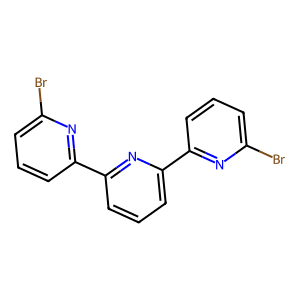
6,6''-Dibromo-2,2':6',2''-terpyridine
Names and Identifiers of 6,6''-Dibromo-2,2':6',2''-terpyridine
CAS Number |
100366-66-3 |
|---|---|
EC Number |
623-737-5 |
MDL Number |
MFCD01863557 |
IUPAC Name |
2,6-bis(6-bromopyridin-2-yl)pyridine |
InChI |
InChI=1S/C15H9Br2N3/c16-14-8-2-6-12(19-14)10-4-1-5-11(18-10)13-7-3-9-15(17)20-13/h1-9H |
InChIKey |
PYMBATDYUCQLBC-UHFFFAOYSA-N |
Canonical SMILES |
C1=CC(=NC(=C1)C2=NC(=CC=C2)Br)C3=NC(=CC=C3)Br |
UNSPSC Code |
12352100 |
Physical and chemical properties of 6,6''-Dibromo-2,2':6',2''-terpyridine
Acidity coefficient |
0.17±0.41(Predicted) |
|---|---|
Boiling Point |
473.0±40.0 °C at 760 mmHg |
Density |
1.7±0.1 g/cm3 |
Exact Mass |
388.916321 |
Flash Point |
239.9±27.3 °C |
H Bond Acceptors |
3 |
H Bond Donors |
0 |
Index of Refraction |
1.654 |
LogP |
3.55 |
Melting Point |
257-263ºC(lit.) |
Molecular Formula |
C15H9Br2N3 |
Molecular Weight |
391.060 |
PSA |
38.67000 |
Vapour Pressure |
0.0±1.1 mmHg at 25°C |
Safety Information of 6,6''-Dibromo-2,2':6',2''-terpyridine

Applications of 6,6''-Dibromo-2,2':6',2''-terpyridine
The unique structure and reactivity of 2,6-bis(6-bromopyridin-2-yl)pyridine make it suitable for various applications:
- Coordination Chemistry: It serves as a ligand in metal complexes, enhancing the stability and reactivity of transition metal catalysts.
- Organic Synthesis: The compound is utilized as an intermediate in synthesizing more complex organic molecules.
- Pharmaceutical Development: Due to its biological activity, it has potential applications in drug discovery and development.
Interaction Studies of 6,6''-Dibromo-2,2':6',2''-terpyridine
Interaction studies involving 2,6-bis(6-bromopyridin-2-yl)pyridine focus on its binding affinity with various metal ions and biological targets. These studies often employ techniques such as spectroscopy and crystallography to elucidate binding mechanisms and affinities. For instance, its ability to coordinate with transition metals has been explored extensively, revealing insights into its potential applications in catalysis .
Biological Activity of 6,6''-Dibromo-2,2':6',2''-terpyridine
Research indicates that compounds similar to 2,6-bis(6-bromopyridin-2-yl)pyridine exhibit significant biological activity. Some derivatives have shown potential as antimicrobial agents and have been evaluated for their ability to inhibit various enzymes . The biological properties are often linked to the structural characteristics of the pyridine rings and their ability to interact with biological targets.
Physical sample testing spectrum (NMR) of 6,6''-Dibromo-2,2':6',2''-terpyridine

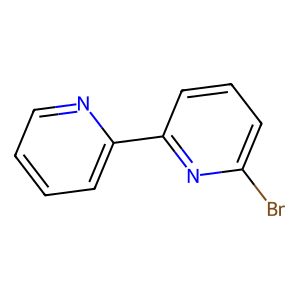 Cas:10495-73-5

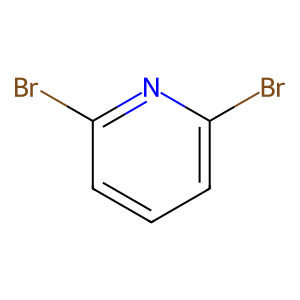 Cas:626-05-1
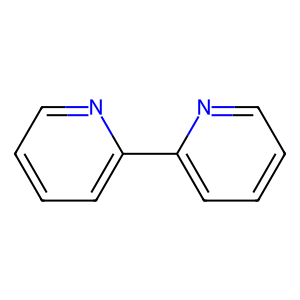 Cas:366-18-7
