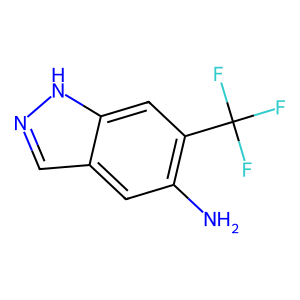
6-(trifluoromethyl)-1H-indazol-5-amine
CAS No.:
1000373-75-0
M. Wt:
201.14900
M. Fa:
C8H6F3N3
InChI Key:
MHRNJCQQTAOQEH-UHFFFAOYSA-N
Appearance:
Gray Solid
Names and Identifiers of 6-(trifluoromethyl)-1H-indazol-5-amine
CAS Number |
1000373-75-0 |
|---|---|
MDL Number |
MFCD24642227 |
IUPAC Name |
6-(trifluoromethyl)-1H-indazol-5-amine |
InChI |
InChI=1S/C8H6F3N3/c9-8(10,11)5-2-7-4(1-6(5)12)3-13-14-7/h1-3H,12H2,(H,13,14) |
InChIKey |
MHRNJCQQTAOQEH-UHFFFAOYSA-N |
Canonical SMILES |
C1=C2C=NNC2=CC(=C1N)C(F)(F)F |
UNSPSC Code |
12352100 |
Physical and chemical properties of 6-(trifluoromethyl)-1H-indazol-5-amine
Exact Mass |
201.05100 |
|---|---|
LogP |
2.74510 |
Molecular Formula |
C8H6F3N3 |
Molecular Weight |
201.14900 |
PSA |
54.70000 |
Safety Information of 6-(trifluoromethyl)-1H-indazol-5-amine

Applications of 6-(trifluoromethyl)-1H-indazol-5-amine
The applications of 6-(trifluoromethyl)-1H-indazol-5-amine are mainly in the pharmaceutical industry:
- Drug Development: Its unique properties make it a candidate for developing new therapeutic agents targeting various diseases, particularly cancers related to FGFR pathways.
- Research Tool: It serves as a model compound in studies exploring the structure-activity relationship of indazole derivatives.
Interaction Studies of 6-(trifluoromethyl)-1H-indazol-5-amine
Interaction studies involving 6-(trifluoromethyl)-1H-indazol-5-amine focus on its binding affinity to various biological targets:
- Kinase Inhibition Profiles: Research has shown that modifications in the indazole structure can significantly affect binding affinity and selectivity towards kinases such as FGFRs.
- Molecular Docking Studies: Computational studies provide insights into how this compound interacts at the molecular level with target proteins, helping guide further modifications for enhanced efficacy.
Biological Activity of 6-(trifluoromethyl)-1H-indazol-5-amine
Indazole derivatives, including 6-(trifluoromethyl)-1H-indazol-5-amine, exhibit diverse biological activities. They have been studied for their potential as:
- Fibroblast Growth Factor Receptor (FGFR) Inhibitors: Some derivatives show promising inhibitory effects on FGFRs, which are crucial in cancer progression.
- Anti-inflammatory Agents: Indazole compounds have been linked to anti-inflammatory properties through modulation of various signaling pathways.
- Anticancer Agents: Due to their ability to inhibit specific kinases involved in tumor growth, these compounds are being explored for cancer therapy.
Physical sample testing spectrum (NMR) of 6-(trifluoromethyl)-1H-indazol-5-amine
