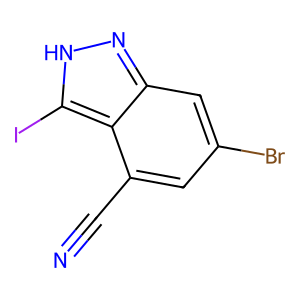
6-BROMO-3-IODO-4-CYANO (1H)INDAZOLE
Names and Identifiers of 6-BROMO-3-IODO-4-CYANO (1H)INDAZOLE
CAS Number |
1000342-60-8 |
|---|---|
IUPAC Name |
6-bromanyl-3-iodanyl-2H-indazole-4-carbonitrile |
Canonical SMILES |
C1=C(C=C(C2=C(NN=C21)I)C#N)Br |
Physical and chemical properties of 6-BROMO-3-IODO-4-CYANO (1H)INDAZOLE
Boiling Point |
469.9±40.0 °C at 760 mmHg |
|---|---|
Density |
2.5±0.1 g/cm3 |
Exact Mass |
346.855499 |
Flash Point |
238.0±27.3 °C |
Index of Refraction |
1.830 |
LogP |
3.07 |
Molecular Formula |
C8H3BrIN3 |
Molecular Weight |
347.938 |
PSA |
52.47000 |
Storage condition |
2-8°C |
Vapour Pressure |
0.0±1.2 mmHg at 25°C |
Applications of 6-BROMO-3-IODO-4-CYANO (1H)INDAZOLE
6-Bromo-3-iodo-1H-indazole-4-carbonitrile finds applications in various fields:
- Medicinal Chemistry: Due to its potential anticancer properties, it is being explored for therapeutic applications.
- Material Science: Its unique chemical properties make it suitable for developing novel materials with specific electronic or optical characteristics.
- Chemical Research: As a versatile building block in organic synthesis, it is used in the development of more complex molecules.
Interaction Studies of 6-BROMO-3-IODO-4-CYANO (1H)INDAZOLE
Interaction studies have demonstrated that 6-Bromo-3-iodo-1H-indazole-4-carbonitrile can bind to specific biological targets. For instance, molecular docking studies suggest that this compound may interact effectively with proteins involved in cancer pathways. Its halogen substituents likely enhance its binding affinity and specificity compared to non-halogenated analogs.
Biological Activity of 6-BROMO-3-IODO-4-CYANO (1H)INDAZOLE
Indazole derivatives, including 6-Bromo-3-iodo-1H-indazole-4-carbonitrile, exhibit various biological activities. Research indicates potential anticancer properties, as some derivatives have shown efficacy against different cancer cell lines. The presence of halogen atoms enhances binding affinity to biological targets, which may include enzymes and receptors involved in cancer progression. Additionally, these compounds may exhibit anti-inflammatory and antioxidant activities.