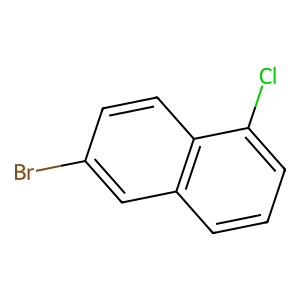
6-Bromo-1-chloronaphthalene
CAS No.:
1000391-24-1
M. Wt:
241.51
M. Fa:
C10H6BrCl
InChI Key:
KUQJGFGVAJMCNG-UHFFFAOYSA-N
Appearance:
Off White Solid
Names and Identifiers of 6-Bromo-1-chloronaphthalene
CAS Number |
1000391-24-1 |
|---|---|
MDL Number |
MFCD18410264 |
IUPAC Name |
6-bromo-1-chloronaphthalene |
InChI |
InChI=1S/C10H6BrCl/c11-8-4-5-9-7(6-8)2-1-3-10(9)12/h1-6H |
InChIKey |
KUQJGFGVAJMCNG-UHFFFAOYSA-N |
Canonical SMILES |
C1=CC2=C(C=CC(=C2)Br)C(=C1)Cl |
UNSPSC Code |
12352100 |
Physical and chemical properties of 6-Bromo-1-chloronaphthalene
H Bond Acceptors |
0 |
|---|---|
H Bond Donors |
0 |
LogP |
4.33551987433333 |
Molecular Formula |
C10H6BrCl |
Molecular Weight |
241.51 |
Storage condition |
Store at room temperature |
Safety Information of 6-Bromo-1-chloronaphthalene

Applications of 6-Bromo-1-chloronaphthalene
6-Bromo-1-chloronaphthalene finds applications across various fields:
- Organic Synthesis: It serves as an important building block for synthesizing more complex organic molecules.
- Pharmaceuticals: The compound may be used in developing pharmaceutical agents due to its potential biological activity.
- Material Science: It can be utilized in creating functional materials with specific electronic or optical properties.
Interaction Studies of 6-Bromo-1-chloronaphthalene
Interaction studies involving 6-Bromo-1-chloronaphthalene primarily focus on its reactivity with nucleophiles and electrophiles. Research indicates that its halogen substituents significantly influence its interaction profile, making it a useful intermediate for synthesizing diverse chemical entities. Studies have also examined its role in catalyzed reactions, revealing insights into reaction mechanisms and pathways .
Physical sample testing spectrum (NMR) of 6-Bromo-1-chloronaphthalene
