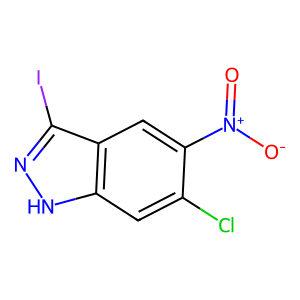
6-CHLORO-3-IODO-5-NITRO (1H)INDAZOLE
Names and Identifiers of 6-CHLORO-3-IODO-5-NITRO (1H)INDAZOLE
CAS Number |
1000342-47-1 |
|---|---|
MDL Number |
MFCD08690112 |
IUPAC Name |
6-chloro-3-iodo-5-nitro-1H-indazole |
InChI |
InChI=1S/C7H3ClIN3O2/c8-4-2-5-3(7(9)11-10-5)1-6(4)12(13)14/h1-2H,(H,10,11) |
InChIKey |
DBFHOJJVQRLTIO-UHFFFAOYSA-N |
Canonical SMILES |
O=[N+]([O-])C1=CC2=C(C=C1Cl)NN=C2I |
UNSPSC Code |
12352100 |
Physical and chemical properties of 6-CHLORO-3-IODO-5-NITRO (1H)INDAZOLE
Boiling Point |
485.5±40.0 °C at 760 mmHg |
|---|---|
Density |
2.3±0.1 g/cm3 |
Exact Mass |
322.895844 |
Flash Point |
247.4±27.3 °C |
H Bond Acceptors |
3 |
H Bond Donors |
1 |
Index of Refraction |
1.813 |
LogP |
3.75 |
Molecular Formula |
C7H3ClIN3O2 |
Molecular Weight |
323.475 |
PSA |
74.50000 |
Storage condition |
2-8°C |
Vapour Pressure |
0.0±1.2 mmHg at 25°C |
Safety Information of 6-CHLORO-3-IODO-5-NITRO (1H)INDAZOLE

Applications of 6-CHLORO-3-IODO-5-NITRO (1H)INDAZOLE
6-Chloro-3-iodo-5-nitro-1H-indazole has several applications:
- Medicinal Chemistry: It serves as a lead compound in the development of new anticancer agents due to its kinase inhibitory properties.
- Research Tool: Used in biochemical studies to explore kinase signaling pathways and their implications in cancer biology.
- Synthetic Intermediate: Acts as a building block for synthesizing more complex indazole derivatives with tailored biological activities.
Interaction Studies of 6-CHLORO-3-IODO-5-NITRO (1H)INDAZOLE
Interaction studies involving 6-chloro-3-iodo-5-nitro-1H-indazole focus on its binding affinity to various kinases. These studies often utilize techniques such as:
- Surface Plasmon Resonance: To measure real-time binding kinetics.
- Molecular Docking Studies: To predict interaction sites and affinities with target proteins.
Such studies help elucidate the compound's potential as a therapeutic agent by identifying its specific targets within cellular pathways.
Biological Activity of 6-CHLORO-3-IODO-5-NITRO (1H)INDAZOLE
6-Chloro-3-iodo-5-nitro-1H-indazole has demonstrated significant biological activities, particularly in cancer research. It has been identified as a potential inhibitor of several kinases involved in cell proliferation and survival pathways. Its ability to modulate these pathways suggests potential therapeutic applications in treating various cancers.
Mechanism of ActionThe compound's mechanism involves the inhibition of specific kinases, which play crucial roles in cellular processes like growth and apoptosis. By interfering with these pathways, it may induce apoptosis in cancer cells and inhibit tumor growth.