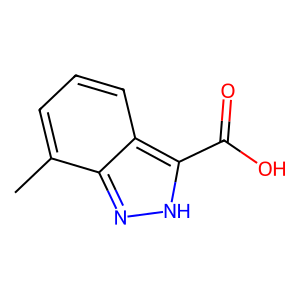
7-Methyl-1H-indazole-3-carboxylic acid
CAS No.:
1000340-53-3
M. Wt:
176.172
M. Fa:
C9H8N2O2
InChI Key:
BRQJRWNBYGCLDU-UHFFFAOYSA-N
Names and Identifiers of 7-Methyl-1H-indazole-3-carboxylic acid
CAS Number |
1000340-53-3 |
|---|---|
EC Number |
884-740-7 |
MDL Number |
MFCD07378884 |
IUPAC Name |
7-methyl-2H-indazole-3-carboxylic acid |
InChI |
InChI=1S/C9H8N2O2/c1-5-3-2-4-6-7(5)10-11-8(6)9(12)13/h2-4H,1H3,(H,10,11)(H,12,13) |
InChIKey |
BRQJRWNBYGCLDU-UHFFFAOYSA-N |
Canonical SMILES |
CC1=CC=CC2=C(NN=C12)C(=O)O |
UNSPSC Code |
12352100 |
Physical and chemical properties of 7-Methyl-1H-indazole-3-carboxylic acid
Acidity coefficient |
3.15±0.10(Predicted) |
|---|---|
Boiling Point |
443.3±25.0 °C at 760 mmHg |
Density |
1.4±0.1 g/cm3 |
Exact Mass |
176.058578 |
Flash Point |
221.9±23.2 °C |
Index of Refraction |
1.709 |
LogP |
1.76 |
Molecular Formula |
C9H8N2O2 |
Molecular Weight |
176.172 |
PSA |
65.98000 |
Vapour Pressure |
0.0±1.1 mmHg at 25°C |
Safety Information of 7-Methyl-1H-indazole-3-carboxylic acid

Applications of 7-Methyl-1H-indazole-3-carboxylic acid
The applications of 7-Methyl-1H-indazole-3-carboxylic acid are diverse:
- Pharmaceuticals: It serves as an intermediate in the synthesis of various pharmaceutical compounds, particularly those targeting neurological disorders.
- Biochemical Research: Utilized in studies investigating enzyme inhibition and receptor interactions due to its biological activity.
- Chemical Probes: Its derivatives are employed as chemical probes in biological assays to elucidate mechanisms of action in cellular systems .
Interaction Studies of 7-Methyl-1H-indazole-3-carboxylic acid
Studies on 7-Methyl-1H-indazole-3-carboxylic acid have focused on its interactions with various biological targets:
- Enzyme Inhibition: Research has demonstrated that this compound can inhibit specific enzymes involved in inflammatory pathways, suggesting potential therapeutic applications in treating inflammatory diseases.
- Receptor Binding: Investigations into its binding affinity with serotonin receptors indicate possible roles in modulating neurotransmitter systems, contributing to its neuroprotective properties .
Biological Activity of 7-Methyl-1H-indazole-3-carboxylic acid
Research indicates that 7-Methyl-1H-indazole-3-carboxylic acid exhibits various biological activities. It has been studied for its potential as an anti-inflammatory agent and has shown promise in inhibiting certain cancer cell lines. Additionally, derivatives of this compound have been explored for their neuroprotective effects, particularly in models of neurodegenerative diseases .