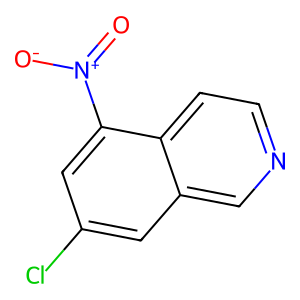
7-chloro-5-nitroisoquinoline
Names and Identifiers of 7-chloro-5-nitroisoquinoline
CAS Number |
1335050-24-2 |
|---|---|
MDL Number |
MFCD22097483 |
IUPAC Name |
7-chloro-5-nitroisoquinoline |
InChI |
InChI=1S/C9H5ClN2O2/c10-7-3-6-5-11-2-1-8(6)9(4-7)12(13)14/h1-5H |
InChIKey |
CFIWPCCLFBNWCW-UHFFFAOYSA-N |
Canonical SMILES |
O=[N+]([O-])C1=CC(Cl)=CC2=CN=CC=C21 |
UNSPSC Code |
12352100 |
Physical and chemical properties of 7-chloro-5-nitroisoquinoline
H Bond Acceptors |
3 |
|---|---|
H Bond Donors |
0 |
LogP |
2.28907901133333 |
Molecular Formula |
C9H5ClN2O2 |
Molecular Weight |
208.6000061 |
Safety Information of 7-chloro-5-nitroisoquinoline

Applications of 7-chloro-5-nitroisoquinoline
7-Chloro-5-nitroisoquinoline finds applications primarily in medicinal chemistry and materials science. Its unique properties make it suitable for:
- Drug Development: As a lead compound for developing new antimicrobial or anticancer drugs.
- Chemical Probes: Utilized in biological studies to probe cellular mechanisms due to its ability to interact with various biomolecules.
Interaction Studies of 7-chloro-5-nitroisoquinoline
Interaction studies involving 7-chloro-5-nitroisoquinoline have focused on its binding affinity with various biological targets, including enzymes and receptors. These studies often utilize techniques such as:
- Molecular Docking: To predict how the compound interacts with specific protein targets.
- In Vitro Assays: To evaluate its biological effects on cell lines or microbial cultures.
Such studies are crucial for understanding the mechanism of action and optimizing the compound's efficacy.
Biological Activity of 7-chloro-5-nitroisoquinoline
The biological activity of 7-chloro-5-nitroisoquinoline has been explored in various studies, highlighting its potential as an antimicrobial and anticancer agent. The presence of both the chlorine and nitro groups is believed to contribute to its biological efficacy by influencing its interaction with biological targets.
Notable Activities:- Antimicrobial Properties: Exhibits activity against certain bacterial strains.
- Anticancer Potential: Studies suggest that it may inhibit cancer cell proliferation through mechanisms that involve apoptosis induction and cell cycle arrest.