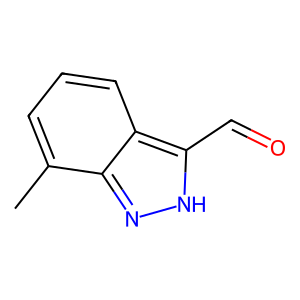
7-methyl-1H-indazole-3-carbaldehyde
Names and Identifiers of 7-methyl-1H-indazole-3-carbaldehyde
CAS Number |
1000340-51-1 |
|---|---|
MDL Number |
MFCD09027036 |
IUPAC Name |
7-methyl-2H-indazole-3-carbaldehyde |
InChI |
InChI=1S/C9H8N2O/c1-6-3-2-4-7-8(5-12)10-11-9(6)7/h2-5H,1H3,(H,10,11) |
InChIKey |
ZAOWDKPCEJINJP-UHFFFAOYSA-N |
Canonical SMILES |
CC1=CC=CC2=C(NN=C12)C=O |
UNSPSC Code |
12352100 |
Physical and chemical properties of 7-methyl-1H-indazole-3-carbaldehyde
Boiling Point |
366.3±22.0 °C at 760 mmHg |
|---|---|
Density |
1.3±0.1 g/cm3 |
Exact Mass |
160.063660 |
Flash Point |
179.0±28.8 °C |
H Bond Acceptors |
2 |
H Bond Donors |
1 |
Index of Refraction |
1.712 |
LogP |
1.50 |
Molecular Formula |
C9H8N2O |
Molecular Weight |
160.173 |
PSA |
45.75000 |
Vapour Pressure |
0.0±0.8 mmHg at 25°C |
Safety Information of 7-methyl-1H-indazole-3-carbaldehyde

Applications of 7-methyl-1H-indazole-3-carbaldehyde
7-Methyl-1H-indazole-3-carbaldehyde has various applications, particularly in medicinal chemistry:
- Drug Development: It serves as a pharmacophore for designing inhibitors targeting specific enzymes or receptors.
- Biological Assays: Used in studies related to enzyme inhibition and receptor binding.
- Material Science: Its unique structure allows for potential applications in developing new materials with specific electronic or optical properties.
Interaction Studies of 7-methyl-1H-indazole-3-carbaldehyde
Research on 7-methyl-1H-indazole-3-carbaldehyde has highlighted its interactions with biological targets. The compound's functional groups contribute to its binding affinity and specificity, influencing its effectiveness as an enzyme inhibitor or receptor modulator. Studies have shown that variations in environmental conditions can affect its action and stability, making it a subject of interest for further investigation in pharmacology and biochemistry.
Biological Activity of 7-methyl-1H-indazole-3-carbaldehyde
Indazole derivatives, including 7-methyl-1H-indazole-3-carbaldehyde, exhibit a range of biological activities. They have been studied for their potential anticancer and antimicrobial properties. The mechanism of action typically involves interaction with specific molecular targets, such as enzymes or receptors, which may lead to inhibition or modulation of biological pathways. This compound's unique structure enhances its binding affinity and specificity toward these targets, contributing to its potential therapeutic applications.
Physical sample testing spectrum (NMR) of 7-methyl-1H-indazole-3-carbaldehyde
