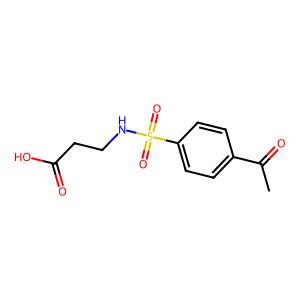
3-(4-Acetylbenzenesulfonamido)propanoic acid
Names and Identifiers of 757192-71-5
CAS Number |
757192-71-5 |
|---|---|
MDL Number |
MFCD06340081 |
IUPAC Name |
3-(4-acetylbenzenesulfonamido)propanoic acid |
InChI |
InChI=1S/C11H13NO5S/c1-8(13)9-2-4-10(5-3-9)18(16,17)12-7-6-11(14)15/h2-5,12H,6-7H2,1H3,(H,14,15) |
InChIKey |
MSLGKCLYKIHMBJ-UHFFFAOYSA-N |
Canonical SMILES |
CC(=O)C1=CC=C(S(=O)(=O)NCCC(=O)O)C=C1 |
UNSPSC Code |
12352100 |
Physical and chemical properties of 757192-71-5
Boiling Point |
506.1±60.0 °C at 760 mmHg |
|---|---|
Density |
1.4±0.1 g/cm3 |
Exact Mass |
271.051453 |
Flash Point |
259.9±32.9 °C |
H Bond Acceptors |
5 |
H Bond Donors |
2 |
Index of Refraction |
1.557 |
LogP |
0.68 |
Molecular Formula |
C11H13NO5S |
Molecular Weight |
271.290 |
Vapour Pressure |
0.0±1.4 mmHg at 25°C |
Safety Information of 757192-71-5

Applications of 757192-71-5
3-(4-acetylbenzenesulfonamido)propanoic acid has potential applications in various fields:
- Pharmaceuticals: As a potential lead compound for developing new antibacterial or anti-inflammatory agents.
- Biochemistry: Used as a biochemical probe to study enzyme activities related to sulfonamide metabolism.
- Material Science: May serve as an intermediate in synthesizing more complex organic materials or polymers.
Interaction Studies of 757192-71-5
Interaction studies involving 3-(4-acetylbenzenesulfonamido)propanoic acid focus on its binding affinity with various biological targets, including enzymes and receptors. Preliminary studies suggest that it may interact with enzymes involved in metabolic pathways related to inflammation and infection. Further research is necessary to elucidate these interactions comprehensively, including kinetic studies and structure-activity relationship analyses.
Biological Activity of 757192-71-5
3-(4-acetylbenzenesulfonamido)propanoic acid exhibits various biological activities, particularly in pharmacology. Compounds with sulfonamide groups are known for their antibacterial properties, as they inhibit bacterial folic acid synthesis. This compound may also exhibit anti-inflammatory effects due to its structural analogies with non-steroidal anti-inflammatory drugs. The specific biological mechanisms and efficacy of this compound require further investigation through experimental studies.