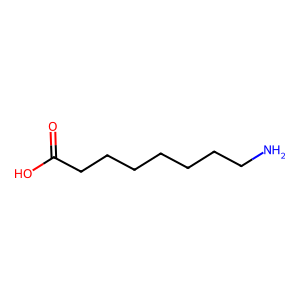
8-Aminooctanoic acid
Names and Identifiers of 8-Aminooctanoic acid
CAS Number |
1002-57-9 |
|---|---|
EC Number |
213-687-9 |
MDL Number |
MFCD00008245 |
IUPAC Name |
8-aminooctanoic acid |
InChI |
InChI=1S/C8H17NO2/c9-7-5-3-1-2-4-6-8(10)11/h1-7,9H2,(H,10,11) |
InChIKey |
UQXNEWQGGVUVQA-UHFFFAOYSA-N |
Canonical SMILES |
C(CCCC(=O)O)CCCN |
UNII |
X8H8HFT75V |
UNSPSC Code |
12352100 |
Physical and chemical properties of 8-Aminooctanoic acid
Acidity coefficient |
4.76±0.10(Predicted) |
|---|---|
Boiling Point |
286.0±23.0 °C at 760 mmHg |
BRN |
1756493 |
Density |
1.0±0.1 g/cm3 |
Exact Mass |
159.125931 |
Flash Point |
126.8±22.6 °C |
Index of Refraction |
1.469 |
LogP |
0.95 |
Melting Point |
194 °C (dec.)(lit.) |
Molecular Formula |
C8H17NO2 |
Molecular Weight |
159.226 |
PSA |
63.32000 |
Solubility |
Methanol (Very Slightly), Water (Slightly) |
Storage condition |
Store at 0-5°C |
Vapour Pressure |
0.0±1.3 mmHg at 25°C |
Water Solubility |
Soluble in water. |
Safety Information of 8-Aminooctanoic acid

Applications of 8-Aminooctanoic acid
8-Aminooctanoic acid finds applications in various fields:
- Pharmaceuticals: It is used as an intermediate in the synthesis of drugs and bioactive compounds.
- Biotechnology: Its role as a building block for peptides makes it valuable in protein engineering and synthetic biology.
- Food Industry: It may be utilized as a flavor enhancer or nutritional supplement due to its amino acid properties.
Interaction Studies of 8-Aminooctanoic acid
Studies on the interactions of 8-aminooctanoic acid with other biomolecules have revealed its potential effects on metabolic pathways and cellular signaling. Research suggests that it may modulate enzyme activities and influence neurotransmitter dynamics, although further studies are needed to fully elucidate these interactions.
Biological Activity of 8-Aminooctanoic acid
Research indicates that 8-aminooctanoic acid exhibits various biological activities. It has been studied for its potential role in metabolic processes and as a precursor for synthesizing other biologically active compounds. Its structural similarity to other amino acids allows it to participate in protein synthesis and cellular functions. Additionally, it may have implications in neurobiology due to its influence on neurotransmitter systems.
Physical sample testing spectrum (NMR) of 8-Aminooctanoic acid

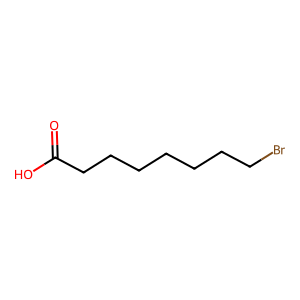 Cas:17696-11-6

 Cas:50530-12-6
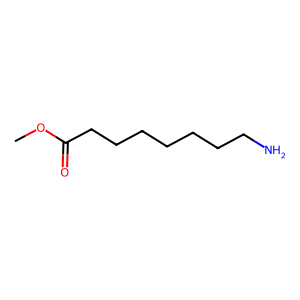 Cas:59080-49-8