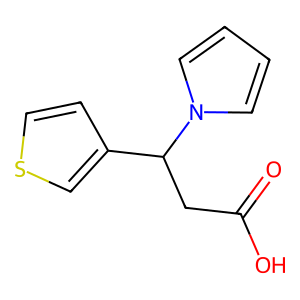
3-(1h-Pyrrol-1-yl)-3-(thiophen-3-yl)propanoic acid
CAS No.:
866019-33-2
M. Wt:
221.275
M. Fa:
C11H11NO2S
InChI Key:
DUPNBMRWTIBTOA-UHFFFAOYSA-N
Names and Identifiers of 866019-33-2
CAS Number |
866019-33-2 |
|---|---|
MDL Number |
MFCD03787346 |
IUPAC Name |
3-(1H-pyrrol-1-yl)-3-(thiophen-3-yl)propanoic acid |
InChI |
InChI=1S/C11H11NO2S/c13-11(14)7-10(9-3-6-15-8-9)12-4-1-2-5-12/h1-6,8,10H,7H2,(H,13,14) |
InChIKey |
DUPNBMRWTIBTOA-UHFFFAOYSA-N |
Canonical SMILES |
O=C(O)CC(C1=CSC=C1)N1C=CC=C1 |
UNSPSC Code |
12352100 |
Physical and chemical properties of 866019-33-2
Boiling Point |
380.0±32.0 °C at 760 mmHg |
|---|---|
Density |
1.3±0.1 g/cm3 |
Exact Mass |
221.051056 |
Flash Point |
183.6±25.1 °C |
H Bond Acceptors |
2 |
H Bond Donors |
1 |
Index of Refraction |
1.633 |
LogP |
2.07 |
Molecular Formula |
C11H11NO2S |
Molecular Weight |
221.275 |
Vapour Pressure |
0.0±0.9 mmHg at 25°C |
Safety Information of 866019-33-2

Applications of 866019-33-2
The unique structure of 3-(1H-pyrrol-1-yl)-3-(thiophen-3-yl)propanoic acid allows for diverse applications:
- Pharmaceuticals: Its potential biological activities make it a candidate for drug development.
- Material Science: The compound may be used in the synthesis of organic semiconductors or polymers due to its electronic properties.
- Agricultural Chemicals: Its antimicrobial properties could be explored for agricultural applications as a pesticide or herbicide.
Interaction Studies of 866019-33-2
Interaction studies involving 3-(1H-pyrrol-1-yl)-3-(thiophen-3-yl)propanoic acid often focus on its binding affinity with various biological targets. Research indicates that:
- It may interact with specific enzymes or receptors involved in inflammation and cancer pathways.
- Studies using molecular docking simulations have suggested potential binding sites that could be targeted for therapeutic interventions.
Biological Activity of 866019-33-2
Research indicates that compounds containing pyrrole and thiophene rings exhibit various biological activities, including:
- Antimicrobial properties: Some derivatives have shown effectiveness against bacterial strains.
- Anti-inflammatory effects: These compounds may modulate inflammatory pathways, making them candidates for therapeutic applications.
- Cytotoxicity: Certain studies suggest potential anti-cancer properties, although more research is needed to confirm these effects.