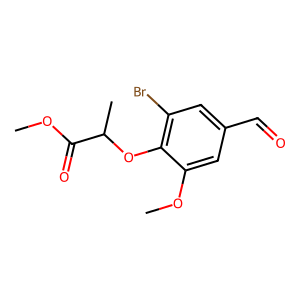
methyl 2-(2-bromo-4-formyl-6-methoxyphenoxy)propanoate
Names and Identifiers of 879180-89-9
CAS Number |
879180-89-9 |
|---|---|
MDL Number |
MFCD07434218 |
IUPAC Name |
methyl 2-(2-bromo-4-formyl-6-methoxyphenoxy)propanoate |
InChI |
InChI=1S/C12H13BrO5/c1-7(12(15)17-3)18-11-9(13)4-8(6-14)5-10(11)16-2/h4-7H,1-3H3 |
InChIKey |
KCEUZNIQQOWRFH-UHFFFAOYSA-N |
Canonical SMILES |
COC(=O)C(C)OC1=C(Br)C=C(C=O)C=C1OC |
UNSPSC Code |
12352100 |
Physical and chemical properties of 879180-89-9
Exact Mass |
315.99500 |
|---|---|
LogP |
2.21050 |
Molecular Formula |
C12H13BrO5 |
Molecular Weight |
317.13300 |
PSA |
61.83000 |
Safety Information of 879180-89-9

Applications of 879180-89-9
Methyl 2-(2-bromo-4-formyl-6-methoxyphenoxy)propanoate has several applications:
- Pharmaceutical Development: Due to its potential biological activities, it is used as a lead compound in drug discovery.
- Research Chemical: It serves as a reference standard in pharmacological studies.
- Chemical Intermediate: It can be used in the synthesis of more complex molecules for various applications in medicinal chemistry.
Interaction Studies of 879180-89-9
Interaction studies are crucial for understanding the pharmacodynamics and pharmacokinetics of methyl 2-(2-bromo-4-formyl-6-methoxyphenoxy)propanoate. Preliminary data suggest interactions with specific enzymes and receptors that may modulate inflammatory pathways. Further studies using molecular docking and biochemical assays are necessary to elucidate these interactions fully and assess their therapeutic potential.
Biological Activity of 879180-89-9
The biological activity of methyl 2-(2-bromo-4-formyl-6-methoxyphenoxy)propanoate is an area of ongoing research. Preliminary studies suggest potential anti-inflammatory and antimicrobial properties. The presence of the methoxy and formyl groups may contribute to its interaction with biological targets, although specific mechanisms of action require further investigation. Additionally, compounds with similar structures have shown promise in cancer therapy, indicating that this compound may also possess anticancer properties.