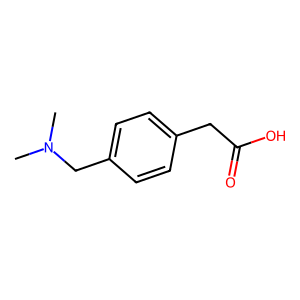
(4-Dimethylaminomethyl-phenyl)-acetic acid
Names and Identifiers of 99985-52-1
CAS Number |
99985-52-1 |
|---|---|
IUPAC Name |
2-[4-[(dimethylamino)methyl]phenyl]acetic acid |
InChI |
InChI=1S/C11H15NO2/c1-12(2)8-10-5-3-9(4-6-10)7-11(13)14/h3-6H,7-8H2,1-2H3,(H,13,14) |
InChIKey |
MQXZEKTWPSSQAU-UHFFFAOYSA-N |
Canonical SMILES |
CN(C)CC1=CC=C(C=C1)CC(=O)O |
Physical and chemical properties of 99985-52-1
Molecular Formula |
C11H15NO2 |
|---|---|
Molecular Weight |
193.24 |
Storage condition |
Inert atmosphere,Room Temperature |
Applications of 99985-52-1
(4-Dimethylaminomethyl-phenyl)-acetic acid has potential applications in:
- Pharmaceuticals: Used as an intermediate in the synthesis of drugs targeting pain relief and inflammation.
- Chemical Research: Serves as a building block for synthesizing more complex organic molecules.
- Biochemical Studies: Useful in studying receptor interactions due to its ability to modulate biological pathways.
Interaction Studies of 99985-52-1
Studies on (4-Dimethylaminomethyl-phenyl)-acetic acid have shown that it interacts with various biological receptors, particularly those involved in neurotransmission and pain modulation. Its structural features allow it to bind effectively to serotonin and norepinephrine transporters, influencing mood and pain perception. These interactions suggest that this compound could be further explored for its therapeutic potential in treating mood disorders or chronic pain conditions.
Biological Activity of 99985-52-1
Research indicates that (4-Dimethylaminomethyl-phenyl)-acetic acid exhibits significant biological activities, particularly in the realm of pharmaceuticals. It has been noted for its anti-inflammatory and analgesic properties, which are common among compounds that contain both amino and carboxylic acid functional groups. The presence of the dimethylamino group enhances its ability to interact with biological targets such as receptors involved in pain and inflammation pathways.
Physical sample testing spectrum (NMR) of 99985-52-1
