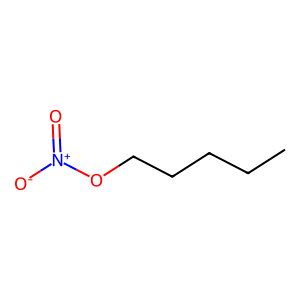
Amyl nitrate
Names and Identifiers of Amyl nitrate
CAS Number |
1002-16-0 |
|---|---|
EC Number |
213-684-2 |
IUPAC Name |
pentyl nitrate |
InChI |
InChI=1S/C5H11NO3/c1-2-3-4-5-9-6(7)8/h2-5H2,1H3 |
InChIKey |
HSNWZBCBUUSSQD-UHFFFAOYSA-N |
Canonical SMILES |
CCCCCO[N+](=O)[O-] |
UNII |
Z77A64H8TF |
UN Number |
1112 |
Physical and chemical properties of Amyl nitrate
Boiling Point |
BP: 145 °C |
|---|---|
Decomposition |
When heated to decomposition it emits toxic fumes of /nitrogen oxides/. |
Density |
0.99 |
Exact Mass |
133.07400 |
Flash Point |
125 °F (open cup) |
Index of Refraction |
1.42 |
LogP |
log Kow = 2.72 (est) |
Melting Point |
-190 °F (USCG, 1999) |
Molecular Formula |
C5H11NO3 |
Molecular Weight |
133.14600 |
Odor |
Sickening sweet odor |
PSA |
55.05000 |
Solubility |
In water, 0.3% |
Vapour Pressure |
5.07 mm Hg at 25 °C |
Water Solubility |
Insoluble in water |
Safety Information of Amyl nitrate


Applications of Amyl nitrate
Amyl nitrite has various applications:
- Medical Use: Primarily prescribed for angina pectoris and as an antidote for cyanide poisoning.
- Recreational Use: Commonly inhaled for its psychoactive effects, leading to its classification as a "party drug" or "poppers"—used for enhanced sexual experiences or euphoria.
- Industrial Use: Employed as an additive in diesel fuels to improve ignition properties.
Interaction Studies of Amyl nitrate
Amyl nitrite interacts with several substances, which may enhance its pharmacological effects or increase the risk of adverse reactions:
- Combining amyl nitrite with other vasodilators or alcohol can exacerbate hypotensive effects.
- It may also interact with medications that affect heart rate or blood pressure.
Biological Activity of Amyl nitrate
Amyl nitrite acts as a potent vasodilator, causing relaxation of smooth muscles and expansion of blood vessels. This leads to decreased blood pressure and increased heart rate. Its therapeutic effects manifest rapidly upon inhalation, typically within one minute. Additionally, amyl nitrite serves as an antidote for cyanide poisoning by promoting the formation of methemoglobin, which binds cyanide to form non-toxic cyanmethemoglobin. Adverse effects may include hypotension, headache, dizziness, and methemoglobinemia—especially concerning for infants due to their physiological differences.
Physical sample testing spectrum (NMR) of Amyl nitrate

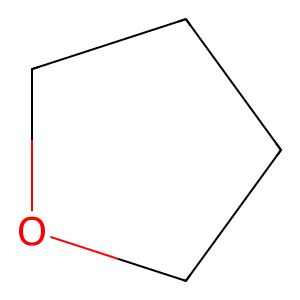 Cas:109-99-9

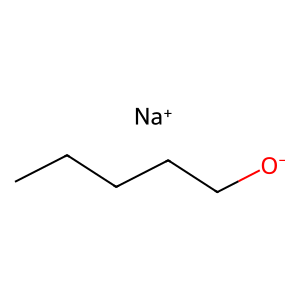 Cas:1941-84-0
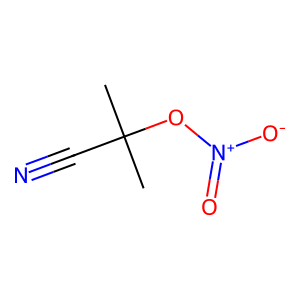 Cas:40561-27-1

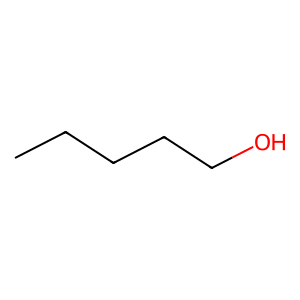 Cas:71-41-0
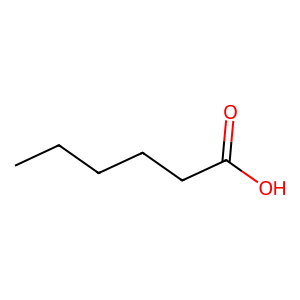 Cas:142-62-1
 Cas:7732-18-5