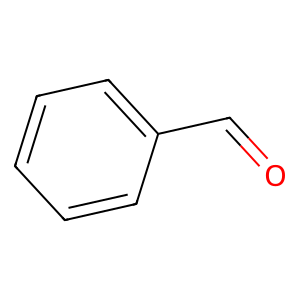
Benzaldehyde
Names and Identifiers of Benzaldehyde
CAS Number |
100-52-7 |
|---|---|
EC Number |
202-860-4 |
MDL Number |
MFCD00003299 |
IUPAC Name |
benzaldehyde |
InChI |
InChI=1S/C7H6O/c8-6-7-4-2-1-3-5-7/h1-6H |
InChIKey |
HUMNYLRZRPPJDN-UHFFFAOYSA-N |
Canonical SMILES |
C1=CC=C(C=C1)C=O |
UNII |
TA269SD04T |
UNSPSC Code |
12352100 |
UN Number |
1990 |
Physical and chemical properties of Benzaldehyde
Acidity coefficient |
14.90(at 25℃) |
|---|---|
Boiling Point |
179 °C |
BRN |
471223 |
Density |
1.040-1.047 |
Exact Mass |
106.041862 |
explosive limit |
1.4-8.5%(V) |
Flash Point |
63 °C c.c. |
Freezing Point |
-56℃ |
Index of Refraction |
1.544-1.547 |
LogP |
1.48 |
Melting Point |
-26 °C |
Merck |
14,1058 |
Molecular Formula |
C7H6O |
Molecular Weight |
106.122 |
Odor |
Odor resembling oil of bitter almond |
pH |
5.9 (1g/l, H2O) |
pH Range |
5.9 |
PSA |
17.07000 |
Sensitivity |
Air Sensitive |
Stability |
Stable. Combustible. Incompatible with strong oxidizing agents, strong acids, reducing agents, steam. Air, light and moisture-sensitive. |
Storage condition |
Store below +30°C. |
Vapour density |
Relative vapor density (air = 1): 3.7 |
Vapour Pressure |
Vapor pressure, Pa at 26 °C: 133 |
Water Solubility |
<0.01 g/100 mL at 19.5 ºC |
Solubility of Benzaldehyde
| Solvent | Dissolution Behavior | Temperature Effect | pH Effect |
|---|---|---|---|
| Water | Slightly soluble, may form oily layer separation | Heating slightly increases solubility, but remains limited | Neutral pH has little effect; acidic or basic conditions may promote hydrolysis |
| Ethanol | Readily soluble, forms a homogeneous solution | Heating further enhances dissolution rate | pH changes have little effect |
| Ether | Readily soluble, forms a transparent solution | Temperature has minimal effect | pH has little effect |
| Acetone | Completely miscible, forms a transparent solution | Temperature has no significant effect on solubility | pH has little effect |
| Chloroform (CHCl₃) | Readily soluble, forms a transparent solution | Increased temperature slightly improves solubility | pH has little effect |
| Dilute Sodium Hydroxide Solution | Slightly soluble or insoluble, may undergo hydrolysis | Increased temperature may promote hydrolysis | Strongly alkaline conditions may cause hydrolysis, yielding benzoic acid and benzyl alcohol |
| Dilute Hydrochloric Acid | Insoluble, may form layer separation | Increased temperature does not significantly improve solubility | Strongly acidic conditions show no significant hydrolysis |
Routine testing items of Benzaldehyde
| Test Item | Common Test Method | Method Overview |
|---|---|---|
| Appearance | Visual Inspection | Observe the color and state of the sample under natural or standard lighting to determine if it is a colorless to pale yellow transparent liquid, and check for turbidity, sediment, or suspended particles. |
| Assay | Gas Chromatography (GC) | Capillary gas chromatography using internal or external standard method to measure the peak area of benzaldehyde and calculate its purity. Offers high resolution and sensitivity. |
| Aldehyde Content | Hydroxylamine Hydrochloride Titration | Benzaldehyde reacts with hydroxylamine to form an oxime and releases hydrochloric acid, which is then titrated with a standard alkaline solution to indirectly determine aldehyde content. Suitable when no interfering substances are present. |
| Moisture Content | Karl Fischer Method | An electrochemical method for determining trace moisture in samples, available as coulometric or volumetric titration. Widely used for moisture analysis in organic solvents with low water content. |
| Acid Value (Acidity) | Acid-Base Titration | Dissolve the sample in ethanol and titrate free acids with standard sodium hydroxide solution. The acid value is expressed in mg KOH/g and indicates the degree of oxidation. |
| Color | Platinum-Cobalt Colorimetric Method | Compare the sample against a platinum-cobalt standard color scale visually or using a colorimeter to assess the intensity of color, reflecting impurities or oxidation levels. |
| Impurity Analysis (e.g., benzoic acid, benzyl alcohol) | High-Performance Liquid Chromatography (HPLC) or GC-MS | HPLC is effective for separating polar impurities (e.g., benzoic acid), while GC-MS can identify volatile impurities and enable qualitative and quantitative multi-component analysis. |
| Refractive Index | Refractometry | Measure the refractive index at a specified temperature (e.g., 20°C) to assist in identification and purity assessment. The refractive index of benzaldehyde is approximately 1.545–1.547. |
| Density | Pycnometer Method or Digital Density Meter | Determine mass per unit volume to verify physical constants. The density of benzaldehyde at 20°C is approximately 1.044–1.048 g/cm³. |
Safety Information of Benzaldehyde

Key Milestone of Benzaldehyde
| Time | Event | Note |
|---|---|---|
| 1832 | First isolation and naming | The German chemists Friedrich Wöhler and Justus von Liebig isolated benzaldehyde from bitter almond oil and named it "benzaldehyde," establishing its molecular formula as C₇H₆O. |
| 1850s | Structural confirmation | With the development of organic chemistry structural theory, the aromatic aldehyde structure (benzene ring connected to an aldehyde group) of benzaldehyde was confirmed, making it a representative compound of aromatic aldehydes. |
| 1870s | Industrial synthesis methods emerge | The industrial production of benzaldehyde began using the chlorination-hydrolysis method of toluene side chains, replacing the earlier inefficient method relying on natural bitter almond extraction. |
| Late 19th century | Rise in food and fragrance applications | Due to its characteristic almond aroma, benzaldehyde was widely used as a food flavoring (such as for cherry and almond flavors) and a fragrance component in personal care products. |
| Early 20th century | Applications in medicine and dyes | Benzaldehyde, as an important organic synthetic intermediate, was used in the synthesis of drugs (such as chloramphenicol, phenobarbital), dyes (such as triarylmethane dyes), and pesticides. |
| 1930s | Safety assessment and regulation | As usage increased, countries began conducting safety assessments of benzaldehyde in food, with the U.S. FDA classifying it as "Generally Recognized as Safe" (GRAS). |
| 1950s–1960s | Exploration of greener synthesis methods | More environmentally friendly synthesis routes, such as direct air oxidation of toluene, were developed to reduce pollution from chlorination processes. |
| 1980s to present | Expanded applications across multiple fields | Benzaldehyde is now widely used in pharmaceuticals (as an intermediate for antitumor drugs), agricultural chemicals, liquid crystal materials, fragrances, and organic synthesis (such as the benzoin condensation and Cannizzaro reaction). |
| Early 21st century | Research on biocatalytic synthesis | Studies have explored microbial or enzymatic catalytic conversion of benzyl alcohol or toluene into benzaldehyde, promoting the development of sustainable green chemistry. |
Applications of Benzaldehyde
Benzaldehyde has diverse applications across various industries:
- Flavoring Agent: Widely used in the food industry for its almond-like flavor.
- Fragrance Component: Commonly found in perfumes and cosmetics due to its pleasant scent.
- Chemical Intermediate: Utilized in the synthesis of other organic compounds, including pharmaceuticals and agrochemicals.
- Bee Repellent: Employed in apiculture to deter bees during honey extraction processes.
Interaction Studies of Benzaldehyde
Recent studies have focused on the interactions of benzaldehyde with other compounds under various conditions. For instance, it has been shown to interact with carbenes to form 1,3-dioxolanes, demonstrating its versatility as a reactant in organic synthesis. Additionally, research into the autoxidation pathways indicates that certain catalysts can enhance or inhibit its oxidation processes, revealing insights into its stability and reactivity under different environmental conditions.
Biological Activity of Benzaldehyde
Benzaldehyde exhibits various biological activities, including antimicrobial properties. It has been studied for its potential to inhibit bacterial growth and may possess antifungal properties as well. Additionally, benzaldehyde has been noted for its role in flavoring and fragrance industries due to its pleasant aroma, which can influence consumer behavior and preferences in food products.
Physical sample testing spectrum (NMR) of Benzaldehyde

 Cas:71-43-2
