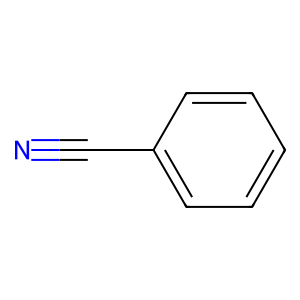
Benzonitrile
Names and Identifiers of Benzonitrile
CAS Number |
100-47-0 |
|---|---|
EC Number |
202-855-7 |
IUPAC Name |
benzonitrile |
InChI |
InChI=1S/C7H5N/c8-6-7-4-2-1-3-5-7/h1-5H |
InChIKey |
JFDZBHWFFUWGJE-UHFFFAOYSA-N |
Canonical SMILES |
C1=CC=C(C=C1)C#N |
UNII |
9V9APP5H5S |
UN Number |
2224 |
Physical and chemical properties of Benzonitrile
Boiling Point |
190.7 °C |
|---|---|
BRN |
506893 |
Decomposition |
When heated to decomp it emits toxic fumes of /cyanides and nitrogen oxides/. |
Density |
Relative density (water = 1): 1.0 |
Exact Mass |
103.042198 |
explosive limit |
1.4-7.2%(V) |
Exposure Limits |
NIOSH: IDLH 14 ppm(25 mg/m3) |
Flash Point |
75 °C c.c. |
Index of Refraction |
Index of refraction: 1.5289 at 20 °C/D |
LogP |
1.56 |
Melting Point |
-12.8 °C |
Merck |
14,1097 |
Molecular Formula |
C7H5N |
Molecular Weight |
103.121 |
Odor |
Odor of volatile oil of almond |
PSA |
23.79000 |
Stability |
Stable. Incompatible with strong bases, strong acids, strong oxidizing agents, strong reducing agents. Air-sensitive. Combustible. |
Storage condition |
Store below +30°C. |
Vapour density |
Relative vapor density (air = 1): 3.6 |
Vapour Pressure |
Vapor pressure, Pa at 25 °C: 102 |
Water Solubility |
10 g/L (100 ºC) |
λmax |
λ: 300 nm Amax: 1.0 λ: 310 nm Amax: 0.40 λ: 335 nm Amax: 0.03 λ: 360-400 nm Amax: 0.01 |
Solubility of Benzonitrile
| Solvent | Dissolution Behavior | Temperature Effect | pH Effect |
|---|---|---|---|
| Water | Practically insoluble (slightly soluble, approximately 0.15 g/100 mL) | Solubility increases slightly with rising temperature | No significant effect (stable under neutral conditions) |
| Ethanol | Soluble | Solubility increases significantly with rising temperature | Stable under both acidic and alkaline conditions |
| Diethyl ether | Soluble | Increased temperature promotes dissolution | Almost no effect |
| Acetone | Soluble | Solubility increases with rising temperature | Stable, unaffected by pH changes |
| Chloroform | Soluble | Dissolving power enhances with higher temperature | No obvious effect |
| Dichloromethane | Soluble | Solubility improves as temperature rises | Unaffected by pH |
| Toluene | Soluble | Better solubility at higher temperatures | No effect |
| Ethyl acetate | Soluble | Heating aids dissolution | Stable under neutral conditions |
Routine testing items of Benzonitrile
| Test Item | Common Test Method | Method Overview |
|---|---|---|
| Appearance | Visual Inspection | Observe the sample's color and state under natural or standard lighting to determine if it is a colorless, transparent liquid, and check for suspended particles or impurities. |
| Content (Purity) | Gas Chromatography (GC) | Use a capillary gas chromatograph with internal or external standard method to determine the content of benzonitrile, offering high resolution and accuracy. |
| Moisture | Karl Fischer Titration | Utilize the quantitative reaction of iodine with sulfur dioxide in methanol with water; measure moisture content via coulometric or volumetric titration, suitable for trace water detection. |
| Acid Value | Acid-Base Titration | Dissolve the sample in ethanol and titrate free acids with standardized sodium hydroxide solution. The acid value is expressed in mg KOH/g, indicating the level of acidic impurities. |
| Color | Platinum-Cobalt Colorimetric Method (APHA Method) | Compare the sample visually or instrumentally against a platinum-cobalt standard color scale to assess color intensity, used for controlling product appearance quality. |
| Density | Density Meter or Digital Density Analyzer | Measure density at a specified temperature (e.g., 20°C) using a glass hydrometer or U-tube oscillating digital densitometer, aiding in purity assessment. |
| Refractive Index | Refractometry | Determine refractive index using an Abbe refractometer at standard temperature (e.g., 20°C), serving as a physical constant for identification and purity evaluation. |
| Residual Solvents | Gas Chromatography (GC) | Detect possible residual organic solvents (e.g., methanol, benzene, acetone) according to pharmacopoeia or relevant standards, using headspace sampling coupled with GC analysis. |
| Impurities (Related Substances) | High-Performance Liquid Chromatography (HPLC) or GC | Separate and detect organic impurities in benzonitrile (e.g., benzaldehyde, benzoic acid, cyanide derivatives) to evaluate the purity of the main component. |
| Cyanide Residue | Spectrophotometry or Ion Chromatography | After hydrolysis to release cyanide ions, detect using colorimetric methods such as isonicotinic acid-pyrazolone, or directly analyze free cyanide ions by ion chromatography. |
Safety Information of Benzonitrile

Key Milestone of Benzonitrile
| Time | Event | Description |
|---|---|---|
| 1844 | First Synthesis | German chemist Hermann Fehling first prepared benzonitrile via dehydration of benzamide, marking one of the earliest synthesized aromatic nitriles. |
| 1870s | Structure Confirmation | With the advancement of organic structural theory (e.g., Kekulé's benzene ring structure), the molecular structure of benzonitrile (a benzene ring connected to a cyano group) was clearly established. |
| late 19th – early 20th century | Industrial Precursor Applications | Used as an intermediate for synthesizing benzoic acid, aniline, and other aromatic compounds, finding small-scale applications in dye and pharmaceutical industries. |
| 1930–1950s | Rise of Organic Synthetic Reagents | Benzonitrile became widely used in Grignard reactions, reduction reactions, and other transformations, serving as an important reagent for constructing C–C bonds and introducing nitrogen-containing functional groups. |
| 1950s | Pesticide and Pharmaceutical Intermediate | Played a key role as an intermediate in the synthesis of pesticides (e.g., herbicides, insecticides) and pharmaceuticals (e.g., antidepressants, antihistamines). |
| 1970s | Coordination Chemistry Research | Used as a weak ligand in transition metal complex studies due to its ability to coordinate with metal centers via the cyano group, contributing to catalysis and materials science. |
| 1980s – present | Core Intermediate in Fine Chemicals | Extensively applied in synthesizing high-value fine chemicals such as benzamides, phenylacetic acid, and benzaldehyde oxime, supporting industries including pharmaceuticals, agrochemicals, and fragrances. |
| 2000s | Development of Green Synthesis Methods | New environmentally friendly synthesis routes were developed, such as toluene ammonia oxidation, replacing traditional toxic cyanide-based processes, improving atom economy and safety. |
| 2010s | Discovery in Astrochemistry | Benzonitrile was detected in interstellar media (e.g., the TMC-1 molecular cloud) through radio astronomical observations, becoming the first confirmed aromatic nitrile found in space—of significant importance to the study of prebiotic molecules. |
| 2020s | New Functional Materials Precursor | Used as a precursor for synthesizing nitrogen-containing heterocyclic polymers, liquid crystals, and organic optoelectronic materials, showing promise in OLEDs and semiconductor applications. |
Applications of Benzonitrile
Benzonitrile has a wide array of applications:
- Solvent: It is commonly used as a solvent in organic synthesis due to its ability to dissolve many organic compounds.
- Chemical Precursor: It serves as a precursor for numerous derivatives and organic building blocks, including 2-cyclopentylacetophenone and 4-carbomethoxy-5-methoxy-2-phenyl-1,3-oxazole.
- Coordination Chemistry: Its ability to form coordination complexes makes it valuable in catalysis and synthetic chemistry.
Interaction Studies of Benzonitrile
Studies involving benzonitrile focus on its interactions with various biological systems and its toxicological effects. The compound's reactivity profile indicates that it can undergo hydrolysis under acidic conditions, producing benzoic acid. Furthermore, research into its metabolism reveals that aromatic hydroxylation is a significant pathway for its transformation within biological systems.
Biological Activity of Benzonitrile
Benzonitrile exhibits biological activity that warrants attention. It has been noted for its potential toxicity; exposure can lead to symptoms such as headaches, nausea, and confusion due to its ability to enter the body through ingestion or skin absorption. Its metabolites include benzoic acid, which results from hydrolysis of the cyanide group. Additionally, benzonitrile has been detected in interstellar mediums, suggesting potential roles in astrochemistry.
 Cas:71-43-2
