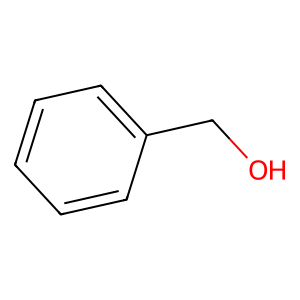
Benzyl Alcohol
CAS No.:
100-51-6
M. Wt:
108.138
M. Fa:
C7H8O
InChI Key:
WVDDGKGOMKODPV-UHFFFAOYSA-N
Appearance:
Colorless to Almost colorless clear liquid
Names and Identifiers of Benzyl Alcohol
CAS Number |
100-51-6 |
|---|---|
EC Number |
202-859-9 |
MDL Number |
MFCD00004599 |
IUPAC Name |
phenylmethanol |
InChI |
InChI=1S/C7H8O/c8-6-7-4-2-1-3-5-7/h1-5,8H,6H2 |
InChIKey |
WVDDGKGOMKODPV-UHFFFAOYSA-N |
Canonical SMILES |
C1=CC=C(C=C1)CO |
UNII |
LKG8494WBH |
UNSPSC Code |
12352100 |
Physical and chemical properties of Benzyl Alcohol
Acidity coefficient |
14.36±0.10(Predicted) |
|---|---|
Boiling Point |
401 °F |
BRN |
878307 |
Decomposition |
When heated to decomposition it emits acrid smoke and fumes. |
Density |
1.05 |
Exact Mass |
108.057518 |
explosive limit |
1.3-13%(V) |
Flash Point |
213 °F |
Index of Refraction |
1.536-1.541 |
LogP |
1.1 |
Melting Point |
4.5 °F |
Merck |
14,1124 |
Molecular Formula |
C7H8O |
Molecular Weight |
108.138 |
Odor |
Faint aromatic odor |
pH |
A solution in water is neutral to litmus |
PSA |
20.23000 |
Stability |
Oxidizes slowly, therefore remains stable for long time |
Storage condition |
Store at +2°C to +25°C. |
Vapour density |
3.72 |
Vapour Pressure |
0.1 mmHg@68 °F |
Water Solubility |
4.29 g/100 mL (20 ºC) |
Solubility of Benzyl Alcohol
| Solvent | Dissolution Behavior | Temperature Effect | pH Effect |
|---|---|---|---|
| Water | Slightly soluble (approximately 1.5% w/w at 20°C) | Solubility slightly increases with rising temperature | Almost no effect (stable under neutral conditions) |
| Ethanol | Freely soluble | Solubility significantly increases with temperature | Remains soluble under acidic or basic conditions, but may undergo slow hydrolysis |
| Acetone | Freely soluble | Solubility increases with rising temperature | Stable; unaffected by common pH variations |
| Diethyl ether | Freely soluble | Higher temperatures promote dissolution | Essentially no effect |
| Chloroform | Freely soluble | Solubility increases with temperature | Possible side reactions under strong acidic or alkaline conditions |
| Dichloromethane | Freely soluble | Solubility increases with rising temperature | Stable; no noticeable effect |
| Glycerol | Miscible (fully miscible with glycerol) | Easier mixing at higher temperatures | Stable under neutral conditions; strong bases may cause esterification or decomposition |
| Toluene | Freely soluble | Solubility increases with temperature | No significant effect |
| Ethyl acetate | Freely soluble | Solubility improves with increasing temperature | Stable in weakly acidic environments; strong bases may cause hydrolysis |
Routine testing items of Benzyl Alcohol
| Test Item | Common Test Method | Method Summary |
|---|---|---|
| Appearance | Visual Inspection | Examine the sample's color and state under natural or standard lighting; it should be a colorless, transparent liquid without suspended particles or precipitate. |
| Identification | Infrared Spectroscopy (IR) | Compare the sample spectrum with a reference standard; characteristic absorption peaks (e.g., O-H, C=O, aromatic C=C) should match to confirm molecular structure. |
| Gas Chromatography-Mass Spectrometry (GC-MS) | Confirm the presence of benzyl alcohol by comparing retention time and mass spectral fragment ions with a reference standard. | |
| Purity/Assay | Gas Chromatography (GC) | Quantify benzyl alcohol using internal or external standard method, capillary column separation, and FID detection to calculate percentage content. |
| High-Performance Liquid Chromatography (HPLC) | Suitable for thermally unstable samples; uses reversed-phase C18 column and UV detection at around 210 nm for purity quantification. | |
| Water Content | Karl Fischer Titration | Precisely determine trace moisture content based on the reaction of iodine and sulfur dioxide with water in an anhydrous environment. |
| Acid Value/Acidity | Acid-Base Titration | Titrate free acids in the sample with standardized sodium hydroxide solution; acid value is calculated as mg KOH per gram of sample based on alkali consumed. |
| Color | Platinum-Cobalt Color Scale (Pt-Co) | Compare sample color visually or instrumentally against Pt-Co standard solutions to assess color intensity and ensure product appearance quality. |
| Density | Pycnometer or Digital Density Meter | Measure mass per unit volume at a specified temperature (e.g., 20°C) to verify consistency of the substance. |
| Refractive Index | Refractometry | Determine refractive index at standard temperature (e.g., 20°C); used as a physical constant for identification and purity assessment. |
| Residual Solvents | Gas Chromatography (GC) | Analyze potential residual organic solvents (e.g., methanol, benzene) from manufacturing using headspace sampling with GC/FID. |
| Heavy Metals | Atomic Absorption Spectroscopy (AAS) or Inductively Coupled Plasma Mass Spectrometry (ICP-MS) | After sample digestion, measure elemental concentrations of heavy metals such as lead, arsenic, and mercury to ensure compliance with pharmacopeial or safety limits. |
| Microbial Limits | Microbial Limit Test | Perform total aerobic microbial count, mold and yeast count, and test for specified microorganisms (e.g., *Escherichia coli*) according to pharmacopeial requirements. |
Safety Information of Benzyl Alcohol

Key Milestone of Benzyl Alcohol
| Time | Event | Description |
|---|---|---|
| 1832 | First Isolation and Naming | German chemists Justus von Liebig and Friedrich Wöhler first obtained benzyl alcohol through the reduction of bitter almond oil (benzaldehyde) during their research and named it "benzyl alcohol." |
| 1870s | Structural Confirmation | With the development of organic structural theory, the molecular structure of benzyl alcohol (C₆H₅CH₂OH) was clarified, confirming it as an aromatic primary alcohol. |
| Late 19th–Early 20th Century | Establishment of Industrial Synthesis Methods | The Cannizzaro reaction of benzaldehyde enabled large-scale production of benzyl alcohol, laying the foundation for its industrial applications. |
| 1920s–1940s | Rise in Pharmaceutical and Fragrance Applications | Benzyl alcohol began to be used as a local anesthetic, preservative, and fragrance component, widely employed in cosmetics, perfumes, and medicinal ointments. |
| 1950s | Use as an Injectable Preservative | Approved by the U.S. FDA as a preservative and solvent in multi-dose injectables to prevent microbial contamination. |
| 1970s | Safety Controversies and Regulations | High doses of benzyl alcohol were found to be toxic to newborns (especially preterm infants), leading to "gasping syndrome." This prompted restrictions on its use in infant formulations and the establishment of safety standards (typically ≤1%). |
| 1980s–1990s | Synthesis Process Optimization | More environmentally friendly and efficient synthesis routes were developed, such as toluene side-chain oxidation followed by hydrolysis or benzaldehyde hydrogenation, reducing byproducts and improving yield. |
| 21st Century–Present | Expansion into Multiple Fields | Widely applied in pharmaceuticals (solvent, intermediate), cosmetics (preservative, fragrance fixative), electronics (cleaning agent), polymers (initiator), among others. Also gaining attention as a green solvent in organic synthesis. |
Applications of Benzyl Alcohol
Benzyl alcohol has numerous applications across various industries:
- Solvent: It serves as a solvent for inks, waxes, shellacs, paints, lacquers, and epoxy resin coatings.
- Precursor for Esters and Ethers: It is used in the production of various esters and ethers utilized in the soap, perfume, and flavor industries.
- Dye Solvent: Enhances dyeing processes for materials like wool and nylon.
- Pharmaceuticals: Acts as a precursor for drugs like thalidomide.
Biological Activity of Benzyl Alcohol
Benzyl alcohol exhibits various biological activities:
- Local Anesthetic: It is used as a local anesthetic, especially when combined with epinephrine.
- Toxicity: While it has low acute toxicity (LD50 of 1.2 g/kg in rats), it can cause respiratory issues and central nervous system depression at high concentrations. Notably, it is toxic to neonates and has been associated with "gasping syndrome".
- Metabolism: In humans, benzyl alcohol is metabolized in the liver to benzoic acid and then conjugated with glycine to form hippuric acid.
Physical sample testing spectrum (NMR) of Benzyl Alcohol

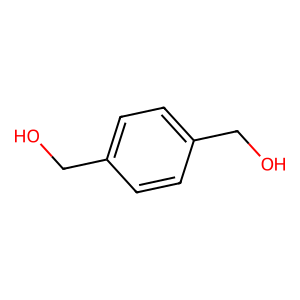 Cas:589-29-7

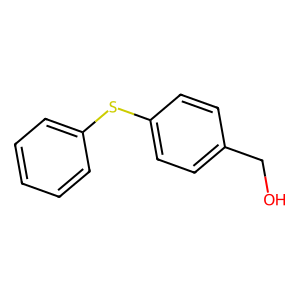 Cas:6317-56-2
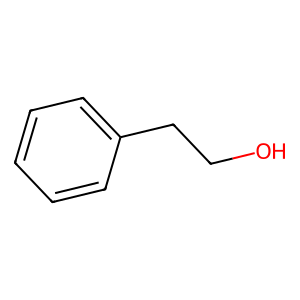 Cas:60-12-8