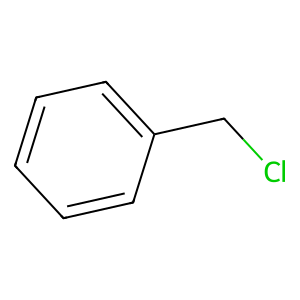
Benzyl Chloride
Names and Identifiers of Benzyl Chloride
CAS Number |
100-44-7 |
|---|---|
EC Number |
905-236-6 |
MDL Number |
MFCD00000889 |
IUPAC Name |
chloromethylbenzene |
InChI |
InChI=1S/C7H7Cl/c8-6-7-4-2-1-3-5-7/h1-5H,6H2 |
InChIKey |
KCXMKQUNVWSEMD-UHFFFAOYSA-N |
Canonical SMILES |
C1=CC=C(C=C1)CCl |
UNII |
83H19HW7K6 |
UNSPSC Code |
12352100 |
UN Number |
1738 |
Physical and chemical properties of Benzyl Chloride
Boiling Point |
354 °F |
|---|---|
BRN |
471308 |
carcinogen classification |
2A (Vol. 29, Sup 7, 71) 1999 |
Decomposition |
Energy of decomposition (in range 290-370 °C) measured as 0.14 kJ/g. |
Density |
1.10 |
Exact Mass |
126.023628 |
explosive limit |
1.1-14%(V) |
Flash Point |
153 °F |
Index of Refraction |
Index of refraction: 1.5415 at 15 °C/D; very refractive |
LogP |
2.3 |
Melting Point |
-38 °F |
Merck |
14,1129 |
Molecular Formula |
C7H7Cl |
Molecular Weight |
126.584 |
Odor |
Pungent, aromatic odor |
Solubility |
0.46g/L at 30°C in Water |
Stability |
Unstable - inhibitors such as propylene oxide or trimethylamine are usually added to prevent polymerization. Combustible. Incompatible with strong oxidizing agents, water, acids, most common metals, dimethyl sulfoxide. Above flash point vapour-air mixtures are explosive within the limits noted above. Contact with water produces toxic fumes. |
Storage condition |
Store below +30°C. |
Vapour density |
4.4 |
Vapour Pressure |
1 mmHg |
Water Solubility |
0.3 g/L (20 ºC) |
Solubility of Benzyl Chloride
| Solvent Type | Solvent Name | Dissolution Behavior | Temperature Effect | pH Effect |
|---|---|---|---|---|
| Polar Solvent | Water | Slightly soluble; slowly hydrolyzes to form benzyl alcohol and HCl | Increased temperature may accelerate hydrolysis | Acidic conditions inhibit hydrolysis; alkaline conditions promote it |
| Ethanol | Soluble | Solubility slightly increases with temperature | Minimal pH effect | |
| Acetone | Soluble | High solubility; higher temperature improves dissolution | No significant effect | |
| Non-polar Solvent | Benzene | Soluble | Good solubility; little affected by temperature changes | No significant effect |
| Diethyl ether | Soluble | Moderate solubility | No significant effect | |
| n-Hexane | Slightly soluble | Low solubility; slight improvement with increased temperature | No significant effect | |
| Strongly Polar Solvent | DMF (Dimethylformamide) | Readily soluble | Dissolves well at room temperature | Little affected by pH changes |
| DMSO (Dimethyl sulfoxide) | Readily soluble | Strong solvating ability; minimal temperature dependence | No significant effect |
Routine testing items of Benzyl Chloride
| Test Item | Common Test Method | Method Overview |
|---|---|---|
| Appearance | Visual Inspection | Place the sample in a colorless transparent glass bottle and observe its color, clarity, and presence of impurities under natural light or fluorescent lighting. The product should be a colorless to pale yellow transparent liquid when qualified. |
| Content (Purity) | Gas Chromatography (GC) | Using capillary column gas chromatography with a flame ionization detector (FID), the peak area of benzyl chloride is measured via external or internal standard method to calculate its content. This method is sensitive and accurate, suitable for high-purity analysis. |
| Moisture | Karl Fischer Titration | Based on the stoichiometric reaction of iodine with sulfur dioxide in methanol in the presence of water, moisture content is determined by potentiometric endpoint detection. Suitable for trace moisture determination with high precision. |
| Acidity (Acid Value) | Acid-Base Titration | Dissolve a certain amount of sample in ethanol or water, use phenolphthalein as indicator, and titrate free acids (e.g., HCl) with standardized sodium hydroxide solution. The result is expressed as hydrochloric acid equivalent content, reflecting the degree of hydrolysis. |
| Color | Platinum-Cobalt Color Scale (Pt-Co) | Visually compare the sample against standard platinum-cobalt solutions to determine color value (units: Hazen or APHA), used to assess product color grade. |
| Impurities (e.g., Benzene, Benzaldehyde) | Gas Chromatography-Mass Spectrometry (GC-MS) | Combines the separation capability of GC with the identification power of MS to detect, identify, and quantify organic impurities such as unreacted benzene or oxidation products like benzaldehyde. |
| Density | Density Meter or Pycnometer Method | Measure mass per unit volume at a specified temperature (e.g., 20°C) using a densitometer or pycnometer, used as an auxiliary method to assess purity and consistency. |
| Refractive Index | Refractometry | Determine the refractive index of the sample using an Abbe refractometer at standard temperature; serves as a physical constant for identification and preliminary purity screening. |
Safety Information of Benzyl Chloride


Key Milestone of Benzyl Chloride
| Time | Event | Background/Significance |
|---|---|---|
| 1842 | First Synthesis | French chemist Auguste Cahours first prepared benzyl chloride by reacting benzyl alcohol with hydrochloric acid, marking the discovery of this compound. |
| Late 19th Century | Initial Industrial Applications | With the development of organic synthetic chemistry, benzyl chloride began to be used in synthesizing dye intermediates and fragrances (e.g., benzyl alcohol, benzaldehyde). |
| Early 1900s | Rise in Pharmaceutical Intermediate Applications | Benzyl chloride was used to synthesize local anesthetics (e.g., precursors to benzocaine) and other pharmaceutical intermediates, promoting its use in the pharmaceutical industry. |
| 1920s–1930s | Expansion in Fragrance and Cosmetics Industry | As a key raw material for synthesizing jasmine-type fragrances (e.g., benzyl acetate), demand for benzyl chloride grew in the daily chemicals industry. |
| 1940s | Development of Pesticides and Fungicides | Benzyl chloride derivatives were used in developing early fungicides and plant growth regulators, expanding its agricultural applications. |
| 1950s–1960s | Applications in Polymer and Resin Industries | Used as a benzylation reagent for synthesizing functional polymer materials such as ion-exchange resins and epoxy resin modifiers. |
| 1970s | Strengthened Safety and Toxicological Research | Due to its irritancy, carcinogenicity, and environmental risks, countries began establishing occupational exposure limits and environmental regulations, promoting research into safer alternative processes. |
| 1980s–Present | Key Intermediate in Fine Chemicals | Widely used in synthesizing pharmaceuticals (e.g., antibiotic side chains), pesticides, dyes, fragrances, and specialty chemicals, becoming an important basic raw material in fine chemistry. |
| Early 21st Century | Trend Toward Green Chemistry Alternatives | Due to its toxicity, researchers are developing more environmentally friendly benzylation methods (e.g., direct catalytic substitution using benzyl alcohol) to reduce the direct use of benzyl chloride. |
Applications of Benzyl Chloride
Benzyl chloride serves multiple purposes across various industries:
- Synthesis of Esters: It is used to produce benzyl esters, which function as plasticizers and flavoring agents.
- Pharmaceuticals: Benzyl chloride is a precursor for synthesizing phenylacetic acid and other pharmaceutical compounds.
- Surfactants: Its ability to form quaternary ammonium salts makes it valuable in producing surfactants.
- Organic Synthesis: It is commonly utilized in organic synthesis for introducing the benzyl group into various compounds.
Interaction Studies of Benzyl Chloride
Research has shown that benzyl chloride interacts with various nucleophiles in solution. For instance, studies on its hydrolysis reveal that the reaction rate is influenced by factors such as pH and temperature. The mechanism of its reaction with hydroxide ions has been explored extensively, indicating that it undergoes nucleophilic substitution reactions under basic conditions.
Biological Activity of Benzyl Chloride
Benzyl chloride exhibits biological activity primarily due to its reactivity as an alkylating agent. It can modify nucleophilic sites on biomolecules, which may lead to cytotoxic effects. This property has implications in toxicology and pharmacology, as exposure can result in irritation of mucous membranes and skin, and it has been monitored as a precursor for illicit drug synthesis, such as amphetamines.
Physical sample testing spectrum (NMR) of Benzyl Chloride

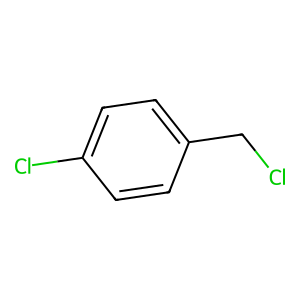 Cas:104-83-6

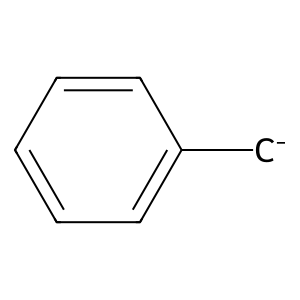 Cas:6711-19-9

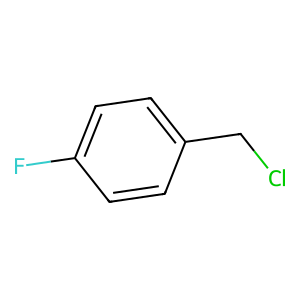 Cas:352-11-4
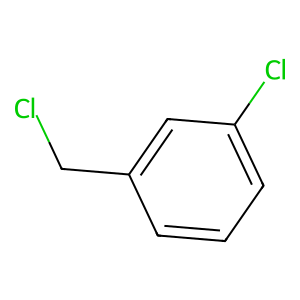 Cas:620-20-2