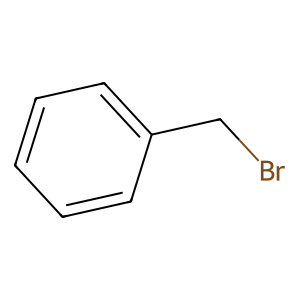
Benzyl bromide
CAS No.:
100-39-0
M. Wt:
171.035
M. Fa:
C7H7Br
InChI Key:
AGEZXYOZHKGVCM-UHFFFAOYSA-N
Appearance:
Colorless liquid
Names and Identifiers of Benzyl bromide
CAS Number |
100-39-0 |
|---|---|
EC Number |
202-847-3 |
MDL Number |
MFCD00000172 |
IUPAC Name |
bromomethylbenzene |
InChI |
InChI=1S/C7H7Br/c8-6-7-4-2-1-3-5-7/h1-5H,6H2 |
InChIKey |
AGEZXYOZHKGVCM-UHFFFAOYSA-N |
Canonical SMILES |
C1=CC=C(C=C1)CBr |
UNII |
XR75BS721D |
UNSPSC Code |
12352100 |
UN Number |
1737 |
Physical and chemical properties of Benzyl bromide
Boiling Point |
198-199 °C |
|---|---|
BRN |
385801 |
Decomposition |
On combustion, forms toxic fumes including hydrogen bromide. |
Density |
Relative density (water = 1): 1.438 |
Exact Mass |
169.973099 |
Flash Point |
79 °C c.c. |
Index of Refraction |
Index of refraction: 1.5752 at 20 °C/D |
LogP |
2.92 |
Melting Point |
-4.0 °C |
Merck |
14,1128 |
Molecular Formula |
C7H7Br |
Molecular Weight |
171.035 |
Odor |
Very sharp; pungent; like tear gas |
Sensitivity |
Moisture Sensitive/Light Sensitive |
Stability |
Stable. Combustible. Incompatible with strong oxidizing agents. |
Storage condition |
Store below +30°C. |
Vapour density |
Relative vapor density (air = 1): 5.9 |
Vapour Pressure |
Vapor pressure, Pa at 32.2 °C: 133 |
Solubility of Benzyl bromide
| Solvent | Dissolution Behavior | Temperature Effect | pH Effect |
|---|---|---|---|
| Water | Slightly soluble; slowly hydrolyzes to form benzyl alcohol and HBr | Increased temperature accelerates hydrolysis, reducing effective solubility | Stable under acidic conditions; rapidly hydrolyzes under alkaline conditions, leading to apparent increase in solubility due to chemical reaction |
| Ethanol | Freely soluble | Solubility increases with rising temperature | Substitution or hydrolysis reactions may occur under strongly alkaline conditions |
| Diethyl ether | Freely soluble | Higher temperature aids dissolution | Minimal effect; stable in neutral environments |
| Chloroform | Freely soluble | Solubility slightly increases with temperature | No significant effect |
| Benzene | Soluble | Increased temperature promotes dissolution | No obvious effect |
| Acetone | Freely soluble | Dissolves well; higher temperature further increases dissolution rate | Possible nucleophilic reactions under alkaline conditions, leading to decomposition |
| Dichloromethane | Freely soluble | Raising temperature improves both dissolution rate and solubility | Stable under neutral conditions; prone to hydrolysis in strongly alkaline environments |
Routine testing items of Benzyl bromide
| Test Item | Common Testing Method | Method Overview |
|---|---|---|
| Appearance | Visual Inspection | Observe the sample's color, physical state, and clarity. The pure product should be a clear, colorless to pale yellow liquid, free of suspended matter or precipitate. |
| Assay (Content Determination) | Gas Chromatography (GC) | Capillary column gas chromatography with internal or external standard method for quantitative analysis of benzyl bromide. Offers high resolution and sensitivity. |
| Impurity Analysis | Gas Chromatography-Mass Spectrometry (GC-MS) | Combines the separation capability of GC with the identification power of MS to detect and identify potential organic impurities (e.g., benzyl alcohol, benzyl chloride). |
| Moisture Content | Karl Fischer Titration | Electrochemical titration method for determining trace amounts of water; suitable for precise measurement of low moisture levels in samples. |
| Acidity / Free Acid | Acid-Base Titration | Titrate free acid (e.g., HBr) in the sample with standardized sodium hydroxide solution. Calculate acid value as HBr to assess storage stability. |
| Density | Densitometer or Pycnometer Method | Measure liquid density at a specified temperature (e.g., 20°C); used to assist in assessing purity and batch consistency. |
| Refractive Index | Refractometry | Determine refractive index using an Abbe refractometer at standard temperature; serves as a physical constant for identification and preliminary purity assessment. |
| Boiling Point | Distillation Method or Automated Boiling Point Apparatus | Measure the boiling range of the sample. Pure benzyl bromide boils at approximately 198–200°C; abnormal boiling range may indicate impurities. |
| Chloride Impurities | Ion Chromatography (IC) or Argentometric Method | Detect possible chlorinated impurities (e.g., benzyl chloride) or inorganic chloride ions. The argentometric method measures chloride via formation of AgCl precipitate. |
| Residual Solvents | Gas Chromatography (GC) | Detect residual organic solvents (e.g., benzene, toluene, diethyl ether) from manufacturing processes according to pharmacopoeia or relevant standards. |
Safety Information of Benzyl bromide

Key Milestone of Benzyl bromide
| Time | Event/Milestone | Description |
|---|---|---|
| 1841 | First Synthesis | French chemist Auguste Laurent first synthesized benzyl bromide by reacting benzyl alcohol with hydrobromic acid, marking the discovery of this compound. |
| Mid-19th century | Early Application in Organic Synthesis Research | Benzyl bromide, due to its high reactivity (stability of the benzyl carbocation), was used in studies of nucleophilic substitution reactions and became a key model compound in early organic chemistry education and mechanistic research. |
| Early 20th century | Widespread Use as an Alkylating Agent | In pharmaceutical and dye industries, benzyl bromide was employed as a benzylating reagent for introducing benzyl protecting groups or constructing benzyl derivatives. |
| 1930s–1950s | Role in Fragrance and Pharmaceutical Intermediate Synthesis | Benzyl bromide was used to synthesize benzyl alcohol, benzaldehyde, and various drugs and fragrance components containing benzyl structures (such as local anesthetics and antihistamines). |
| 1960s–1980s | Standardization as a Laboratory Reagent | Benzyl bromide was included in catalogs of major chemical suppliers (e.g., Aldrich, Merck) and became a routine benzylating reagent in organic synthesis laboratories. |
| Since the 1970s | Increased Awareness of Safety and Toxicity | Studies revealed that benzyl bromide is highly irritating, sensitizing, and potentially carcinogenic, prompting updates to laboratory safety protocols (e.g., use in fume hoods, wearing protective equipment). |
| 1990s–2000s | Application in Solid-Phase Synthesis and Protecting Group Chemistry | Benzyl bromide was used to introduce benzyl protecting groups (e.g., for carboxylic acids and alcohol hydroxyl groups), particularly playing a role in peptide and carbohydrate synthesis. |
| 21st century | Development of Alternatives and Green Chemistry Considerations | Owing to its toxicity and environmental impact, researchers have gradually turned to safer benzylating agents (e.g., benzyl chloride, benzyl trifluoromethanesulfonate) or catalytic methods as alternatives. However, it remains irreplaceable in specific scenarios requiring high reactivity. |
Applications of Benzyl bromide
Benzyl bromide is widely used in various applications:
- Organic Synthesis: It serves as a key reagent for introducing benzyl groups into organic molecules when other methods are insufficient .
- Protecting Groups: In synthetic chemistry, benzyl groups can act as protecting groups for alcohols and carboxylic acids during multi-step syntheses .
- Chemical Warfare Training: Due to its irritating properties, it has been utilized in training scenarios for chemical warfare .
Interaction Studies of Benzyl bromide
Interaction studies of benzyl bromide focus on its reactivity with various nucleophiles and electrophiles. The compound reacts vigorously with strong bases and oxidizing agents, leading to potentially hazardous situations. Its interactions can produce toxic byproducts such as hydrogen bromide when exposed to moisture or water .
Physical sample testing spectrum (NMR) of Benzyl bromide

 Cas:145-49-3

 Cas:623-24-5

 Cas:100-51-6
 Cas:51788-61-5
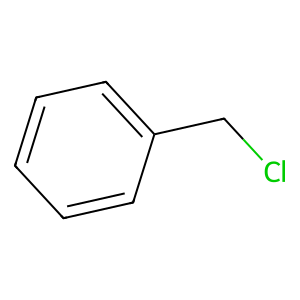 Cas:100-44-7
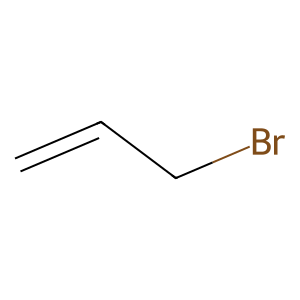 Cas:106-95-6