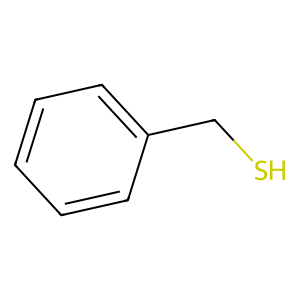
Benzyl mercaptan
CAS No.:
100-53-8
M. Wt:
124.203
M. Fa:
C7H8S
InChI Key:
UENWRTRMUIOCKN-UHFFFAOYSA-N
Appearance:
Clear colorless liquid
Names and Identifiers of Benzyl mercaptan
CAS Number |
100-53-8 |
|---|---|
EC Number |
202-862-5 |
IUPAC Name |
phenylmethanethiol |
InChI |
InChI=1S/C7H8S/c8-6-7-4-2-1-3-5-7/h1-5,8H,6H2 |
InChIKey |
UENWRTRMUIOCKN-UHFFFAOYSA-N |
Canonical SMILES |
C1=CC=C(C=C1)CS |
UNII |
OS34A21OBZ |
Physical and chemical properties of Benzyl mercaptan
Acidity coefficient |
9.43(at 25℃) |
|---|---|
Boiling Point |
194.00 to 195.00 °C. @ 760.00 mm Hg |
BRN |
605864 |
Decomposition |
When heated to decomposition and on contact with acid or acid fumes it emits highly toxic fumes of /sulfur oxides/. |
Density |
1.050-1.058 |
Exact Mass |
124.034668 |
explosive limit |
1%(V) |
Flash Point |
158 °F (70 °C)(Closed cup) |
Index of Refraction |
1.573-1.578 |
LogP |
2.739 (est) |
Melting Point |
-30 °C |
Merck |
14,9322 |
Molecular Formula |
C7H8S |
Molecular Weight |
124.203 |
Odor |
Odor of leek |
PSA |
38.80000 |
Sensitivity |
Air Sensitive |
Solubility |
1 ml in 1 ml 95% alcohol (in ethanol) |
Stability |
Stable. Combustible. |
Storage condition |
2-8°C |
Vapour density |
4.28 (Air= 1) |
Vapour Pressure |
4.7X10⁻¹ mm Hg at 25 °C (est) |
Water Solubility |
Not miscible or difficult to mix in water. |
Solubility of Benzyl mercaptan
| Solvent | Dissolution Behavior | Effect of Temperature | Effect of pH |
|---|---|---|---|
| Water | Sparingly soluble, low solubility (~0.1–0.5 g/L) | Increasing temperature slightly increases solubility | Solubility increases under alkaline conditions (high pH) due to deprotonation forming thiolate ion (C₆H₅CH₂S⁻); no significant effect under acidic conditions |
| Ethanol | Readily soluble, miscible | Increasing temperature further enhances solubility | Minimal pH effect, as pH is not significant in non-aqueous ethanol systems |
| Diethyl ether | Readily soluble | Temperature has negligible effect | Essentially unaffected by pH |
| n-Hexane | Soluble | Solubility slightly increases with rising temperature | No significant pH effect |
| Chloroform | Readily soluble | Increasing temperature improves solubility | Unaffected by pH |
| Benzene | Soluble | Increasing temperature enhances solubility | No pH effect |
| Sodium hydroxide aqueous solution (0.1 M) | Solubility significantly increased, forming water-soluble thiolate | Increasing temperature further promotes reaction and dissolution | Strongly pH-dependent: significant solubilization occurs only under alkaline conditions (pH > 9) via deprotonation |
Routine testing items of Benzyl mercaptan
| Test Item | Common Testing Method | Method Overview |
|---|---|---|
| Appearance | Visual Inspection | Observe the color and state of the sample under natural light or standard illumination to determine if it is a colorless to pale yellow liquid, and check for turbidity, precipitation, or impurities. |
| Assay | Gas Chromatography (GC) | Use a capillary column (e.g., DB-5, HP-INNOWAX) with an FID detector. Qualitative analysis is based on retention time, while quantitative analysis of benzyl mercaptan purity is performed using external or internal standard methods based on peak area. Suitable for highly volatile organic compounds. |
| Impurity Analysis | Gas Chromatography-Mass Spectrometry (GC-MS) | Combines the separation capability of GC with the structural identification power of MS to identify and quantify organic impurities in the sample (e.g., by-products such as anisole, dibenzyl sulfide). |
| Water Content | Karl Fischer Titration | Measures trace moisture by the quantitative reaction of iodine and sulfur dioxide with water in a pyridine/methanol system. Applicable for moisture control in sulfur-containing compounds. |
| Sulfur Content | Ultraviolet Fluorescence (SCD) or Elemental Analysis | The sample is combusted at high temperature, converting sulfur compounds into SO₂, whose concentration is detected via ultraviolet fluorescence. Used to verify whether the sulfur content matches the theoretical value. |
| Acid Value | Acid-Base Titration | Titrate free acids (e.g., acidic impurities like thiophenol formed by oxidation) in the sample with a standardized ethanol solution of sodium hydroxide. Expressed as milligrams of KOH required to neutralize one gram of sample. |
| Density | Densimeter or Pycnometer Method | Measure mass per unit volume at a specified temperature (e.g., 20°C) to provide a preliminary assessment of substance purity and consistency. |
| Refractive Index | Abbe Refractometer Method | Determine the refractive index at a specific temperature (e.g., 20°C), serving as a physical constant for compound identification and purity evaluation. |
Safety Information of Benzyl mercaptan

Key Milestone of Benzyl mercaptan
| Year | Milestone Event | Description |
|---|---|---|
| 1850s | First Synthesis and Characterization | German chemist Adolf von Baeyer and others synthesized benzyl mercaptan for the first time while studying thiol compounds, confirming its structure as C₆H₅CH₂SH through the reaction of benzyl halides with thiourea. |
| 1890s | Identified as a Natural Product Component | Benzyl mercaptan was detected in trace amounts in some plant essential oils (such as garlic and onions) and animal secretions, confirming its natural existence, though it was not yet isolated. |
| 1930s | Begins to be Used as an Intermediate in Flavor Chemistry | With the growing recognition of organic sulfur compounds in flavor and fragrance chemistry, benzyl mercaptan was used due to its strong odor to synthesize more complex sulfur-containing fragrances (such as derivatives of cinnamaldehyde). |
| 1950s | Industrial Synthesis Route Standardized (Benzyl Chloride + Sodium Hydrogen Sulfide) | The industrial production method based on nucleophilic substitution reactions matured, using benzyl chloride reacting with NaSH in an ethanol/water system, becoming the mainstream preparation process and promoting large-scale production. |
| 1960s | Used as an Odor Marker for Gas Leak Detection | Due to its extremely low threshold (about 0.0003 ppm) and strong garlic-like odor, it was added to natural gas and liquefied petroleum gas as a warning agent to ensure public safety. |
| 1970s | Preliminary Exploration in Medicinal Chemistry | It was used as a sulfur-containing precursor for the synthesis of thiol-containing drugs (such as penicillin derivatives and intermediate compounds for antihypertensive drugs), but its use was limited due to odor issues. |
| 1980s | Biological Studies Reveal Its Role in Metabolic Pathways | It was found to be a byproduct of the metabolism of phenylalanine in certain microorganisms (such as yeast), used for studying sulfur metabolism and aromatic amino acid degradation pathways. |
| 1990s | Systematic Research in Food Flavor Chemistry | Studies confirmed that benzyl mercaptan is a key trace flavor compound responsible for "roasted" and "sulfur-like" aromas in coffee, roasted meats, and fermented foods, promoting its application as a reference standard in flavor analysis. |
| 2000s | Application as an Organic Synthesis Building Block in Materials Science | Used to synthesize functional monomers for thiol-ene click chemistry, applied in photopolymerizable coatings, biomaterials, and nanoscale assembly. |
| 2010s | Focus on Environmental Monitoring and Toxicology | It was listed as a target analyte for industrial emissions and atmospheric pollutants, with studies on its transformation pathways in air and its irritant effects on the respiratory system, promoting the development of environmental standards. |
| 2020s | New Applications in Smart Sensing and Bioimaging | Utilizing its high selectivity for metal ions (such as Hg²⁺, Ag⁺), fluorescent and electrochemical sensors were developed; exploring its use as a thiol probe for monitoring intracellular thiol dynamics. |
Applications of Benzyl mercaptan
Benzyl mercaptan has several applications across different industries:
- Flavoring Agent: It is used as a synthetic flavoring substance in food products due to its distinctive aroma.
- Chemical Intermediate: Benzyl mercaptan serves as a precursor for the synthesis of herbicides and other agrochemicals, particularly in the thiocarbamate family.
- Analytical Chemistry: It is utilized as a fluorescence probe for detecting and quantifying other thiols in various analytical applications.
- Pharmaceuticals: Its reactivity allows it to be involved in drug synthesis and development processes.
Interaction Studies of Benzyl mercaptan
Interaction studies involving benzyl mercaptan have revealed its potential effects on biological systems. For instance, it has been shown to interact with various enzymes and proteins through thiol-disulfide exchange mechanisms. This property makes it significant in studies related to redox biology and cellular signaling pathways. Moreover, research indicates that benzyl mercaptan may influence metabolic processes by modulating enzyme activities related to detoxification and antioxidant defense systems.
Physical sample testing spectrum (NMR) of Benzyl mercaptan

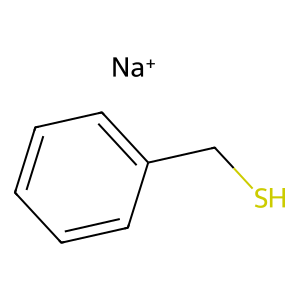 Cas:3492-64-6

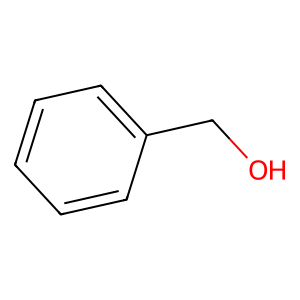 Cas:100-51-6
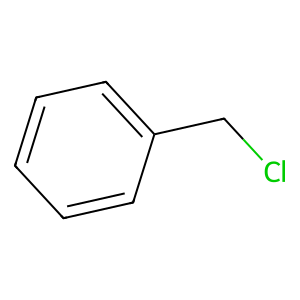 Cas:100-44-7

 Cas:2667-20-1