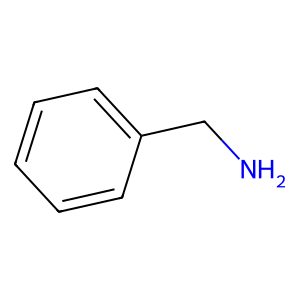
Benzylamine
CAS No.:
100-46-9
M. Wt:
107.153
M. Fa:
C7H9N
InChI Key:
WGQKYBSKWIADBV-UHFFFAOYSA-N
Appearance:
Colorless Liquid
Names and Identifiers of Benzylamine
CAS Number |
100-46-9 |
|---|---|
EC Number |
202-854-1 |
MDL Number |
MFCD00008106 |
IUPAC Name |
phenylmethanamine |
InChI |
InChI=1S/C7H9N/c8-6-7-4-2-1-3-5-7/h1-5H,6,8H2 |
InChIKey |
WGQKYBSKWIADBV-UHFFFAOYSA-N |
Canonical SMILES |
C1=CC=C(C=C1)CN |
UNII |
A1O31ROR09 |
UNSPSC Code |
12352100 |
Physical and chemical properties of Benzylamine
Acidity coefficient |
9.33(at 25℃) |
|---|---|
Boiling Point |
185 °C |
BRN |
741984 |
Decomposition |
When heated to decomposition it emits toxic fumes. |
Density |
Relative density (water = 1): 0.98 |
Exact Mass |
107.073502 |
explosive limit |
0.7-8.2%(V) |
Flash Point |
60 °C |
Index of Refraction |
MAX ABSORPTION: 255 NM (LOG E= 2.1); 262 NM (LOG E= 2.2); 270 NM (LOG E= 2.0); INDEX OF REFRACTION: 1.5401 @ 20 °C/D; SADTLER REFERENCE NUMBER: 866 (IR, PRISM); 170 (IR, GRATING) |
LogP |
1.09 |
Melting Point |
10 °C |
Merck |
14,1125 |
Molecular Formula |
C7H9N |
Molecular Weight |
107.153 |
Odor |
Weak amine-like odor |
pH |
pH = 11.6 in water at a concentration of 100 g/L |
PSA |
26.02000 |
Sensitivity |
Air Sensitive |
Solubility |
Solubility in water: miscible |
Stability |
Stability Combustible. Incompatible with strong oxidizing agents, strong acids. |
Storage condition |
Store below +30°C. |
Vapour Pressure |
Vapor pressure, Pa at 25 °C: 87 |
Water Solubility |
soluble |
Solubility of Benzylamine
| Solvent | Dissolution Behavior | Temperature Effect | pH Effect |
|---|---|---|---|
| Water | Readily soluble, miscible with water, forming a clear solution | Increasing temperature slightly improves solubility, but solubility is already high, so the effect is not significant | Forms salts under acidic conditions (e.g., benzylamine hydrochloride), significantly increasing solubility; solubility remains good under basic conditions |
| Ethanol | Readily soluble, completely miscible | Higher temperature promotes dissolution, but solubility is already good | More likely to form salts under acidic conditions, enhancing solubility; solubility remains stable under basic conditions |
| Acetone | Readily soluble, completely miscible | Increased temperature aids dissolution, though already highly soluble | Solubility increases under acidic conditions; no significant change under basic conditions |
| Diethyl ether | Soluble, but with lower solubility; may phase separate or form an emulsion | Raising temperature improves solubility, but remains limited | Solubility significantly increases under acidic conditions (due to salt formation); poor solubility under neutral/basic conditions |
| Chloroform | Soluble, with good solubility | Higher temperature aids dissolution | Solubility enhanced under acidic conditions; stable under basic conditions |
| Dichloromethane | Soluble, with good solubility | Increased temperature improves solubility | Similar to chloroform, acidic conditions favor better dissolution |
| Toluene | Slightly soluble or poorly soluble, may become cloudy or phase separate | Elevated temperature slightly improves solubility | Poor solubility under neutral or basic conditions; slightly improved under acidic conditions due to salt formation |
| Acetic acid | Readily soluble, completely miscible | Higher temperature promotes dissolution | Good solubility under acidic conditions; as an acid itself, it has strong interaction with benzylamine |
Routine testing items of Benzylamine
| Test Item | Common Testing Methods | Method Overview |
|---|---|---|
| Assay | Gas Chromatography (GC) | Uses a capillary column (e.g., DB-5 or HP-INNOWax) and a flame ionization detector (FID); quantification by internal or external standard method. Suitable for assay analysis of high-purity benzylamine. |
| Acid-Base Titration | Utilizes the basic nature of benzylamine, titrated with standardized hydrochloric acid solution using phenolphthalein or methyl red as indicator to calculate content. Suitable for determination of main component in crude products or raw pharmaceutical materials. | |
| Purity and Impurity Analysis | High-Performance Liquid Chromatography (HPLC) | Reverse-phase C18 column with UV detector (210–230 nm); mobile phase typically methanol-water or acetonitrile-water system, used to separate and quantify organic impurities. |
| Gas Chromatography-Mass Spectrometry (GC-MS) | Combines separation capability of GC with structural identification power of MS, used for identifying and characterizing trace impurities, degradation products, or residual solvents. | |
| Water Content | Karl Fischer Method | Either coulometric or volumetric method; accurately determines water content in samples, particularly important for hygroscopic substances. |
| Residual Solvents | Gas Chromatography (GC) | Headspace sampling is used to detect organic solvents possibly remaining from the benzylamine synthesis process (e.g., methanol, ethanol, acetone, toluene). |
| Appearance and Physical Characteristics | Visual Inspection | Observe color, clarity, presence of suspended matter or precipitate; normal appearance is colorless to pale yellow transparent liquid. |
| pH Value | pH Meter Measurement | Dissolve benzylamine in water or suitable solvent, then measure the pH of the solution using a calibrated pH meter to assess its alkalinity. |
| Density | Pycnometer Method or Digital Density Meter | Measures mass per unit volume at 20°C, used to evaluate purity and consistency of the substance. |
| Refractive Index | Refractometry | Measures refractive index at standard temperature (e.g., 20°C), used as a physical constant for identification and purity assessment. |
| Infrared Spectroscopic Identification | Fourier Transform Infrared Spectroscopy (FTIR) | Sample is prepared as a liquid film or KBr pellet; characteristic absorption peaks are measured (e.g., N-H stretching vibration around 3300–3400 cm⁻¹, aromatic C-H around 3030 cm⁻¹), used for structural confirmation. |
Safety Information of Benzylamine

Key Milestone of Benzylamine
| Time | Milestone | Description |
|---|---|---|
| 1870s | First synthesis | Benzylamine was first prepared in the late 19th century by German chemists through the reaction of benzyl halides (e.g., benzyl chloride) with ammonia, marking one of the earliest syntheses of aromatic amines. |
| Early 1900s | Fundamental chemical studies | Chemists systematically investigated benzylamine’s basicity, nucleophilicity, and reactivity in organic synthesis, establishing it as a prototypical primary amine. |
| 1930–1940s | Adoption as an organic-synthesis intermediate | Benzylamine became widely used to manufacture pharmaceuticals, dyes, and agrochemicals, serving as a precursor for nitrogen-containing heterocycles. |
| 1950s | Expansion in medicinal chemistry | The benzylamine motif was incorporated into numerous drug molecules, such as local anesthetics and antihistamines, to enhance lipophilicity and bioavailability. |
| 1960s | Use as a protecting-group strategy | Benzylamine derivatives (e.g., benzyloxycarbonyl, Cbz) were employed as amino-protecting groups in peptide synthesis, advancing polypeptide chemistry. |
| 1970–1980s | Industrial-scale production | Driven by the growth of fine chemicals, benzylamine was produced industrially via routes such as ammonolysis of benzyl chloride or reductive amination of benzaldehyde. |
| 1990s | Enzyme-inhibitor research | Benzylamine was identified as a weak inhibitor or substrate analogue of certain amine oxidases (e.g., monoamine oxidase, MAO), aiding neuropharmacological studies. |
| 2000s | Development of new materials and ligands | Benzylamine was utilized to synthesize metal–organic frameworks (MOFs), coordination polymers, and chiral catalyst ligands, broadening its role in materials science. |
| 2010s–present | Green synthesis and sustainable processes | Environmentally benign routes to benzylamine—such as catalytic hydrogenation of benzonitrile or biocatalytic reductions—have been developed to minimize by-products and energy consumption. |
Applications of Benzylamine
Benzylamine finds applications across multiple fields:
- Pharmaceuticals: It serves as an intermediate in the synthesis of various drugs and bioactive compounds.
- Agrochemicals: Used in the formulation of pesticides and herbicides.
- Dyes and Pigments: Acts as a precursor in dye manufacturing processes.
- Polymer Chemistry: Utilized in producing certain polymers and resins due to its reactivity with isocyanates and epoxides.
Interaction Studies of Benzylamine
Research indicates that benzylamine interacts with various biological systems:
- Enzyme Inhibition: Certain studies have shown that benzylamine can inhibit specific enzymes, which could lead to therapeutic applications but also necessitates caution due to potential side effects.
- Receptor Binding: As a trace amine, it may bind to receptors involved in neurotransmission, suggesting possible roles in mood regulation and neurological health.
Biological Activity of Benzylamine
Benzylamine exhibits various biological activities, including:
- Antimicrobial Properties: Some derivatives of benzylamine have shown effectiveness against certain bacterial strains, making them potential candidates for pharmaceutical applications.
- Neurotransmitter Function: Benzylamine acts as a trace amine and may influence neurotransmitter systems in the brain, although its precise role is still under investigation.
Physical sample testing spectrum (NMR) of Benzylamine

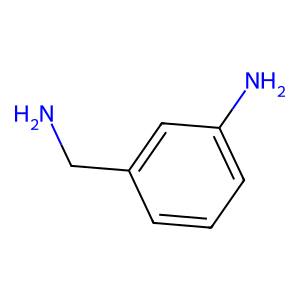 Cas:4403-70-7

 Cas:85600-11-9
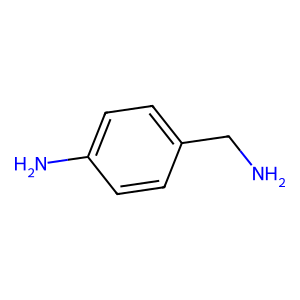 Cas:4403-71-8