
Benzyltrimethylammonium hydroxide
CAS No.:
100-85-6
M. Wt:
167.25
M. Fa:
C10H17NO
InChI Key:
NDKBVBUGCNGSJJ-UHFFFAOYSA-M
Appearance:
Colorless Liquid
Names and Identifiers of Benzyltrimethylammonium hydroxide
CAS Number |
100-85-6 |
|---|---|
EC Number |
202-895-5 |
MDL Number |
MFCD00008281 |
IUPAC Name |
benzyl(trimethyl)azanium;hydroxide |
InChI |
InChI=1S/C10H16N.H2O/c1-11(2,3)9-10-7-5-4-6-8-10;/h4-8H,9H2,1-3H3;1H2/q+1;/p-1 |
InChIKey |
NDKBVBUGCNGSJJ-UHFFFAOYSA-M |
Canonical SMILES |
C[N+](C)(C)CC1=CC=CC=C1.[OH-] |
UNII |
8P4488425W |
Physical and chemical properties of Benzyltrimethylammonium hydroxide
Boiling Point |
65°C |
|---|---|
BRN |
3917256 |
Density |
1.059 g/mL at 25 °C |
Exact Mass |
167.131012 |
explosive limit |
5.50-36.50% |
Exposure Limits |
ACGIH: TWA 200 ppm; STEL 250 ppm (Skin) OSHA: TWA 200 ppm(260 mg/m3) NIOSH: IDLH 6000 ppm; TWA 200 ppm(260 mg/m3); STEL 250 ppm(325 mg/m3) |
Flash Point |
60 °F |
H Bond Acceptors |
0 |
H Bond Donors |
0 |
Index of Refraction |
n20/D 1.43 |
LogP |
1.71600 |
Melting Point |
-98ºC |
Molecular Formula |
C10H17NO |
Molecular Weight |
167.25 |
PSA |
23.06000 |
Sensitivity |
Air Sensitive |
Solubility |
Miscible with alcohols, hydrocarbons, aromatic hydrocarbons and halogenated solvents. |
Storage condition |
Store below +30°C. |
Vapour Pressure |
0Pa at 25℃ |
Water Solubility |
Miscible with water, hydrocarbons, aromatic hydrocarbons and halogenated solvents. |
Safety Information of Benzyltrimethylammonium hydroxide


Applications of Benzyltrimethylammonium hydroxide
Benzyltrimethylammonium hydroxide finds diverse applications across various fields:
- Phase-Transfer Catalyst: Its primary application is as a phase-transfer catalyst in organic synthesis, facilitating reactions between immiscible phases.
- Antimicrobial Agent: Due to its biological activity, it is used in formulations aimed at controlling microbial growth.
- Chemical Synthesis: It plays a role in numerous chemical syntheses including polymerization processes and the production of fine chemicals.
Interaction Studies of Benzyltrimethylammonium hydroxide
Interaction studies involving benzyltrimethylammonium hydroxide have shown that it can interact with various biological membranes. These interactions are crucial for understanding its antimicrobial mechanisms. Research indicates that the compound can penetrate lipid bilayers, affecting membrane integrity and leading to cell death. Additionally, its interactions with other chemical agents can influence reaction pathways and product yields.
Physical sample testing spectrum (NMR) of Benzyltrimethylammonium hydroxide

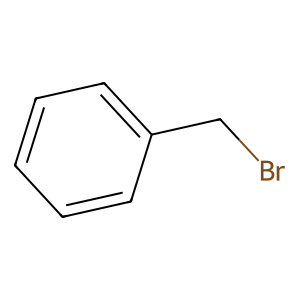 Cas:100-39-0

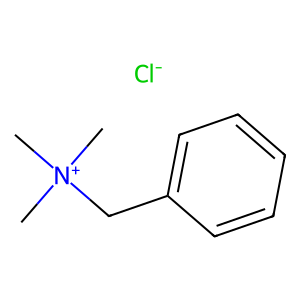 Cas:56-93-9

 Cas:7732-18-5