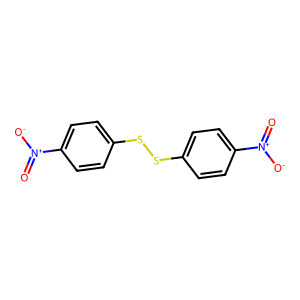
Bis(4-nitrophenyl) disulfide
Names and Identifiers of Bis(4-nitrophenyl) disulfide
CAS Number |
100-32-3 |
|---|---|
EC Number |
202-840-5 |
MDL Number |
MFCD00003573 |
IUPAC Name |
1-nitro-4-[(4-nitrophenyl)disulfanyl]benzene |
InChI |
InChI=1S/C12H8N2O4S2/c15-13(16)9-1-5-11(6-2-9)19-20-12-7-3-10(4-8-12)14(17)18/h1-8H |
InChIKey |
KWGZRLZJBLEVFZ-UHFFFAOYSA-N |
Canonical SMILES |
C1=CC(=CC=C1[N+](=O)[O-])SSC2=CC=C(C=C2)[N+](=O)[O-] |
UNII |
F16G70DEUU |
UNSPSC Code |
12352100 |
Physical and chemical properties of Bis(4-nitrophenyl) disulfide
Boiling Point |
478.8±30.0 °C at 760 mmHg |
|---|---|
Density |
1.5±0.1 g/cm3 |
Exact Mass |
307.992554 |
Flash Point |
243.4±24.6 °C |
Index of Refraction |
1.718 |
LogP |
4.59 |
Melting Point |
141 °C |
Molecular Formula |
C12H8N2O4S2 |
Molecular Weight |
308.333 |
PSA |
142.24000 |
Stability |
Stable. Incompatible with strong oxidizing agents, strong bases. |
Storage condition |
Sealed in dry,Room Temperature |
Vapour Pressure |
0.0±1.2 mmHg at 25°C |
Safety Information of Bis(4-nitrophenyl) disulfide


Applications of Bis(4-nitrophenyl) disulfide
Bis(4-nitrophenyl) disulfide finds applications across various fields:
- Chemical Reagent: It serves as a versatile reagent in organic synthesis, particularly in the formation of other sulfur-containing compounds.
- Antimicrobial Agent: Its biological properties make it a candidate for developing new antimicrobial agents.
- Research Tool: Used in studies related to redox reactions and thiol chemistry, it helps elucidate mechanisms involving sulfur compounds.
Interaction Studies of Bis(4-nitrophenyl) disulfide
Studies on bis(4-nitrophenyl) disulfide have focused on its interactions with biological molecules, particularly proteins and enzymes containing thiol groups. These interactions can lead to modifications that affect protein function, making it a useful tool in biochemical research. Investigations into its binding affinities and reaction kinetics provide insights into its potential therapeutic applications.
Biological Activity of Bis(4-nitrophenyl) disulfide
Research indicates that bis(4-nitrophenyl) disulfide exhibits biological activity, particularly in the realm of antimicrobial and anticancer properties. Its ability to generate reactive oxygen species may contribute to its cytotoxic effects against various cancer cell lines. Moreover, its interactions with thiol-containing biomolecules suggest potential applications in redox biology and therapeutic development.
Physical sample testing spectrum (NMR) of Bis(4-nitrophenyl) disulfide

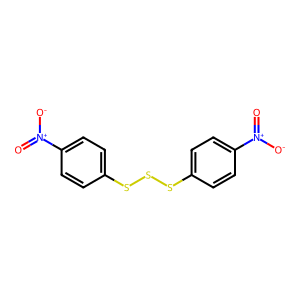 Cas:20057-76-5

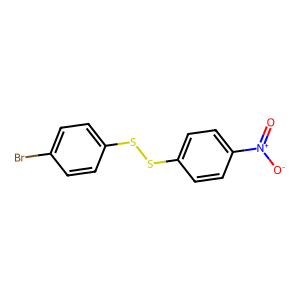 Cas:40897-58-3
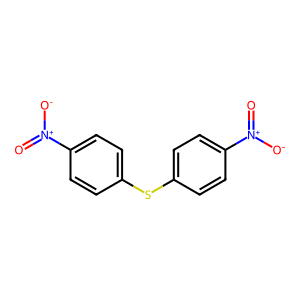 Cas:1223-31-0