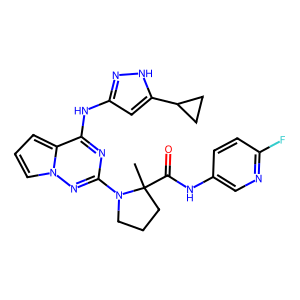
Bms-754807
CAS No.:
1001350-96-4
M. Wt:
461.495
M. Fa:
C23H24FN9O
InChI Key:
LQVXSNNAFNGRAH-QHCPKHFHSA-N
Appearance:
White Solid
Names and Identifiers of Bms-754807
CAS Number |
1001350-96-4 |
|---|---|
IUPAC Name |
(2S)-1-[4-[(5-cyclopropyl-1H-pyrazol-3-yl)amino]pyrrolo[2,1-f][1,2,4]triazin-2-yl]-N-(6-fluoropyridin-3-yl)-2-methylpyrrolidine-2-carboxamide |
InChI |
InChI=1S/C23H24FN9O/c1-23(21(34)26-15-7-8-18(24)25-13-15)9-3-10-32(23)22-28-20(17-4-2-11-33(17)31-22)27-19-12-16(29-30-19)14-5-6-14/h2,4,7-8,11-14H,3,5-6,9-10H2,1H3,(H,26,34)(H2,27,28,29,30,31)/t23-/m0/s1 |
InChIKey |
LQVXSNNAFNGRAH-QHCPKHFHSA-N |
Canonical SMILES |
CC1(CCCN1C2=NN3C=CC=C3C(=N2)NC4=NNC(=C4)C5CC5)C(=O)NC6=CN=C(C=C6)F |
Isomeric SMILES |
C[C@]1(CCCN1C2=NN3C=CC=C3C(=N2)NC4=NNC(=C4)C5CC5)C(=O)NC6=CN=C(C=C6)F |
UNII |
W9E3353E8J |
Physical and chemical properties of Bms-754807
Density |
1.6±0.1 g/cm3 |
|---|---|
Exact Mass |
461.208771 |
Index of Refraction |
1.795 |
LogP |
1.76 |
Molecular Formula |
C23H24FN9O |
Molecular Weight |
461.495 |
optical activity |
[α]/D -86 to -96°, c = 1 in methanol |
PSA |
116.13000 |
Storage condition |
-20℃ |
Solubility of Bms-754807
| Solvent | Dissolution Behavior | Temperature Effect | pH Effect |
|---|---|---|---|
| Water | Practically insoluble (< 0.1 mg/mL) | Slight improvement with temperature, but solubility remains very low | Solubility slightly improved under acidic conditions (pH < 4); degradation may occur under alkaline conditions |
| Ethanol | Slightly soluble (approximately 1–5 mg/mL), forms a clear solution | Solubility increases with temperature (e.g., better at 40–60°C) | Stable under neutral to weakly basic conditions; decomposition may occur under strong acid or base |
| DMSO (Dimethyl sulfoxide) | Freely soluble (> 20 mg/mL), forms a clear and transparent solution | Increased temperature significantly enhances solubility | Stable within neutral pH range; may become unstable or undergo hydrolysis under extreme pH conditions |
| Acetone | Slightly soluble (approximately 5–10 mg/mL), clear solution | Heating slightly improves solubility | Low sensitivity to pH, but slow degradation may occur under strong acidic or alkaline conditions |
| Acetonitrile | Moderately soluble (approximately 10–15 mg/mL), clear solution | Solubility increases with rising temperature | Stable under neutral conditions; degradation may be promoted under acidic conditions |
| DMF (N,N-Dimethylformamide) | Freely soluble (> 20 mg/mL), forms a stable solution | Solubility further increases at elevated temperatures | Generally stable, but side reactions may occur under high temperature and strong alkaline conditions |
| PBS buffer (pH 7.4) | Practically insoluble, tends to precipitate | Temperature increase provides limited improvement in solubility | Solubility varies with pH deviation; slightly increased in acidic buffers |
| 10% DMSO in water | Freely soluble (> 10 mg/mL), commonly used for in vitro experimental preparation | Good stability at 37°C | Relatively stable at neutral pH; avoid prolonged exposure to strong acids or bases |
Key Milestone of Bms-754807
| Time | Milestone Event | Description |
|---|---|---|
| 2008 | First Synthesis and Structure Publication | Bristol-Myers Squibb (BMS) researchers first synthesized BMS-754807 and published its chemical structure and preliminary activity data in the Journal of Medicinal Chemistry. The compound was identified as a potent, reversible dual inhibitor of the insulin-like growth factor 1 receptor (IGF-1R) and insulin receptor (IR). |
| 2009 | Clinical Pre-Study Validation of Antitumor Activity | Multiple in vitro and in vivo studies confirmed that BMS-754807 exhibited significant antiproliferative and pro-apoptotic effects in various tumor models, such as breast cancer, colon cancer, and osteosarcoma, supporting its potential as an anticancer drug. |
| 2010 | Initiation of Phase I Clinical Trial | BMS initiated the first-in-human Phase I clinical trial (NCT00881615) of BMS-754807, aiming to evaluate its safety, tolerability, pharmacokinetics, and preliminary efficacy in patients with advanced solid tumors. |
| 2011–2013 | Clinical Trial Data Published | Phase I clinical trial results showed that BMS-754807 had an acceptable safety profile but limited efficacy, and it caused hyperglycemia-related adverse events associated with its target. No significant objective responses were observed, limiting further development as a single-agent therapy. |
| 2014 and onwards | Shift to Combination Therapy and Mechanism Studies | Although it did not progress to later-stage clinical development, BMS-754807 has been widely used as a research tool compound to study the role of the IGF-1R/IR signaling pathway in tumor progression, drug resistance, and metabolic regulation, and to explore its potential for combination with other targeted therapies or chemotherapeutic agents. |
| Ongoing | Widely Used as a Research Tool | BMS-754807 is now used by numerous research institutions and pharmaceutical companies for basic research, helping to elucidate the mechanisms of action of IGF-1R inhibitors, biomarker development, and resistance mechanisms, and holds important reference value for the design of subsequent IGF-1R-targeted drugs. |
Applications of Bms-754807
This compound has potential applications in:
- Pharmaceutical Development: Due to its diverse biological activities, it could serve as a lead compound for developing new drugs targeting cancer or infectious diseases.
- Research Tools: Its unique structure allows it to be used in studies exploring enzyme interactions and molecular mechanisms of action.
Interaction Studies of Bms-754807
Interaction studies are crucial for understanding how this compound affects biological systems. Techniques such as:
- Molecular Docking: To predict how the compound binds to target proteins.
- In vitro Assays: To evaluate its effects on cell viability and proliferation.
- In vivo Studies: To assess pharmacokinetics and therapeutic efficacy in animal models .
Several compounds share structural similarities with (2S)-1-[4-[(5-cyclopropyl-1H-pyrazol-3-yl)amino]pyrrolo[2,1-f][1,2,4]triazin-2-yl]-N-(6-fluoropyridin-3-yl)-2-methylpyrrolidine-2-carboxamide. These include:
| Compound Name | Structural Features | Biological Activity |
|---|---|---|
| 5-Cyclopropylpyrazole | Contains a cyclopropyl group | Antimicrobial |
| Pyrrolidine derivatives | Similar ring structure | Anticancer |
| Triazine-based compounds | Shared triazine core | Antiviral |
Biological Activity of Bms-754807
The biological activity of this compound is likely linked to its structural features. Compounds with similar structures often exhibit:
- Anticancer Properties: Many triazine derivatives have been studied for their ability to inhibit cancer cell proliferation.
- Antimicrobial Activity: Pyrazole-containing compounds have shown promise as antimicrobial agents due to their ability to disrupt bacterial cell functions.
- Neuroprotective Effects: Some derivatives may interact with neurotransmitter systems, offering potential in treating neurodegenerative diseases .
Physical sample testing spectrum (NMR) of Bms-754807

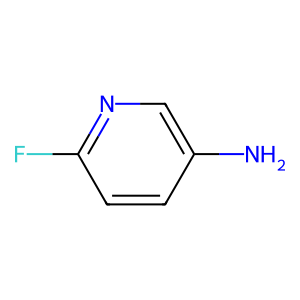 Cas:1827-27-6
