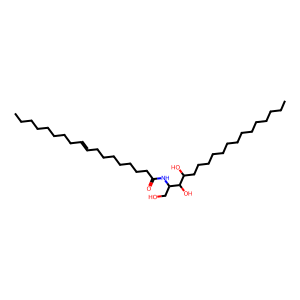
Ceramide np
CAS No.:
100403-19-8
M. Wt:
397.63488
M. Fa:
C24H47NO3
InChI Key:
ATGQXSBKTQANOH-UWVGARPKSA-N
Appearance:
Crystalline Solid
Names and Identifiers of Ceramide np
CAS Number |
100403-19-8 |
|---|---|
EC Number |
812-963-1 |
IUPAC Name |
(Z)-N-[(2S,3S,4R)-1,3,4-trihydroxyoctadecan-2-yl]octadec-9-enamide |
InChI |
InChI=1S/C36H71NO4/c1-3-5-7-9-11-13-15-17-18-19-21-23-25-27-29-31-35(40)37-33(32-38)36(41)34(39)30-28-26-24-22-20-16-14-12-10-8-6-4-2/h17-18,33-34,36,38-39,41H,3-16,19-32H2,1-2H3,(H,37,40)/b18-17-/t33-,34+,36-/m0/s1 |
InChIKey |
ATGQXSBKTQANOH-UWVGARPKSA-N |
Canonical SMILES |
CCCCCCCCCCCCCCC(C(C(CO)NC(=O)CCCCCCCC=CCCCCCCCC)O)O |
Isomeric SMILES |
CCCCCCCCCCCCCC[C@H]([C@H]([C@H](CO)NC(=O)CCCCCCC/C=C\CCCCCCCC)O)O |
Physical and chemical properties of Ceramide np
Molecular Formula |
C24H47NO3 |
|---|---|
Molecular Weight |
397.63488 |
Storage condition |
-20°C |
Solubility of Ceramide np
| Solvent | Dissolution Behavior | Temperature Effect | pH Effect |
|---|---|---|---|
| Ethanol | Slightly soluble to soluble (approximately 1–5% w/v), forms a clear solution | Increased temperature significantly improves solubility | Stable under neutral to weakly alkaline conditions; acidic conditions may promote hydrolysis |
| Propylene Glycol | Soluble, good solubility (>10% w/v) | Higher temperature aids dissolution | Tolerates a wide pH range; stability decreases under strong acidic or alkaline conditions |
| Dimethyl Sulfoxide (DMSO) | Highly soluble (>20% w/v), excellent solubility | Solubility further increases with temperature | Good stability, but prolonged exposure to extreme pH may cause degradation |
| Diethyl Ether | Practically insoluble or slightly soluble | Solubility slightly increases with temperature | Unaffected by common pH changes, but prone to oxidation |
| Chloroform | Soluble, good solubility | Solubility increases with temperature | Relatively stable toward acids and bases; avoid contact with strong alkalis |
| Methanol | Soluble (approximately 5–10% w/v) | Increased temperature promotes dissolution | Better in neutral or weakly alkaline environments; may hydrolyze under strongly acidic conditions |
| Water | Practically insoluble (<0.1% w/v), forms emulsion or colloid | High temperature slightly improves dispersibility, but not significantly | More stable under weakly acidic or neutral conditions; prone to hydrolysis in alkaline conditions |
| Glycerol | Slightly soluble, requires heating to aid dissolution | Heating significantly improves solubility | Good stability, but may degrade under high temperature and alkaline conditions |
| N,N-Dimethylformamide (DMF) | Soluble (>15% w/v) | Solubility increases with temperature | Stable under neutral to weakly alkaline conditions; may be unstable under strong acidic conditions |
Routine testing items of Ceramide np
| Test Item | Common Detection Methods | Method Overview |
|---|---|---|
| Ceramides | High-Performance Liquid Chromatography (HPLC) | Uses reversed-phase HPLC to separate ceramide species, combined with UV or evaporative light scattering detection for quantitative analysis. Suitable for separation and determination of various ceramide homologs. |
| Ceramides | Ultra-High Performance Liquid Chromatography-Tandem Mass Spectrometry (UHPLC-MS/MS) | A high-resolution, highly sensitive method that enables qualitative and quantitative analysis of ceramide molecules via mass spectrometry. Particularly suitable for detecting trace levels of ceramides in complex matrices. |
| Ceramides | Thin-Layer Chromatography (TLC) | Used for preliminary separation and identification of ceramides. Simple to operate and low-cost, but has lower sensitivity and resolution. Mostly used for qualitative or semi-quantitative analysis. |
| Ceramides | Gas Chromatography-Mass Spectrometry (GC-MS) | Requires derivatization of ceramides prior to analysis. Applicable for volatile or convertible derivatives. Less commonly used due to complex sample preparation and potential structural degradation. |
| Ceramides | Nuclear Magnetic Resonance Spectroscopy (NMR) | Provides detailed structural information of ceramide molecules, useful for structural confirmation and purity assessment. However, it requires expensive equipment and has relatively low sensitivity, so it is typically used as a supplementary technique. |
| Ceramides | UV-Visible Spectrophotometry | An indirect measurement method, often combined with colorimetric reactions (e.g., sphingolipid-specific staining) to estimate total ceramide content. Simple to perform but lacks specificity. |
Key Milestone of Ceramide np
| Year | Milestone Event | Description |
|---|---|---|
| 1884 | First Discovery | German chemist Johann Ludwig Wilhelm Thudichum first isolated and named "ceramide" (Ceramide) while studying the lipid components of brain tissue. The name comes from the Latin "cera" (wax) and the Greek "amide" (amide), due to its waxy nature and amide structure. |
| 1920s–1930s | Initial Structural Elucidation | Scientists gradually confirmed that ceramide consists of a sphingosine backbone linked to a fatty acid via an amide bond, making it a core structural unit of sphingolipids. |
| 1940s–1950s | Initial Elucidation of Biosynthetic Pathways | Research revealed that ceramide is a central molecule in sphingolipid metabolism, capable of being converted into complex sphingolipids such as sphingomyelin and cerebrosides, playing a key role in cell membrane structure. |
| 1980s | Discovery of Signaling Functions | Scientists discovered that ceramide is not only a structural lipid but also acts as a second messenger involved in cellular stress, apoptosis, aging, and other signaling pathways, particularly playing a key role in tumor necrosis factor (TNF)-induced and radiation-induced cell death. |
| 1990s | Confirmation of Skin Barrier Function | Studies confirmed that ceramide is the main component of intercellular lipids in the stratum corneum of the skin (accounting for about 50%), essential for maintaining the integrity of the skin barrier and preventing water loss. Ceramide deficiency is closely related to skin conditions such as atopic dermatitis and psoriasis. |
| 1990s–2000s | Rise of Cosmetic Applications | Due to its moisturizing and barrier-repairing properties, ceramide has been widely added to skincare products, becoming a key ingredient in high-end moisturizing, anti-sensitive, and repairing products. |
| 2000s–2010s | Development of Synthetic and Plant-derived Ceramides | To address ethical and stability issues with animal-derived ceramides, scientists developed yeast fermentation, plant extraction (such as rice bran and wheat), and chemically synthesized ceramide analogs (such as Ceramide NP, AP, EOP, etc.), promoting their large-scale application in cosmetics and medicine. |
| 2010s–Present | Exploration of Therapeutic Potential | Ceramide metabolic abnormalities have been associated with various diseases, including insulin resistance, cardiovascular diseases, neurodegenerative diseases, and cancer. Drugs targeting ceramide synthases (such as CerS) are emerging as potential therapeutic strategies, currently in preclinical or early clinical research stages. |
| 2020s | Precision Skincare and Personalized Applications | With the development of skin lipidomics, personalized skincare approaches based on individual ceramide profiles are gradually emerging, driving the development of customized skincare products and skin health assessment technologies. |
Physical sample testing spectrum (NMR) of Ceramide np
