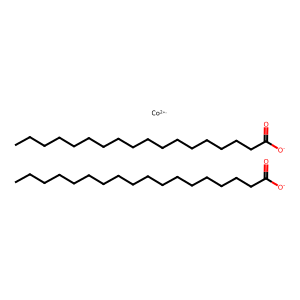
Cobalt(II) stearate
CAS No.:
1002-88-6
M. Wt:
342.40300
M. Fa:
C18H35CoO2+
InChI Key:
AMFIJXSMYBKJQV-UHFFFAOYSA-L
Appearance:
Black Solid
Names and Identifiers of Cobalt(II) stearate
CAS Number |
1002-88-6 |
|---|---|
EC Number |
237-016-4 |
IUPAC Name |
cobalt(2+);octadecanoate |
InChI |
InChI=1S/2C18H36O2.Co/c2*1-2-3-4-5-6-7-8-9-10-11-12-13-14-15-16-17-18(19)20;/h2*2-17H2,1H3,(H,19,20);/q;;+2/p-2 |
InChIKey |
AMFIJXSMYBKJQV-UHFFFAOYSA-L |
Canonical SMILES |
CCCCCCCCCCCCCCCCCC(=O)[O-].CCCCCCCCCCCCCCCCCC(=O)[O-].[Co+2] |
UNII |
000J930IO1 |
Physical and chemical properties of Cobalt(II) stearate
Boiling Point |
359.4ºC at 760 mmHg |
|---|---|
Density |
1.71 |
Exact Mass |
342.19700 |
Exposure Limits |
ACGIH: TWA 10 mg/m3; TWA 3 mg/m3 |
Flash Point |
162.4ºC |
LogP |
4.99780 |
Melting Point |
109-112ºC(lit.) |
Molecular Formula |
C18H35CoO2+ |
Molecular Weight |
342.40300 |
PSA |
40.13000 |
RTECS |
RG1212000 |
Storage condition |
under inert gas (nitrogen or Argon) at 2-8°C |
Vapour Pressure |
8.58E-06mmHg at 25°C |
Water Solubility |
Insoluble in water. |
λmax |
275nm(MCH)(lit.) |
Solubility of Cobalt(II) stearate
| Solvent | Dissolution Behavior | Temperature Effect | pH Effect |
|---|---|---|---|
| Water | Almost insoluble | Increasing temperature shows no significant improvement in solubility | May undergo partial hydrolysis under acidic conditions, but remains insoluble; still insoluble under alkaline conditions |
| Ethanol | Slightly soluble or poorly soluble | Heating slightly increases solubility | Minimal pH influence, as ethanol is a non-aqueous solvent |
| Toluene | Soluble, forming a homogeneous solution | Solubility increases with rising temperature | Essentially unaffected by pH (non-aqueous system) |
| Acetone | Insoluble or extremely poorly soluble | Increasing temperature has negligible effect | No significant pH effect |
| Chloroform | Soluble | Solubility increases with temperature rise | No pH influence |
| Diethyl ether | Slightly soluble | Mild heating promotes dissolution | No pH effect |
| Mineral oil | Can be dispersed or partially dissolved, commonly used in lubricants | Increasing temperature aids dispersion and dissolution | No pH effect |
| Isopropanol | Difficult to dissolve | Heating improves solubility slightly | Effect is insignificant |
Safety Information of Cobalt(II) stearate


Key Milestone of Cobalt(II) stearate
| Time | Event / Milestone | Background & Significance |
|---|---|---|
| Mid-19th century (ca. 1840s–1860s) | First synthesis and study of fatty-acid metal salts, including stearates | As organic chemistry and saponification research advanced, scientists began systematically preparing metal salts of fatty acids. Stearic acid (octadecanoic acid), a common fatty acid, was likely converted into its cobalt salt in laboratories during this period, although no specific literature records its isolated application. |
| Late 19th – early 20th century | Early trials as a drier in oil-based paints | With the growth of the paint industry, cobalt salts (e.g., cobalt naphthenate, cobalt stearate) were found to accelerate oxidative polymerization of drying oils (e.g., linseed oil) thanks to their strong oxidative catalytic power, thereby shortening drying times. Cobalt stearate, owing to its good lipophilicity and high stability, was included in these investigations. |
| 1920s–1930s | Industrial-scale production and widespread adoption in coatings | Cobalt stearate became a standard “surface-drying” siccative in oil paints and varnishes, establishing itself as one of the benchmark additives in the coatings industry. Manufacturing processes (e.g., double-decomposition between stearic acid and a cobalt salt) reached maturity. |
| 1940s–1950s | Expansion into rubber and plastics as stabilizer and activator | Cobalt stearate was adopted as a vulcanization activator for synthetic rubbers such as chloroprene rubber (CR) and as a component of heat stabilizers for polyvinyl chloride (PVC), improving processing stability. |
| 1970s–1980s | Environmental and health concerns trigger substitution research | Potential toxicity of cobalt compounds (skin sensitization, environmental accumulation) led to restrictions on their use in consumer coatings in Europe and North America, spurring the development of low-cobalt or cobalt-free driers (e.g., zirconium-, calcium-, or iron-based systems). Nevertheless, cobalt stearate continued to be used in industrial coatings and niche applications. |
| 1990s–2000s | Emerging applications in specialty materials | Cobalt stearate served as a precursor for cobalt-based nanomaterials, catalysts, or magnetic materials. It also persisted as an additive in lubricating greases, printing inks, and—under restricted conditions—cosmetics. |
| 2010s–present | Strict regulation under REACH drives specialization | Under the EU’s REACH regulation, cobalt stearate is classified as a substance requiring authorization for certain uses (e.g., coatings), pushing the industry toward safer alternatives. Nonetheless, it remains irreplaceable in high-performance industrial coatings and as a precursor for electronic materials. |
Applications of Cobalt(II) stearate
Cobalt(II) stearate has diverse applications across various industries:
- Rubber Industry: It serves as a high-performance bonding agent for natural rubber and synthetic rubbers, enhancing adhesion to metals such as brass and zinc-plated steel.
- Catalyst in Organic Synthesis: Utilized in polymerization reactions and other organic synthesis processes.
- Pigment Production: Cobalt compounds are known for their vibrant colors, making them useful in pigments for paints and ceramics.
Interaction Studies of Cobalt(II) stearate
Studies on the interactions of cobalt(II) stearate with other compounds reveal its potential use as a stabilizer and bonding agent. Its ability to enhance adhesion properties makes it valuable in composite materials where metal-to-rubber bonding is critical. Additionally, investigations into its biological interactions highlight both its essential role in certain metabolic pathways and the potential health risks associated with exposure to cobalt compounds.
Physical sample testing spectrum (NMR) of Cobalt(II) stearate
