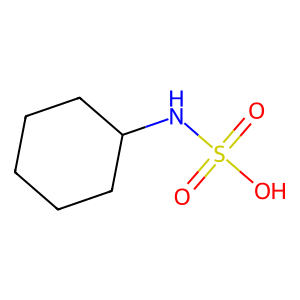
Cyclamic acid
CAS No.:
100-88-9
M. Wt:
179.23700
M. Fa:
C6H13NO3S
InChI Key:
HCAJEUSONLESMK-UHFFFAOYSA-N
Appearance:
White Solid
Names and Identifiers of Cyclamic acid
CAS Number |
100-88-9 |
|---|---|
EC Number |
202-898-1 |
MDL Number |
MFCD00065234 |
IUPAC Name |
cyclohexylsulfamic acid |
InChI |
InChI=1S/C6H13NO3S/c8-11(9,10)7-6-4-2-1-3-5-6/h6-7H,1-5H2,(H,8,9,10) |
InChIKey |
HCAJEUSONLESMK-UHFFFAOYSA-N |
Canonical SMILES |
C1CCC(CC1)NS(=O)(=O)O |
UNII |
HN3OFO5036 |
UNSPSC Code |
12352100 |
Physical and chemical properties of Cyclamic acid
Acidity coefficient |
pKa 2.28(H2O t=RT c=0.056) (Uncertain) |
|---|---|
Boiling Point |
332.48℃[at 101 325 Pa] |
BRN |
2208885 |
Decomposition |
When heated to decomposition it emits toxic fumes of sulfoxides and nitroxides. /Calcium cyclamate dihydrate/ |
Density |
1.32g/cm3 |
Exact Mass |
179.06200 |
Index of Refraction |
1.529 |
LogP |
-1.610 (est) |
Melting Point |
169 - 170 °C |
Merck |
14,2703 |
Molecular Formula |
C6H13NO3S |
Molecular Weight |
179.23700 |
Odor |
Odorless |
pH |
pH of 10% aqueous solution: 0.8-1.6 |
PSA |
74.78000 |
Solubility |
1000000 mg/L @ 25 °C (exp) |
Storage condition |
Refrigerator |
Vapour Pressure |
5.31X10⁻⁷ mm Hg at 25 °C (est) |
Water Solubility |
133g/L |
Solubility of Cyclamic acid
| Solvent | Dissolution Behavior | Effect of Temperature | Effect of pH |
|---|---|---|---|
| Water | Slightly soluble, low solubility | Increased temperature slightly improves solubility | Solubility significantly increases under alkaline conditions (e.g., forming sodium cyclamate); decreases under acidic conditions, where precipitation tends to occur |
| Ethanol | Partially soluble | Solubility moderately increases with rising temperature | Minimal pH effect, though solubility remains limited when in molecular form |
| Methanol | Soluble | Solubility increases with rising temperature | Limited influence, although strong acids or bases may cause decomposition or reactions |
| Acetone | Almost insoluble | Temperature changes have negligible impact on solubility | Essentially unaffected by pH due to extremely low solubility |
| Diethyl ether | Insoluble | Remains poorly soluble even at higher temperatures | No significant pH effect, as it is nearly insoluble in this solvent |
| Chloroform | Insoluble or very slightly soluble | No significant improvement with increased temperature | pH effect is negligible |
Safety Information of Cyclamic acid

Key Milestone of Cyclamic acid
| Year | Milestone Event | Description |
|---|---|---|
| 1937 | Discovery | American graduate student Michael Sveda at the University of Illinois accidentally tasted its sweetness while synthesizing anti-malaria drugs, becoming the first to discover the sweet properties of cyclamate. |
| 1949–1950 | Industrial Production Begins | German and American companies (such as Hoechst and Abbott) began industrial production of cyclamate. Due to its sweetness being 30–50 times that of sucrose, low cost, and good stability, it was quickly adopted in the food industry. |
| 1950s–1960s | Global Widespread Use | Cyclamate was widely used as a low-calorie sweetener in sugar-free beverages, chewing gum, desserts, medicines, and diabetic foods, especially popular in Europe, Japan, and Latin America. |
| 1966 | First Safety Concerns | Swedish scientists reported a link between long-term cyclamate intake in rats and increased bladder cancer rates, raising initial safety concerns, though not widely accepted at the time. |
| 1969 | Banned by the US FDA | The U.S. Food and Drug Administration (FDA) banned cyclamate as a food additive based on a rat study (a 10:1 mixture of cyclamate and saccharin caused bladder cancer), marking a turning point in global regulation. |
| 1970s–1980s | Other Countries Follow with Bans or Restrictions | Countries such as Canada, the UK, and Australia successively banned or restricted the use of cyclamate in food, significantly reducing its global usage. |
| 1980s–1990s | Scientific Controversy and Re-evaluation | Subsequent studies indicated that cyclamate itself does not produce carcinogens in the human body, and the rat bladder cancer mechanism (urine pH, high dosage, species-specific factors) does not apply to humans. Some countries (e.g., EU) began re-evaluating its safety. |
| 1996 | EU Reassessment (Partial Reauthorization) | The European Food Safety Authority (EFSA's predecessor) allowed cyclamate to be used in certain countries (e.g., Germany, France) at limited doses in specific foods (e.g., low-calorie beverages), but without a unified EU-wide approval. |
| 2000s–2010s | Some Countries Resume Use | Countries such as Japan, Mexico, Russia, and China continued to permit cyclamate as a food additive (in China, according to GB 2760 standard, it is allowed in beverages, pastries, etc., with maximum usage of 0.25–0.65 g/kg). |
| 2011 | JECFA Reassessment | The Joint FAO/WHO Expert Committee on Food Additives (JECFA) set the acceptable daily intake (ADI) of cyclamate at 11 mg/kg body weight, confirming its safety when consumed within limits. |
| 2020s | Continued Use as a Blended Sweetener Component | Cyclamate continues to be used in some countries (especially in Asia and Latin America), often blended with saccharin, aspartame, etc., in low-cost sugar-free products, although it remains restricted in major Western markets. |
Applications of Cyclamic acid
Cyclamic acid and its salts have diverse applications:
- Food Industry: Primarily used as a non-nutritive sweetener in various food products, often blended with other sweeteners like saccharin to mask off-tastes.
- Pharmaceuticals: Employed as a flavoring agent in medications and dietary supplements.
- Chemical Industry: Acts as a catalyst in the production of paints and plastics due to its chemical properties.
Interaction Studies of Cyclamic acid
Research on cyclamic acid interactions has primarily focused on its metabolic pathways and potential health effects. Studies indicate that intestinal bacteria can metabolize cyclamate back into cyclohexylamine, which raises concerns about chronic toxicity. Furthermore, interactions with other artificial sweeteners have been explored to understand their combined effects on taste perception and potential health outcomes.
Similar Compounds: ComparisonCyclamic acid shares similarities with several other compounds within the sulfamic acid family and artificial sweeteners. Here are some comparable compounds:
| Compound Name | Structure | Sweetness Relative to Sucrose | Notes |
|---|---|---|---|
| Saccharin | C7H5NO3S | 300-500 times | One of the oldest artificial sweeteners; often used in combination with cyclamate. |
| Aspartame | C14H18N2O5 | 200 times | A dipeptide sweetener that is widely used; stable under heat. |
| Sucralose | C12H19Cl3O8 | 600 times | Derived from sucrose; stable at high temperatures and used in cooking. |
| Acesulfame Potassium | C4H4KNO4S | 200 times | Often used alongside other sweeteners; stable under heat. |
Physical sample testing spectrum (NMR) of Cyclamic acid

 Cas:2211-64-5

 Cas:1122-60-7
 Cas:108-91-8