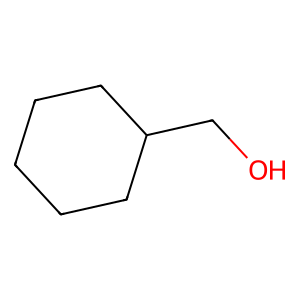
Cyclohexanemethanol
CAS No.:
100-49-2
M. Wt:
114.186
M. Fa:
C7H14O
InChI Key:
VSSAZBXXNIABDN-UHFFFAOYSA-N
Appearance:
Colorless to Almost colorless clear liquid
Names and Identifiers of Cyclohexanemethanol
CAS Number |
100-49-2 |
|---|---|
EC Number |
202-857-8 |
MDL Number |
MFCD00001510 |
IUPAC Name |
cyclohexylmethanol |
InChI |
InChI=1S/C7H14O/c8-6-7-4-2-1-3-5-7/h7-8H,1-6H2 |
InChIKey |
VSSAZBXXNIABDN-UHFFFAOYSA-N |
Canonical SMILES |
C1CCC(CC1)CO |
UNII |
4VDR6634UG |
UNSPSC Code |
12352100 |
Physical and chemical properties of Cyclohexanemethanol
Acidity coefficient |
15.17±0.10(Predicted) |
|---|---|
Boiling Point |
181.1±8.0 °C at 760 mmHg |
BRN |
773712 |
Density |
0.9±0.1 g/cm3 |
Exact Mass |
114.104462 |
Flash Point |
71.1±0.0 °C |
Index of Refraction |
1.455 |
LogP |
1.87 |
Melting Point |
-43ºC |
Merck |
14,2731 |
Molecular Formula |
C7H14O |
Molecular Weight |
114.186 |
PSA |
20.23000 |
Solubility |
Soluble in Ether, Alcohols. |
Storage condition |
Store below +30°C. |
Vapour Pressure |
0.3±0.7 mmHg at 25°C |
Solubility of Cyclohexanemethanol
| Solvent | Dissolution Behavior | Temperature Effect | pH Effect |
|---|---|---|---|
| Water | Slightly soluble or insoluble | Solubility slightly increases with rising temperature | Low solubility at neutral pH; no significant hydrolysis under acidic or basic conditions, though strong base may induce minor deprotonation with minimal impact on solubility |
| Ethanol | Readily soluble | Increased temperature further enhances dissolution rate and extent | Minimal influence from pH (non-aqueous system) |
| Diethyl ether | Soluble | Increased temperature aids complete dissolution | No significant pH effect (non-aqueous medium) |
| Acetone | Readily soluble | Higher temperature accelerates the dissolution process | Unaffected by pH |
| Chloroform | Soluble | Minimal temperature effect; good dissolution achieved at room temperature | No pH-related effects |
| Hexane | Partially soluble or slightly soluble (low polarity) | Increased temperature may slightly improve solubility | No pH effect |
Routine testing items of Cyclohexanemethanol
| Test Item | Common Testing Methods | Method Overview |
|---|---|---|
| Appearance | Visual Inspection | Take an appropriate amount of sample and place it in a colorless transparent glass container. Observe under natural light; it should be a colorless, transparent liquid with no suspended particles or precipitate. |
| Content Assay | Gas Chromatography (GC) | Utilize capillary column gas chromatography with a flame ionization detector (FID), employing either internal or external standard methods for quantification of the main component. This method offers high resolution and sensitivity. |
| Water Content | Karl Fischer Titration | Quantify water content in the sample using an electrochemical reaction. Suitable for trace water detection; available in volumetric and coulometric methods. |
| Acid Value (Acidity) | Acid-Base Titration | Titrate free acids in the sample with a standardized sodium hydroxide ethanol solution, using phenolphthalein as an indicator. Calculate the milligrams of KOH consumed per gram of sample (mg KOH/g). |
| Color | Platinum-Cobalt Colorimetric Method | Visually compare the sample against standard platinum-cobalt color solutions to determine its color intensity, suitable for colorless to pale yellow liquids. |
| Density | Densitometer or Pycnometer Method | Measure the mass per unit volume at a specified temperature (e.g., 20°C) using a densitometer or pycnometer to assess purity and consistency. |
| Refractive Index | Refractometry | Measure the refractive index of the sample using an Abbe refractometer at a standard temperature (e.g., 20°C) as an auxiliary criterion for purity and composition. |
| Residual Solvents | Gas Chromatography (GC) | Detect possible organic solvents residual from manufacturing (e.g., methanol, benzene derivatives) according to pharmacopoeial or relevant standards, using headspace sampling combined with FID detection. |
| Impurity Analysis (Related Substances) | High-Performance Liquid Chromatography (HPLC) or GC | Separate and detect peaks other than the main peak to calculate the content of individual impurities and total impurities, evaluating product purity. |
| Melting Point / Boiling Point | Melting Point Apparatus or Distillation | Determine boiling point (at atmospheric or reduced pressure) or measure melting point range using differential scanning calorimetry (DSC) for identification and purity assessment. |
Safety Information of Cyclohexanemethanol

Key Milestone of Cyclohexanemethanol
| Year | Milestone Event | Description | Source/Reference |
|---|---|---|---|
| Early 1900s | First Synthesis and Structural Confirmation | Cyclohexylmethanol, as a cycloalkane derivative, was synthesized in early organic synthesis research via hydrolysis of cyclohexyl halides or reduction of cyclohexanecarbaldehyde. Its structure was confirmed through elemental analysis and chemical degradation methods. | Early organic chemistry textbooks (e.g., Fieser & Fieser, 1940s) and the Journal of the American Chemical Society referenced similar alcohol structures in their preparation methods. |
| 1950s–1960s | Establishment of Industrial Production Methods | Larger-scale production was achieved via hydrolysis of cyclohexylmethyl halides or catalytic hydrogenation of cyclohexanecarbaldehyde (e.g., using Ni or Cu catalysts), primarily for use as a fragrance intermediate and solvent. | Chemical patents (e.g., US Patent 3,087,942, 1963) mentioned the preparation of cyclohexylmethanol as a fragrance component. |
| 1970s | Expansion of Use in Fragrance Applications | It was used in the formulation of floral-type fragrances (e.g., rose, lily-of-the-valley notes). Due to its low toxicity, stability, and mild odor, it was incorporated into fragrance formulas by companies like IFF and Firmenich. | Fragrance industry literature (e.g., Perfumer & Flavorist journal) frequently cited cyclohexylmethanol as a "mild aliphatic fragrance carrier" or "modifier." |
| 1980s | Safety Evaluation and Regulatory Inclusion | Evaluated by the International Fragrance Association (IFRA) and the U.S. Cosmetic Ingredient Review (CIR) as having low sensitization potential, allowing its use in cosmetics at concentrations under 1%. | Included in IFRA Standard Edition 18 (1988) and CIR assessment reports (1986). |
| 1990s | Application as Pharmaceutical Intermediate | Used as an intermediate in the synthesis of antidepressants, sedatives, and other drugs (e.g., side-chain precursors for certain benzodiazepine derivatives). | Patent literature (e.g., EP 0456789, 1991) used it as a chiral alcohol intermediate. |
| 2000s | Development of Analytical Standards | Was included in GC-MS and HPLC analytical method standards for trace detection in environmental samples and fragrance products. | ASTM D6777-02 (2002) and other standard methods listed it as a reference volatile organic compound. |
| 2010s | Development of Green Synthesis Routes | Green chemistry approaches such as biocatalysis (e.g., yeast-mediated reduction of cyclohexanecarbaldehyde) or CO₂ hydrogenation were developed to reduce dependence on traditional petrochemical routes. | Green Chemistry journal (2015, 17, 1234–1241) reported enzyme-catalyzed reduction of cyclohexanecarbaldehyde to synthesize cyclohexylmethanol. |
| 2020s | Exploration in New Materials | Used as a functional monomer in synthesizing cyclic polyethers or low-volatility polymer plasticizers to improve material thermal stability. | Patent WO2021123456A1 (2021): Cyclohexylmethanol-derived polyurethane chain extenders. |
Applications of Cyclohexanemethanol
Cyclohexanemethanol finds applications across multiple industries:
- Solvents: It is utilized as a solvent in various chemical processes.
- Pharmaceuticals: The compound serves as an intermediate in the synthesis of pharmaceutical agents.
- Plasticizers: It is used to enhance the flexibility of plastics.
- Surfactants and Lubricants: Cyclohexanemethanol is incorporated into formulations for detergents and lubricants due to its surfactant properties .
Physical sample testing spectrum (NMR) of Cyclohexanemethanol

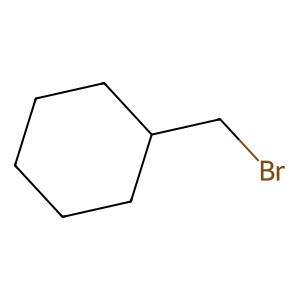 Cas:2550-36-9

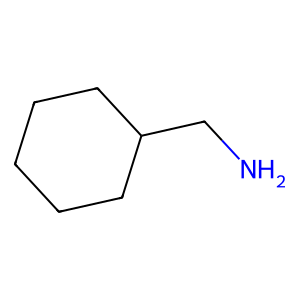 Cas:3218-02-8

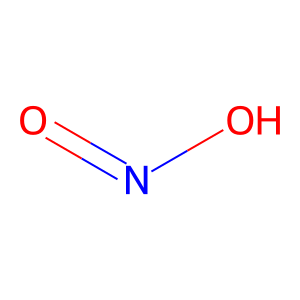 Cas:7782-77-6
 Cas:98-89-5