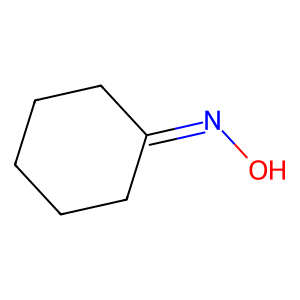
Cyclohexanone oxime
CAS No.:
100-64-1
M. Wt:
113.158
M. Fa:
C6H11NO
InChI Key:
VEZUQRBDRNJBJY-UHFFFAOYSA-N
Appearance:
White to Tan Solid
Names and Identifiers of Cyclohexanone oxime
CAS Number |
100-64-1 |
|---|---|
EC Number |
202-874-0 |
IUPAC Name |
N-cyclohexylidenehydroxylamine |
InChI |
InChI=1S/C6H11NO/c8-7-6-4-2-1-3-5-6/h8H,1-5H2 |
InChIKey |
VEZUQRBDRNJBJY-UHFFFAOYSA-N |
Canonical SMILES |
C1CCC(=NO)CC1 |
UNII |
2U60L00CGF |
Physical and chemical properties of Cyclohexanone oxime
Acidity coefficient |
12.42±0.20(Predicted) |
|---|---|
Boiling Point |
206-210 °C |
BRN |
1616769 |
Density |
1.1±0.1 g/cm3 |
Exact Mass |
113.084061 |
Flash Point |
112.4±8.0 °C |
Index of Refraction |
1.529 |
LogP |
1.12 |
Melting Point |
89-90 °C |
Molecular Formula |
C6H11NO |
Molecular Weight |
113.158 |
PSA |
32.59000 |
Solubility |
SOL IN WATER, ALCOHOL, ETHER, METHYL ALCOHOL |
Stability |
Stable. Combustible. Incompatible with strong oxidizing agents. Reacts violently with fuming sulfuric acid at elevated temperature. |
Storage condition |
Store below +30°C. |
Vapour density |
3.91 (NTP, 1992) (Relative to Air) |
Vapour Pressure |
0.1±0.8 mmHg at 25°C |
Water Solubility |
<0.1 g/100 mL at 20 ºC |
Solubility of Cyclohexanone oxime
| Solvent | Dissolution Behavior | Temperature Effect | pH Effect |
|---|---|---|---|
| Water | Slightly soluble or poorly soluble | Increasing temperature slightly improves solubility | Acidic or strongly alkaline conditions may promote hydrolysis, reducing stability and indirectly affecting solubility |
| Ethanol | Freely soluble | Solubility increases with rising temperature | Minimal pH influence, but decomposition may occur under strongly acidic or alkaline conditions |
| Methanol | Freely soluble | Solubility increases with temperature | Similar to ethanol; strong acids or bases may cause hydrolysis of the oxime group |
| Acetone | Freely soluble | Higher temperatures favor dissolution | Essentially no significant effect, but unstable under extreme pH conditions |
| Diethyl ether | Soluble | Solubility changes little with temperature | Almost unaffected by pH |
| Chloroform | Freely soluble | Slight positive dependence on temperature | Stable under neutral conditions; acidic or alkaline environments may cause decomposition |
| Ethyl acetate | Freely soluble | Solubility increases with temperature | Strong acids may catalyze hydrolysis reactions in this ester solvent |
| Benzene | Soluble | Solubility rises slowly with temperature | No obvious pH influence (aprotic solvent) |
| Dichloromethane | Freely soluble | Higher temperatures aid dissolution | Highly chemically inert; negligible pH effect |
Routine testing items of Cyclohexanone oxime
| Test Item | Common Testing Method | Method Overview |
|---|---|---|
| Assay | High-Performance Liquid Chromatography (HPLC) | Uses a reversed-phase C18 column and a UV detector (typically at 210–230 nm wavelength), with methanol-water or acetonitrile-water as the mobile phase. The content of cyclohexanone oxime is quantified by external standard method, offering high sensitivity and excellent separation. |
| Purity Analysis | Gas Chromatography (GC) | Suitable for volatile samples. Impurity peaks are separated on a capillary column and detected by an FID detector. Purity is calculated using the main peak normalization method, allowing simultaneous evaluation of organic impurities. |
| Residual Solvent Testing | Gas Chromatography (GC) | Based on pharmacopoeial methods (e.g., Chinese Pharmacopoeia, USP), headspace sampling coupled with gas chromatography is used to detect residual organic solvents (such as methanol, acetone, ethyl acetate, etc.) from the manufacturing process. |
| Moisture Content Determination | Karl Fischer Titration | Determines water content precisely based on the reaction of iodine and sulfur dioxide with water in an anhydrous environment. Suitable for trace moisture detection. |
| Melting Point Determination | Melting Point Apparatus Method | Uses an automatic or manual melting point apparatus to determine the melting temperature range of cyclohexanone oxime, which helps assess purity and crystal form consistency. The melting point of pure material is approximately 87–89°C. |
| Related Substances (Impurity) Analysis | High-Performance Liquid Chromatography (HPLC) | Builds upon the assay method with optimized gradient elution to separate and identify potential degradation products or synthesis intermediates (e.g., cyclohexanone, hydroxylamine by-products). Impurity levels are calculated using peak area normalization or reference impurity standards. |
| Appearance Inspection | Visual Examination | Observation of sample color, physical state (white to off-white crystalline powder), and presence of visible foreign matter, serving as a preliminary quality assessment. |
| Infrared Spectroscopic Identification | Fourier Transform Infrared Spectroscopy (FTIR) | Compares the sample spectrum with a reference standard to confirm characteristic functional group absorptions (e.g., C=N-OH oxime group), used for qualitative identification. |
Safety Information of Cyclohexanone oxime


Key Milestone of Cyclohexanone oxime
| Time | Event | Background/Significance |
|---|---|---|
| around 1880 | First synthesis | Was first synthesized by German chemists when they reacted cyclohexanone with hydroxylamine in the study of oximes. It belongs to the early exploration of organic oxime compounds. |
| 1930s–1940s | Deep study of the Beckmann rearrangement mechanism | Cyclohexanone oxime served as a typical substrate for the Beckmann rearrangement, widely used in studying the reaction mechanism, laying the theoretical foundation for subsequent industrial applications. |
| 1943 | Establishment of the industrial route for caprolactam | IG Farben company in Germany developed an industrial process using cyclohexanone oxime as an intermediate, undergoing Beckmann rearrangement to produce caprolactam, which became a key synthetic pathway for nylon-6 monomer. |
| 1950s–1960s | Rise of large-scale industrial application | With the growing demand for nylon-6, cyclohexanone oxime, as a precursor of caprolactam, was widely produced globally, becoming an important intermediate in fine chemical industry. |
| 1970s–1980s | Process optimization and environmental concerns | The traditional process used pyrosulfuric acid as a catalyst for the Beckmann rearrangement, producing a large amount of ammonium sulfate byproducts. The industry began to explore more environmentally friendly catalytic systems (such as gas-phase rearrangement, solid acid catalysts). |
| 1990s–2000s | Development of green synthesis routes | Companies such as Sumitomo Chemical in Japan developed "sulfuric acid ammonium-free" processes (e.g., using silica-supported catalysts or gas-phase rearrangement), significantly reducing environmental pollution. |
| 2010 present | Research on new catalysts and sustainable processes | Focused on biocatalysis, electrochemical synthesis, green solvents, etc., aiming to achieve efficient, low-carbon, atom-economical synthesis of cyclohexanone oxime to support the sustainable development of the nylon industry. |
Applications of Cyclohexanone oxime
Interaction Studies of Cyclohexanone oxime
Research on the interactions of cyclohexanone oxime with other compounds is limited but indicates potential reactivity with strong acids and oxidizing agents. For instance, it reacts violently with fuming sulfuric acid at elevated temperatures, leading to hazardous conditions such as explosions during distillation processes. Understanding these interactions is crucial for safe handling and application in industrial settings.
Physical sample testing spectrum (NMR) of Cyclohexanone oxime

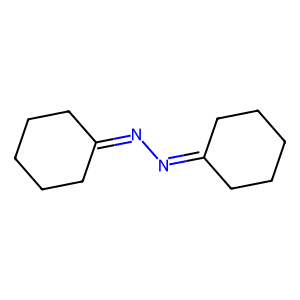 Cas:4278-87-9

 Cas:10424-93-8
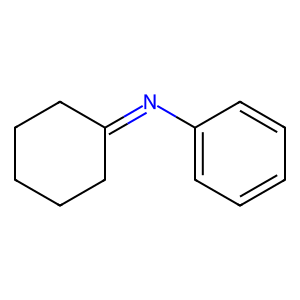 Cas:1132-38-3