
Cyclopentylamine
CAS No.:
1003-03-8
M. Wt:
85.147
M. Fa:
C5H11N
InChI Key:
NISGSNTVMOOSJQ-UHFFFAOYSA-N
Appearance:
Liquid
Names and Identifiers of Cyclopentylamine
CAS Number |
1003-03-8 |
|---|---|
EC Number |
213-697-3 |
MDL Number |
MFCD00001380 |
IUPAC Name |
cyclopentanamine |
InChI |
InChI=1S/C5H11N/c6-5-3-1-2-4-5/h5H,1-4,6H2 |
InChIKey |
NISGSNTVMOOSJQ-UHFFFAOYSA-N |
Canonical SMILES |
C1CCC(C1)N |
UNII |
4259VRY3GN |
UNSPSC Code |
12352100 |
Physical and chemical properties of Cyclopentylamine
Acidity coefficient |
pK1:10.65(+1) (25°C) |
|---|---|
Boiling Point |
110.0±8.0 °C at 760 mmHg |
BRN |
635706 |
Density |
0.9±0.1 g/cm3 |
Exact Mass |
85.089149 |
explosive limit |
1.3-9.40%(V) |
Flash Point |
17.2±0.0 °C |
Index of Refraction |
1.465 |
LogP |
0.83 |
Melting Point |
-85°C |
Molecular Formula |
C5H11N |
Molecular Weight |
85.147 |
PSA |
26.02000 |
Storage condition |
Flammables area |
Vapour Pressure |
24.2±0.2 mmHg at 25°C |
Water Solubility |
MISCIBLE |
Solubility of Cyclopentylamine
| Solvent | Dissolution Behavior | Temperature Effect | pH Effect |
|---|---|---|---|
| Water | Highly soluble (miscible with water) | Solubility increases with rising temperature | Solubility significantly increases under acidic conditions (due to protonation forming salts) |
| Alcohol (Ethanol) | Highly soluble | Solubility increases with rising temperature | More soluble under acidic conditions (formation of ammonium salts) |
| Diethyl Ether | Soluble | Solubility slightly increases with rising temperature | Better solubility under basic conditions; may precipitate under acidic conditions |
| Acetone | Highly soluble | Solubility increases with rising temperature | Acidic conditions promote solubility (formation of soluble salts) |
| Chloroform | Soluble | Solubility slightly increases with rising temperature | Stable under basic conditions; may decompose or react under acidic conditions |
| Toluene | Slightly soluble | Solubility slightly improves with rising temperature | Insensitive to pH changes, but side reactions may occur under strong acid or strong base |
| Dichloromethane | Soluble | Solubility slightly increases with rising temperature | Stable under acidic conditions, but should avoid strong bases |
| Acetonitrile | Highly soluble | Solubility increases with rising temperature | Higher solubility under acidic conditions (protonation enhances polarity) |
Safety Information of Cyclopentylamine


Key Milestone of Cyclopentylamine
| Time | Event | Description |
|---|---|---|
| Late 19th – Early 20th Century | First Synthesis | Cyclopentylamine, as a cyclalkylamine compound, was synthesized during the early development of organic chemistry, possibly via reductive amination of cyclopentanone or ammonolysis of cyclopentanol, but detailed records of its first synthesis are not widely documented. |
| 1940s–1950s | Systematic Study as an Organic Synthesis Intermediate | With the rise of pharmaceutical chemistry and fine chemicals, cyclopentylamine was used as a building block for nitrogen-containing heterocycles or chiral molecules due to its rigid alicyclic structure and basic amino group. |
| 1960s–1970s | Initial Applications in Drug Development | The cyclopentylamine structural unit began appearing in certain bioactive molecules, such as analogs of sympathomimetic drugs or local anesthetics, though it did not become a mainstream medicinal scaffold. |
| 1980s–1990s | Use in Agricultural Chemicals and Functional Materials | Cyclopentylamine derivatives were employed in developing new herbicides, fungicides, and liquid crystal materials, leveraging their alicyclic properties to modulate molecular polarity and spatial configuration. |
| 2000s | Role as Chiral Auxiliaries or Ligand Precursors | Chiral cyclopentylamine derivatives gained attention in asymmetric synthesis for constructing chiral catalysts or ligands, improving reaction enantioselectivity. |
| 2010s–Present | Renewed Focus in Drug Molecular Design | Cyclopentylamine, valued for its metabolic stability, moderate lipophilicity, and three-dimensional structural features, has been used to optimize ADMET properties in drug molecules—e.g., as a replacement for phenyl or cyclohexylamine groups in antivirals, kinase inhibitors, and CNS drugs. |
| Recent (2020s) | Emergence in Preclinical Drug Candidates | Pharmaceutical companies (e.g., Pfizer, Merck) have disclosed cyclopentylamine-containing candidates in patents for treating cancer, inflammation, and metabolic disorders, reflecting its growing importance in modern medicinal chemistry. |
Applications of Cyclopentylamine
Cyclopentylamine has several applications across various fields:
- Pharmaceuticals: Due to its biological activity, it may serve as a precursor for developing new analgesic drugs.
- Chemical Intermediates: It is utilized in synthesizing other organic compounds, including agrochemicals and dyes.
- Research: Cyclopentylamine is often used in laboratory settings for studying amine reactions and properties.
Interaction Studies of Cyclopentylamine
Interaction studies involving cyclopentylamine focus on its reactivity with various substrates. For example, investigations into its nucleophilic behavior reveal how it interacts with electrophiles like phthalimide derivatives, leading to the formation of complex products. These studies are essential for understanding its potential applications in medicinal chemistry and material science.
Physical sample testing spectrum (NMR) of Cyclopentylamine

 Cas:137-43-9

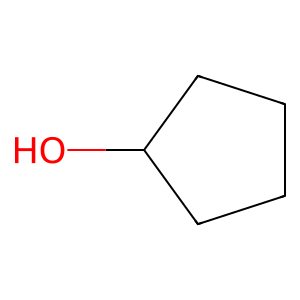 Cas:96-41-3
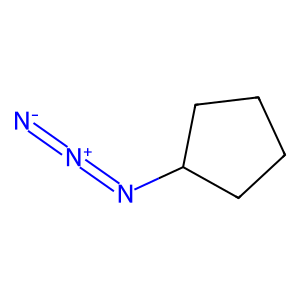 Cas:33670-50-7