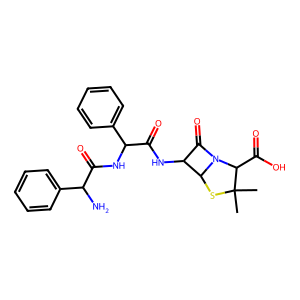
D-Phenylglycylampicillin
Names and Identifiers of D-Phenylglycylampicillin
CAS Number |
10001-82-8 |
|---|---|
IUPAC Name |
(2S,5R,6R)-6-[[(2R)-2-[[(2R)-2-amino-2-phenylacetyl]amino]-2-phenylacetyl]amino]-3,3-dimethyl-7-oxo-4-thia-1-azabicyclo[3.2.0]heptane-2-carboxylic acid |
InChI |
InChI=1S/C24H26N4O5S/c1-24(2)18(23(32)33)28-21(31)17(22(28)34-24)27-20(30)16(14-11-7-4-8-12-14)26-19(29)15(25)13-9-5-3-6-10-13/h3-12,15-18,22H,25H2,1-2H3,(H,26,29)(H,27,30)(H,32,33)/t15-,16-,17-,18+,22-/m1/s1 |
InChIKey |
ZHYDGVCSWXXUDM-OSAVLUCMSA-N |
Canonical SMILES |
CC1(C(N2C(S1)C(C2=O)NC(=O)C(C3=CC=CC=C3)NC(=O)C(C4=CC=CC=C4)N)C(=O)O)C |
Isomeric SMILES |
CC1([C@@H](N2[C@H](S1)[C@@H](C2=O)NC(=O)[C@@H](C3=CC=CC=C3)NC(=O)[C@@H](C4=CC=CC=C4)N)C(=O)O)C |
UNII |
FR42YK1I2F |
Physical and chemical properties of D-Phenylglycylampicillin
Acidity coefficient |
2.44±0.50(Predicted) |
|---|---|
Boiling Point |
863.8±65.0 °C(Predicted) |
Density |
1.43±0.1 g/cm3(Predicted) |
Exact Mass |
482.16200 |
LogP |
3.49440 |
Molecular Formula |
C24H26N4O5S |
Molecular Weight |
482.55200 |
PSA |
174.11000 |
Applications of D-Phenylglycylampicillin
D-Phenylglycylampicillin has potential applications in clinical settings primarily as an antibiotic agent. Its unique structure allows for targeted therapy against infections caused by resistant bacterial strains. Moreover, research into its pharmacokinetic properties could lead to improved formulations for oral or intravenous administration. Additionally, it may serve as a lead compound for developing new antibiotics with enhanced efficacy and reduced side effects.
Interaction Studies of D-Phenylglycylampicillin
Interaction studies involving D-Phenylglycylampicillin focus on its pharmacological interactions with other drugs and biological molecules. These studies are essential for understanding potential drug-drug interactions that could affect therapeutic outcomes. Preliminary research indicates that this compound may interact with various cytochrome P450 enzymes, impacting its metabolism and clearance rates in vivo. Furthermore, investigations into its binding affinity with serum proteins are crucial for predicting its bioavailability and distribution within biological systems.
Biological Activity of D-Phenylglycylampicillin
D-Phenylglycylampicillin exhibits significant antibacterial activity against a range of Gram-positive and Gram-negative bacteria. Its mechanism of action involves the inhibition of bacterial cell wall synthesis by binding to penicillin-binding proteins, leading to cell lysis and death. Studies have shown that this compound retains potency against certain resistant strains, making it a candidate for further development in combating antibiotic resistance.
The D-enantiomer specifically may offer advantages in terms of bioavailability and reduced susceptibility to enzymatic degradation by beta-lactamases compared to its L-counterpart.
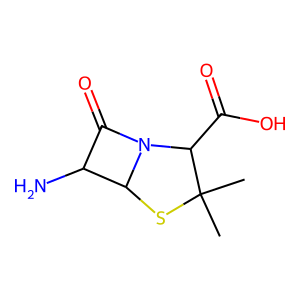 Cas:551-16-6

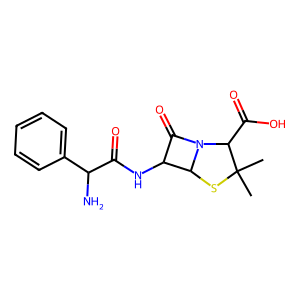 Cas:69-53-4