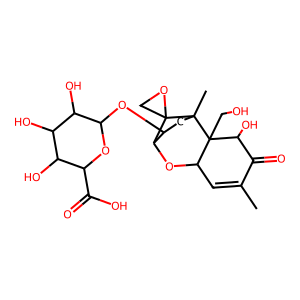
Deoxynivalenol 3-glucuronide
Names and Identifiers of Deoxynivalenol 3-glucuronide
CAS Number |
1000000-13-4 |
|---|---|
IUPAC Name |
(2S,3S,4S,5R,6R)-3,4,5-trihydroxy-6-[(1R,2R,3S,7R,9R,10R,12S)-3-hydroxy-2-(hydroxymethyl)-1,5-dimethyl-4-oxospiro[8-oxatricyclo[7.2.1.02,7]dodec-5-ene-12,2'-oxirane]-10-yl]oxyoxane-2-carboxylic acid |
InChI |
InChI=1S/C21H28O12/c1-7-3-9-20(5-22,15(27)10(7)23)19(2)4-8(16(32-9)21(19)6-30-21)31-18-13(26)11(24)12(25)14(33-18)17(28)29/h3,8-9,11-16,18,22,24-27H,4-6H2,1-2H3,(H,28,29)/t8-,9-,11+,12+,13-,14+,15-,16-,18-,19-,20-,21+/m1/s1 |
InChIKey |
GRFAWUZMBBQEMX-IJNZYEPRSA-N |
Canonical SMILES |
CC1=CC2C(C(C1=O)O)(C3(CC(C(C34CO4)O2)OC5C(C(C(C(O5)C(=O)O)O)O)O)C)CO |
Isomeric SMILES |
CC1=C[C@@H]2[C@]([C@@H](C1=O)O)([C@]3(C[C@H]([C@H]([C@@]34CO4)O2)O[C@H]5[C@@H]([C@H]([C@@H]([C@H](O5)C(=O)O)O)O)O)C)CO |
UNII |
I0I7J8KVP2 |
Physical and chemical properties of Deoxynivalenol 3-glucuronide
Molecular Formula |
C21H28O12 |
|---|---|
Molecular Weight |
472.43982 |
Applications of Deoxynivalenol 3-glucuronide
Deoxynivalenol 3-glucuronide has several applications:
- Biomonitoring: It serves as a valuable biomarker for assessing human exposure to deoxynivalenol through dietary intake.
- Toxicology Research: Understanding its metabolism helps elucidate the detoxification pathways of mycotoxins in mammals.
- Food Safety: Monitoring levels of deoxynivalenol and its metabolites in food products aids in ensuring consumer safety from mycotoxin contamination.
Interaction Studies of Deoxynivalenol 3-glucuronide
Research on interaction studies involving deoxynivalenol 3-glucuronide indicates that it may interact with various biological systems differently than its parent compound. For instance, studies have shown that while deoxynivalenol can inhibit protein synthesis and induce cellular stress responses, deoxynivalenol 3-glucuronide does not exhibit these effects to a significant degree. This difference suggests that the glucuronidation process effectively mitigates the toxicological impact of deoxynivalenol. Additionally, studies have demonstrated that renal excretion rates of this metabolite are higher compared to free deoxynivalenol, indicating efficient detoxification mechanisms at play.
Biological Activity of Deoxynivalenol 3-glucuronide
Deoxynivalenol 3-glucuronide exhibits significantly lower biological activity compared to its parent compound, deoxynivalenol. While deoxynivalenol is known for its ability to inhibit protein synthesis and cause cytotoxic effects in various cell types, deoxynivalenol 3-glucuronide does not exhibit these toxic properties to the same extent. Studies have shown that this metabolite is rapidly absorbed and excreted in humans, indicating its role as a less harmful form of deoxynivalenol.
Moreover, the presence of deoxynivalenol 3-glucuronide in biological fluids serves as a biomarker for exposure to deoxynivalenol, aiding in the assessment of dietary intake and potential health risks associated with mycotoxin exposure.