
Dibenzyldimethylammonium chloride
Names and Identifiers of Dibenzyldimethylammonium chloride
CAS Number |
100-94-7 |
|---|---|
EC Number |
202-903-7 |
IUPAC Name |
dibenzyl(dimethyl)azanium;chloride |
InChI |
InChI=1S/C16H20N.ClH/c1-17(2,13-15-9-5-3-6-10-15)14-16-11-7-4-8-12-16;/h3-12H,13-14H2,1-2H3;1H/q+1;/p-1 |
InChIKey |
LCXAARCEIWRIMU-UHFFFAOYSA-M |
Canonical SMILES |
C[N+](C)(CC1=CC=CC=C1)CC2=CC=CC=C2.[Cl-] |
UNII |
7QFJ58C47V |
Physical and chemical properties of Dibenzyldimethylammonium chloride
Exact Mass |
261.12800 |
|---|---|
LogP |
0.46720 |
Melting Point |
93-95 °C |
Molecular Formula |
C16H20ClN |
Molecular Weight |
261.79000 |
Safety Information of Dibenzyldimethylammonium chloride

Applications of Dibenzyldimethylammonium chloride
Dibenzyldimethylammonium chloride finds applications across various fields:
- Antimicrobial Agent: Used in disinfectants and antiseptics due to its ability to kill bacteria and fungi.
- Phase Transfer Catalyst: Facilitates organic synthesis by enabling reactants to interact more effectively across different phases.
- Industrial Use: Employed in the production of zeolites and other materials important for catalysis and separation processes.
Interaction Studies of Dibenzyldimethylammonium chloride
Research has shown that dibenzyldimethylammonium chloride interacts with various biological molecules, including enzymes and proteins. Its ability to disrupt lipid bilayers makes it a valuable tool for studying membrane dynamics and cellular processes. Studies have also explored its effects on gene expression and enzyme inhibition, highlighting its potential in biomedical research.
Biological Activity of Dibenzyldimethylammonium chloride
Dibenzyldimethylammonium chloride exhibits significant biological activity, particularly as an antimicrobial agent. Its mechanism of action involves disrupting the phospholipid membranes of microorganisms, leading to cell lysis and death. This disruption results in leakage of intracellular components, which is critical for its effectiveness against bacteria and fungi.
Additionally, studies indicate that this compound can induce oxidative stress in cells, affecting processes such as cell growth by increasing reactive oxygen species production while decreasing glutathione activity.
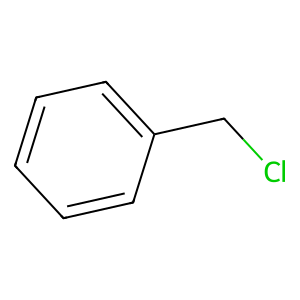 Cas:100-44-7


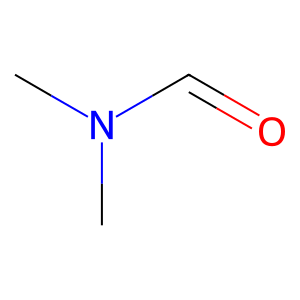 Cas:68-12-2