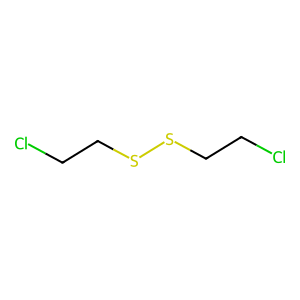
Disulfide, bis(2-chloroethyl)
CAS No.:
1002-41-1
M. Wt:
191.14200
M. Fa:
C4H8Cl2S2
InChI Key:
XDFZUXHZXUFQOS-UHFFFAOYSA-N
Appearance:
Colorless Liquid
Names and Identifiers of Disulfide, bis(2-chloroethyl)
CAS Number |
1002-41-1 |
|---|---|
EC Number |
815-981-8 |
IUPAC Name |
1-chloro-2-(2-chloroethyldisulfanyl)ethane |
InChI |
InChI=1S/C4H8Cl2S2/c5-1-3-7-8-4-2-6/h1-4H2 |
InChIKey |
XDFZUXHZXUFQOS-UHFFFAOYSA-N |
Canonical SMILES |
C(CCl)SSCCCl |
UNII |
WJ3GQ42HNY |
Physical and chemical properties of Disulfide, bis(2-chloroethyl)
Boiling Point |
249.4ºC at 760mmHg |
|---|---|
Density |
1.315g/cm3 |
Exact Mass |
189.94400 |
Flash Point |
103.9ºC |
Index of Refraction |
1.549 |
LogP |
2.84540 |
Molecular Formula |
C4H8Cl2S2 |
Molecular Weight |
191.14200 |
PSA |
50.60000 |
Vapour Pressure |
0.0364mmHg at 25°C |
Safety Information of Disulfide, bis(2-chloroethyl)


Biological Activity of Disulfide, bis(2-chloroethyl)
Disulfide, bis(2-chloroethyl), exhibits significant biological activity primarily due to its alkylating properties. It acts as a potent cytotoxic agent that can lead to severe cellular damage. Upon exposure, it can cause blistering of the skin and mucous membranes, respiratory distress upon inhalation, and long-term carcinogenic effects due to DNA damage. Its mechanism involves the formation of reactive intermediates that interact with cellular macromolecules, leading to cell death or mutation.
Physical sample testing spectrum (NMR) of Disulfide, bis(2-chloroethyl)

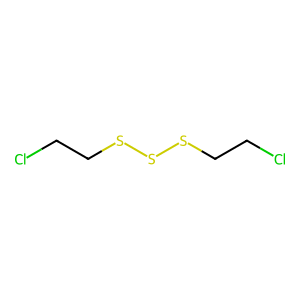 Cas:19149-77-0

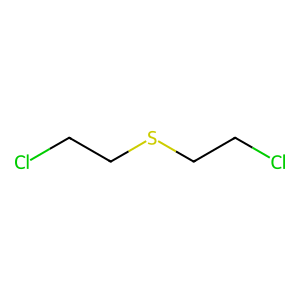 Cas:505-60-2
 Cas:26650-04-4
